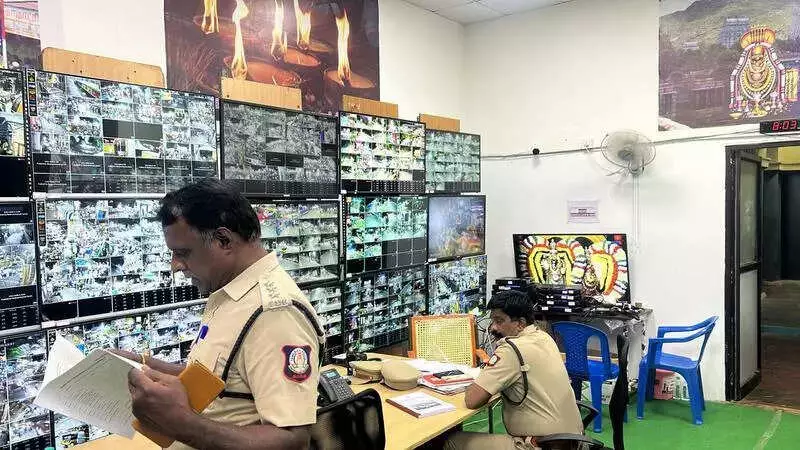
In a groundbreaking move, the Tiruvannamalai district police in Tamil Nadu have transformed the security and crowd management for the iconic Karthigai Deepam festival into a fully artificial intelligence-driven operation. This massive technological deployment is being supported by a formidable force of 15,000 police personnel on the ground, tasked with overseeing the safety of an anticipated more than 40 lakh (4 million) devotees. A significant portion of these pilgrims are arriving from the neighbouring states of Andhra Pradesh and Karnataka.
AI-Powered Planning and Predictive Analysis
The extensive preparations for the festival, which commenced on November 24 and will reach its zenith with the Maha Deepam on December 3, began with a meticulous AI-based study. According to G Dharmarajan, DIG of the Vellore range, the analysis covered the entire Annamalaiyar temple complex, the four maada veedhis, the 14-kilometre Girivalam path, the outer ring road (ORR), and densely populated residential areas surrounding the temple.
The AI system was fed with three years of historical data, including incident logs, identified congestion points, and records of crowd density spikes. This deep analysis helped authorities create accurate models predicting how crowds swell and move during different ritual hours throughout the festival days.

Real-Time Crowd Control and Traffic Management
The core of the AI system is its real-time monitoring capability. Police have identified 28 congestion-prone hotspots where AI software constantly computes the crowd density per square metre. The moment the density crosses thresholds set by the National Disaster Response Force (NDRF), alerts are sent from the central control room. Sector officers are immediately directed to intervene by opening additional lanes or actively dispersing choke points to prevent dangerous crushes.
Traffic flow is being managed with equal precision. Predictive models are tracking vehicle movement across 40 critical junctions in and around Tiruvannamalai. A major infrastructural improvement this year is the creation of 130 clearly marked parking zones, all of which have been mapped on Google Maps for easy devotee access. The district administration has also installed delineators on roads, especially around the ORR and temple-adjacent roads, to enforce strict lane discipline.
High-Tech Surveillance and Safety Measures
The surveillance network is extensive and sophisticated. Jaffer Sadiq, DSP of Arakkonam, explained that all nine major approach roads connecting to Tiruvannamalai via the Outer Ring Road are now fitted with Automated Number Plate Recognition (ANPR) systems, headcount cameras, and facial analytics software. This setup allows for real-time tracking of the devotee inflow.
Furthermore, the Tiruvannamalai railway station has been upgraded with fixed people-count cameras. To address a critical concern during such large gatherings, officials have proactively distributed 45,000 safety hand tags to children. These tags carry a child's basic details and their parents' contact numbers, providing a swift way to reunite families in case a child goes missing.
The high-level oversight for the festival arrangements is being handled by ministers and senior bureaucrats. HR&CE minister P K Sekarbabu confirmed that he, along with Minister E V Velu and other senior officials, are personally monitoring the situation. This integration of cutting-edge AI with traditional, large-scale police bandobust represents a new paradigm in managing India's grand religious festivals, aiming to ensure both devotion and safety proceed seamlessly.