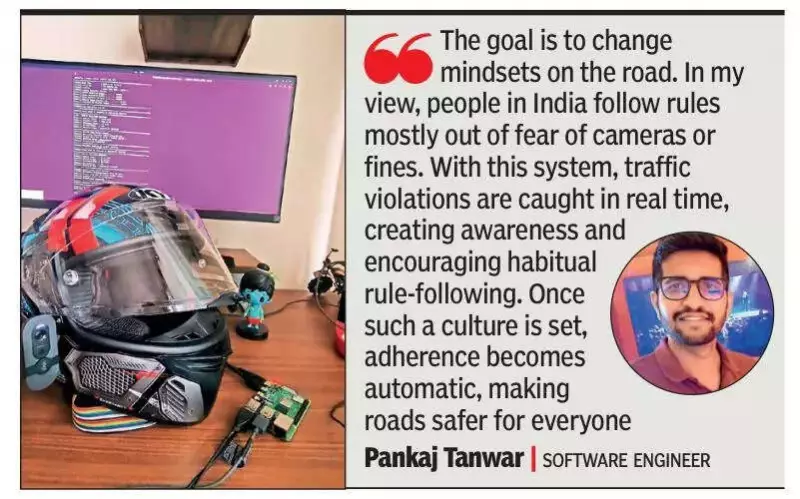
In Bengaluru, a city notorious for its chaotic roads where traffic rules are frequently ignored, a young software engineer has devised a unique tech-driven solution. Instead of engaging in roadside arguments, 27-year-old Pankaj Tanwar has turned to artificial intelligence to enforce discipline, directly from his helmet.
From Daily Frustration to a Tech Solution
Originally from Rajasthan, Pankaj Tanwar moved to Bengaluru for work. The daily sight of rampant traffic violations—from vehicles driving on the wrong side to riders ignoring red lights—left him deeply frustrated. He realized that confronting drivers was ineffective. This daily annoyance sparked an idea: to use technology as a force for order on the streets.
His research revealed that the Bengaluru traffic police already accept citizen-reported violations through their official app, email, and WhatsApp, provided the complaints include solid evidence like photos, videos, and location details. This existing framework became the foundation for his innovative project.

How the AI-Powered Helmet System Works
Tanwar's system is a clever assembly of accessible technology. He attached a Logitech webcam to his helmet, connecting it to a compact Raspberry Pi computer that processes live video footage during his commute. The core intelligence comes from AI models that analyze each video frame to detect four common offenses:
- Riding without a helmet
- Jumping road dividers
- Running red lights
- Driving on the wrong side of the road
To ensure accuracy and minimize false reports, Tanwar built a robust two-step verification process. The system doesn't rely on a single AI model. Detected violations are cross-checked using multiple AI models, including OpenAI's GPT and Google's Gemini. Only when the system's confidence score exceeds 96% over a five-second window is a report generated and sent.
Automated Reporting and Police Response
Once a violation is verified, the system automatically compiles an evidence package and emails it to the traffic police. This package includes still images, short video clips, the vehicle's license plate number, and precise GPS coordinates. Based on this evidence, the police can then issue a challan (fine) directly, requiring no further action from Tanwar.
The engineer built the prototype largely from spare parts, with a total cost of under Rs 4,000. He estimates that with mass production, the cost could drop to around Rs 2,000 per unit. Powered by a standard power bank, the device runs for six to seven hours and is designed to be adaptable for use in cars, taxis, or trucks. "The idea is scalable monitoring without installing expensive cameras everywhere," Tanwar explained.
His innovation has already caught the attention of the authorities. After Tanwar shared a video and description of his system on social media platform X, Bengaluru traffic police reached out to him and scheduled a meeting. Joint Commissioner of Police (Traffic) Karthik Reddy confirmed he would review the post and speak with the techie to better understand the system's potential.