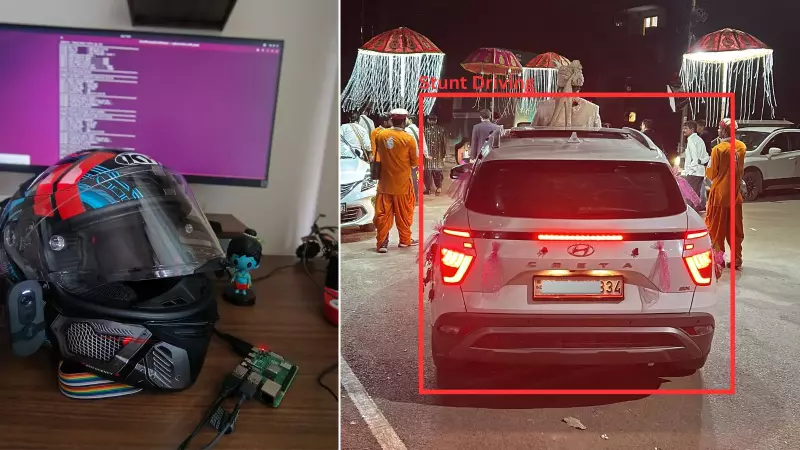
Frustrated by the daily chaos and disregard for rules on Bengaluru's roads, a young software engineer has taken traffic enforcement into his own hands—or rather, onto his own head. Pankaj Tanwar, a 27-year-old professional and avid biker, has ingeniously transformed his helmet into a real-time, AI-powered device that automatically detects traffic violations and reports them to the authorities.
From Road Rage to Real-Time Reporting
Pankaj Tanwar's inspiration stemmed from his personal experiences navigating the city's traffic. As a passionate rider, he grew increasingly tired of witnessing reckless behavior that endangered everyone. "I have been riding bikes for both short and long distances," Tanwar told indianexpress.com. "What really annoyed me was how some errant riders not only risk their lives but also put other lives at risk. There was no point in arguing on the streets." His breakthrough idea came when he discovered that the Bengaluru Traffic Police actively accept citizen-reported violations through their official app, email, and WhatsApp, provided the complaints include solid evidence like photos, videos, and location details.
How the AI-Powered Helmet Works
Tanwar, who works with artificial intelligence, used his expertise to build a practical enforcement system. The setup is remarkably straightforward yet powerful. A Logitech webcam is attached to his helmet, connected to a compact Raspberry Pi computer that processes live video feed. AI models then analyze each video frame to detect four common violations: riding without a helmet, jumping dividers, running red lights, and wrong-side driving.

To ensure accuracy and minimize false reports, Tanwar implemented a dual-verification system. When a potential violation is spotted, it is cross-checked by multiple AI models, including OpenAI's GPT and Google's Gemini, before being validated. "The system checks frame by frame for nearly five seconds, and if the AI is confident, the report goes directly to the police," he explained.
Evidence Sent Directly, Cost Under Rs 4,000
Once a violation is confirmed, the system compiles an email containing all necessary evidence: still images, short video clips, the vehicle's number plate, and precise GPS coordinates. This package is sent automatically to the police, who can then issue a challan (fine) without requiring further action from Tanwar. Remarkably, this device was built primarily from spare parts and cost less than Rs 4,000. Tanwar estimates that with mass production, the cost could be halved to around Rs 2,000. Powered by a standard power bank, it runs for six to seven hours and could be adapted for use in cars, taxis, or trucks.
Tanwar announced his creation on X (formerly Twitter) on January 3, 2026, with a post that quickly went viral: "i was tired of stupid people on road so i hacked my helmet into a traffic police device... while i ride, ai agent runs in near real time, flags violations, and proof with location & no plate goes straight to police. blr people – so now ride safe... or regret it." The innovation caught the attention of the Bengaluru Traffic Police, who have invited him for a meeting to discuss his project further.
This isn't Tanwar's first tech-driven solution to go viral. The engineer, with over 5.5 years of professional experience, previously created a system that connected his stock portfolio to his bedroom lights, causing them to turn red when he lost money. His latest project, however, tackles a far more pressing public safety issue, offering a glimpse into how citizen tech and AI can collaborate with authorities to make roads safer for everyone.