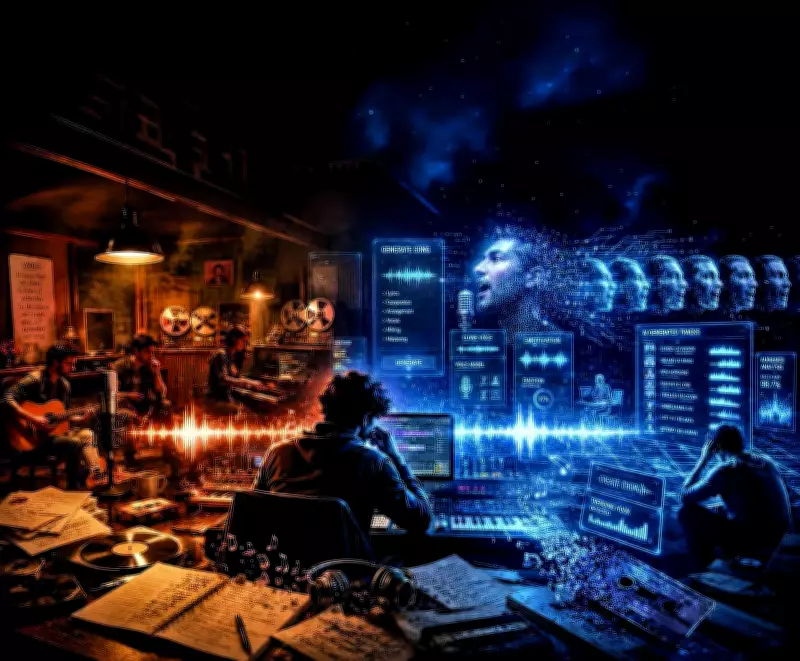
From writing lyrics and cloning legendary voices to generating complete songs in minutes, artificial intelligence is no longer knocking on the music industry's door — it is already inside the studio. But the debate has now moved beyond whether AI music is 'good' or 'bad'. Musicians are asking a more complex question: what happens to music itself when the process of creating it fundamentally changes? Across genres, artists are navigating a future where prompts can replace parts of composition, technology is reshaping collaboration, and audiences are increasingly unable to distinguish between human-made and AI-generated music.
'Anyone can prompt a song, but not everyone can compose'
Singer-songwriter, producer and audio engineer Rohan Solomon believes AI is simply another technological shift musicians will have to adapt to. “Prompting and creating or composing are two different worlds that may achieve a similar goal,” he says. Comparing AI to the arrival of digital audio workstations decades ago, he adds, “Those who learned the new process stayed in the game, while others got pushed out. Whether we like it or not is not the question. It’s about who can keep up with the times and adapt.” Musician Varun Rajput also sees a clear distinction between prompting and composing. Though he uses AI for assistive tasks and experimented with AI visuals for Antariks’ release Naaqis, he says composition still demands deeper musical understanding. “Anyone and almost everyone can prompt a song, but not everyone can compose one. Composing requires talent, knowledge and understanding of music, instruments and tools,” he says. At the same time, Varun believes the industry is entering what he calls the 'Creative Director' era, where the creative act shifts from writing melody and harmony to selecting, steering and filtering generated outcomes. “I just hope AI is used as an assistant to fuel creativity rather than mass-producing slop,” he adds.
Independent Kannada musician Sumedh K, whose track Tulasi recently went viral, says AI has altered the relationship artists have with time and craft. “The most important thing for an artist is the time you dedicate to crafting something. Now, all you have to put time into is crafting a good prompt,” he says. For him, music stems from instinct, lived experience and emotional response. Though he has experimented with AI tools, the experience left him emotionally disconnected. “It doesn’t move me as an artist or as an audience. Using parts of AI for sampling and as a tool is still fine, but making an entire track using AI is what doesn’t sit well with me,” he explains.

'Music is not just about the composition; it’s also about people'
For decades, music-making has depended on collaboration — musicians, engineers, arrangers, producers and singers feeding off each other inside studios. AI workflows are now reducing that dependency, allowing one person to do what once required an entire team. Varun says the emotional chemistry of music-making changes drastically when collaboration disappears. “The process is far more fun and gratifying when there’s an exchange of energies between humans. AI-driven workflows will obviously speed things up and reduce dependencies, but whether the process remains gratifying is yet to be seen,” he says. Sumedh echoes the concern. “Music is not just about the composition; it’s also about people. Artists coming together and their experiences are what make the music industry function,” he says. Not everyone, however, sees the transition negatively. Three-time Grammy-winning composer Ricky Kej compares AI to earlier technological leaps such as virtual instruments and digital recording. “There was resistance back then too. People felt music lacked the organic feel of real musicians. But eventually musicians got more work, not less,” he says.

'A singer’s voice is their identity'
One of the biggest concerns surrounding AI music is voice cloning, especially when legendary singers are digitally recreated. Playback singer Nikhita Gandhi says the biggest issue right now is the lack of clear legal frameworks. “The ethical boundaries and legalities need to be much more defined. We need proper permissions from families if posthumous voices are being used, and these protections need legal recognition in India,” she says. Singer and dubbing artist Lipsika Bhashyam understands why audiences feel emotional hearing familiar voices recreated through AI. “It feels like a beautiful token of love, almost as if those legends are singing for us once more,” she says. But she is equally firm about ethical limits. “A singer’s voice is their identity. That is why copyright and legal protection are extremely important. AI may recreate a voice, but it cannot recreate the soul, depth and emotional resonance humans naturally bring into music.” Singer-songwriter Armaan Malik calls the current situation worrying. “Voices of legends like Kishore Kumar or Mohammad Rafi are being replicated without permission and shared online. Using a singer’s voice without consent is unlawful,” he says. For Rohan Solomon, however, the line is simpler. “Using legendary singers’ voices is okay as long as it’s just for fun and there’s no profit-making involved,” he says.
'The human connect will always be missing'
As AI-generated music becomes increasingly sophisticated, many musicians admit audiences may no longer care whether a song is made by humans or machines, as long as it creates an emotional connection. Ricky Kej says he sometimes cannot distinguish AI-generated music from human-made music anymore. “If something connects with us, we are going to appreciate it. Art is defined by its effect on the listener. AI-generated content has already emotionally moved audiences online. The lyrics connect, the voice tone connects, the expressions connect — it’s already happening,” he says. Still, many artists believe emotional honesty remains uniquely human. “A songwriter draws from real experiences, something AI can’t replicate. It can process data and generate combinations, but it will never match the emotional depth of human expression,” says Armaan Malik. Singer-songwriter Anuv Jain echoes the sentiment. “Even when people chase trends or algorithms, listeners are ultimately looking for something they emotionally relate to. Honesty in songwriting will always matter more than formulas,” he says. For Bollywood composer Raju Singh, AI is simply another technological phase the industry will eventually absorb. “Technology may change the speed of creation, but meaningful music will still come from human understanding, emotional connection and putting in the time,” he says.
A future of coexistence?
Some musicians believe the future could split into two streams: AI-generated utility music and premium human-led artistic experiences. Varun Rajput believes the distinction may exist, “but it’ll be blurry.” Sumedh feels such a separation may eventually become necessary. “Right now, AI-generated content is mixed up with real art. At some point, it becomes deception,” he says. Others do not see a strict divide emerging. Rohan Solomon compares AI to the transition from tape recording to digital production. “There may have been a split in the beginning, but eventually integration happened,” he says. Ricky agrees. “I would say 90 per cent of music that is considered organic already has some amount of AI in it,” he says.
The streaming flood
- 50,000+: The estimated number of fully AI-generated tracks uploaded to streaming platforms every single day.
- 34%: The percentage of all daily music deliveries to major platforms that are now completely AI-generated.
- < 3%: The actual percentage of total streams these tracks receive, revealing a massive gap between what is being generated and what humans are actually choosing to listen to.
- $3.2 billion: The global market size for generative AI music in 2025. The numbers are expected to reach $19 billion by 2034.
Can we tell the difference?
A recent global consumer study by Deezer and Ipsos exposed a striking paradox in how audiences interact with AI music:
- 97% of listeners failed to correctly identify whether a track was fully AI-generated or human-made in a blind audio test.
- 52% of those listeners expressed feeling 'uncomfortable' or 'deceived' once they were told the track was made by a machine.
- The Transparency Trap: Academic research shows that listeners consistently rate AI pop songs highly — until they are told the track is AI, at which point their appreciation and willingness to pay drops significantly.
The cost of cloning: Artists at risk
As the industry grapples with unauthorized voice clones of legendary artists, the economic and ethical stakes are coming into sharp focus:
- €4 billion: The potential revenue loss projected for human music creators by 2028 due to generative AI taking over utility music.
- 25%: The percentage of traditional songwriter and composer revenues currently deemed "at risk" by international copyright societies.
- 73%: The percentage of music streaming users who believe it is unethical for AI companies to train models on copyrighted music without explicit consent from the artist.
Sources: Market Intelo, Deezer, ProMarket, Music AI
(Inputs by Riya Sharma, Debarati Sen, Divya Shree, Shreya Varanasi, Sanjana Pulugurtha)