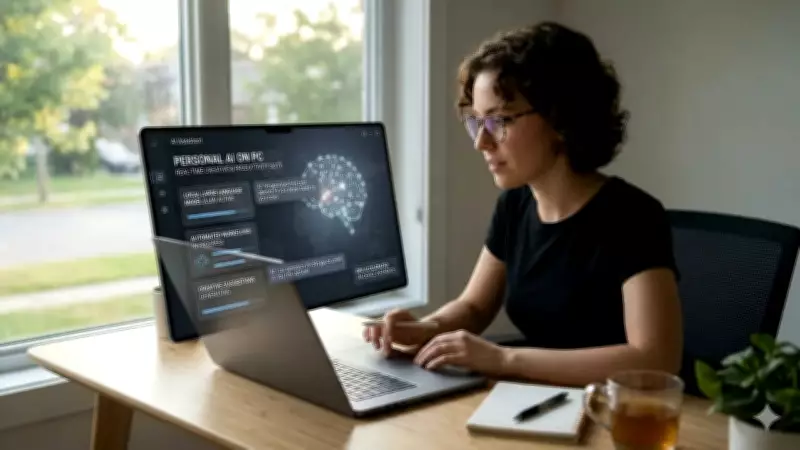
The AI PC Revolution: From Background Processes to Desktop Intelligence
The evolution of artificial intelligence on personal computers has undergone a remarkable transformation, moving from invisible background operations to specialized software workflows. Today, we find ourselves firmly in the era of the "AI PC," where computational heavy lifting has shifted from remote cloud servers back to local desktop environments. This transition enables real-time generative capabilities including live language translation, sophisticated background noise removal, and on-device image generation without latency concerns.
The ChatGPT Catalyst and Microsoft's Rapid Response
When OpenAI introduced ChatGPT in November 2022, the technology landscape experienced an immediate and profound transformation. This conversational AI system, capable of writing essays, debugging code, answering complex questions, and maintaining coherent dialogue, represented a genuine inflection point in technological accessibility. Microsoft responded with unprecedented speed, announcing a multi-billion dollar partnership expansion with OpenAI and beginning to weave AI capabilities into products used by hundreds of millions globally.
Microsoft Bing received an AI-powered search overhaul, Microsoft Edge incorporated an AI assistant directly into the browser interface, and Microsoft 365 productivity tools gained Copilot functionality. This AI assistant could summarize documents, draft professional emails, and generate presentations with minimal user input. The hardware revolution followed swiftly, with Microsoft encouraging partners like Asus, Dell, and MSI to develop a new category: the Copilot+ PC, featuring dedicated Neural Processing Units (NPUs) specifically designed for local AI workloads.

Industry Confession: Dell's Candid Assessment
Despite significant industry investment and marketing efforts, Dell's head of product Kevin Terwilliger made a surprising admission at CES 2026. "What we've learned over the course of this year, especially from a consumer perspective, is they're not buying based on AI. In fact, I think AI probably confuses them more than it helps them understand a specific outcome," Terwilliger told PC Gamer. This confession came from one of Microsoft's largest hardware partners, which had spent two years launching Copilot+ certified devices and marketing AI features extensively.
Raj Kumar Rishi, vice president and general manager of Dell Technologies' APJ Consumer business, provided additional context to The Times of India. "We're committed to advancing AI capabilities across our consumer and commercial portfolios, but our approach is tailored to different audiences. With consumers, core needs still drive purchasing decisions – performance, battery life, reliability, and value," Rishi explained. He noted that deliberate AI spending primarily originates from large enterprises and government organizations, followed by professional creators and small businesses, while students and casual consumers often engage with AI through integrated features without explicit awareness.
Manufacturer Strategies: Diverse Approaches to AI Integration
Different PC manufacturers have adopted varied strategies for AI implementation. Asus has integrated Copilot across approximately 90% of its device lineup while developing proprietary AI-native software experiences like StoryCube (an AI media hub) and MuseTree (an AI-powered image generation application). Arnold Su, vice president of consumer and gaming business at Asus India, emphasized how AI has become more embedded in system operations. "AI is no longer something you use occasionally, it's quietly working in the background, improving how the device performs, how applications interact, and how efficiently users can get things done," Su told TOI.

MSI has focused particularly on gaming applications, where AI enhances visual quality through upscaling technologies like NVIDIA's DLSS, AMD's FSR, and Intel's XeSS. James Sung, Notebook sales director of India at MSI, explained how AI extends beyond NPUs to graphics processing. "Performance varies by task — for heavy AI computing like machine learning and modeling, graphics power matters most, while NPUs handle daily AI tasks, freeing up GPUs and boosting overall power efficiency," Sung detailed. MSI's AI integration also extends to thermal management, where NPUs intelligently redistribute workloads between CPU and GPU to maintain optimal temperatures during extended gaming sessions.
The Agentic Future: Autonomous AI Systems
Industry conversation has increasingly shifted toward agentic AI – systems capable of autonomous action on behalf of users rather than simply responding to commands. Asus views this as the next logical evolution. "Agentic AI is essentially the next logical step, moving from systems that respond to systems that actually assist in actioning the tasks at hand," Su explained. He emphasized that the goal isn't immediate full autonomy but rather streamlining user interactions to reduce complexity and effort.
MSI approaches the agentic shift through what it calls an Edge AI strategy, ensuring devices can handle persistent, autonomous computing tasks locally without cloud dependency. "MSI's preparation for agentic AI begins with the foundation we are building today, hardware capable of running intelligent workloads locally, without cloud dependency," Sung stated regarding MSI's plans for agentic AI integration.
The Indian Market: Price Sensitivity and Value Perception
Nowhere is the gap between AI's promise and consumer reality more pronounced than in India, one of the world's fastest-growing yet most price-sensitive technology markets. All three major brands – Asus, Dell, and MSI – acknowledge that Indian consumers aren't paying premiums specifically for AI features but rather for devices representing good overall value, with AI increasingly contributing to future-readiness.
"India continues to be a price-sensitive market, but what's important is that price sensitivity doesn't mean unwillingness to spend. It means users are far more conscious about what they're paying for," Su observed. He noted strong double-digit growth in India's premium laptop segment, with some quarters recording nearly 50% year-on-year expansion. Rishi praised Indian consumers' technological awareness, stating, "India is ahead of the curve on mindset - consumers here show high awareness and a strong appetite for experimentation."
Conclusion: Invisible Integration as the Path Forward
According to industry leaders, the path to broad AI PC adoption runs through making artificial intelligence invisible rather than overtly prominent. The AI PC era represents genuine technological advancement, producing devices more capable than previous generations, but consumer adoption patterns reveal that AI must enhance rather than define the user experience. Dell's candid assessment at CES 2026 paradoxically represents an optimistic sign – an industry willing to acknowledge when its messaging isn't resonating and capable of developing more effective approaches to technological integration.