

AI Emerges as Key Driver for Viksit Bharat 2047 at Advantage Vidarbha Summit
Artificial intelligence has been firmly established as a foundational element in India's strategic roadmap towards achieving the ambitious Viksit Bharat 2047 vision. This declaration came during a high-level session at the Advantage Vidarbha 2026 event, which serves as Vidarbha's premier industrial exposition, business conclave, and investment summit. The gathering brought together industry leaders, government officials, and academic experts who collectively emphasized how AI-powered solutions can revolutionize multiple sectors while promoting inclusive and sustainable economic growth.
Multi-Sector Transformation Through AI Innovation
Participants at the summit detailed how artificial intelligence applications could transform diverse industries ranging from traditional mining operations to modern logistics networks, tourism development, agricultural practices, and educational systems. A recurring theme throughout the discussions was the significant potential for Generation Z to contribute meaningfully to the national development vision through technological innovation and implementation.
Rahul Karangale, principal consultant at Infosys based in Mihan, established the foundational perspective by explaining the comprehensive vision behind Viksit Bharat. "Development cannot be viewed in isolation. Ecological considerations, economic factors, and overall societal progress must advance together in a coordinated manner," he asserted. Using Gadchiroli as a specific case study, Karangale emphasized the critical need for sustainable mining practices enhanced by AI-based precision technologies.

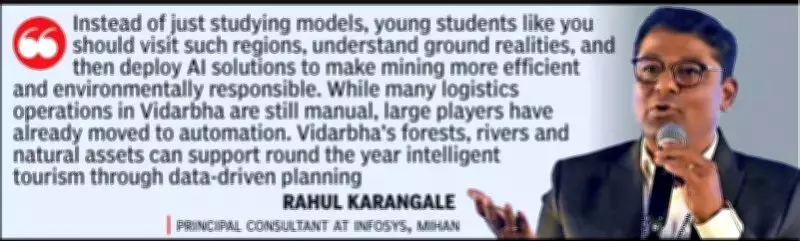
"Rather than merely studying theoretical models, young students should actively visit such regions, comprehend the ground realities, and then deploy artificial intelligence solutions to make mining operations more efficient while maintaining environmental responsibility," Karangale advised. He further identified substantial opportunities in automated logistics systems and intelligent tourism development, noting that while many logistics operations in Vidarbha remain manual, larger industry players have already transitioned to automation.
Evolution and Practical Applications of AI Technology
Shantanu Vishwanadha, developer relations specialist for the APAC region at Zencoder, traced the remarkable evolution of artificial intelligence from rigid, rule-based systems to today's sophisticated, adaptive models. Illustrating everyday applications, he explained, "Popular food delivery platforms utilize application programming interfaces to track user history and personalize recommendations—this represents artificial intelligence in practical action."
Vishwanadha highlighted the paradigm shift occurring between 2005 and 2025, citing transformative examples from autonomous vehicles to digital payment systems. He particularly emphasized AI's crucial role in platforms like the Unified Payments Interface, where security protocols and threat detection mechanisms rely extensively on advanced machine learning algorithms.
Smart Village Initiatives and Educational Integration
Ranjan Pandhare, head of the Nagpur division at MahaSTRIDE, delivered a comprehensive presentation on India's first intelligent smart village, Satnavari, showcasing existing implementations of artificial intelligence and Internet of Things technologies. These innovative applications include:
- Smart healthcare systems that connect rural patients with specialized medical professionals
- Precision agriculture techniques that optimize pesticide usage through data analysis
- AI-driven water monitoring systems that improve both quality and supply management
"Each model village requires an investment ranging between 60 to 70 lakh rupees, with approximately 75 such villages planned across Maharashtra state," Pandhare revealed, highlighting the scalability of these technological interventions.

Dr. Pramod Jumle, director of training at the Board of Apprenticeship Training under the Government of Maharashtra, focused on practical implementation aspects of Viksit Bharat for both students and educators. Referencing the National Education Policy 2020, he noted the policy's strong emphasis on employability through skill-based learning and apprenticeship programs.
Dr. Jumle highlighted a significant paradox in India's technological landscape: while the country possesses approximately 16 percent of the world's artificial intelligence talent and maintains a rapidly expanding pool exceeding 600,000 AI professionals, demand for specialized skills in artificial intelligence, data science, cybersecurity, cloud computing, and related domains continues to substantially outpace available supply.
Additionally, Dr. Smita Singh (Dabholkar), assistant professor at the Institute of Management Technology in Nagpur, emphasized the crucial role of youth and academic institutions in responsibly harnessing artificial intelligence capabilities to support the national development vision. Her remarks underscored the importance of ethical considerations and sustainable implementation strategies as India advances toward its 2047 development goals.
