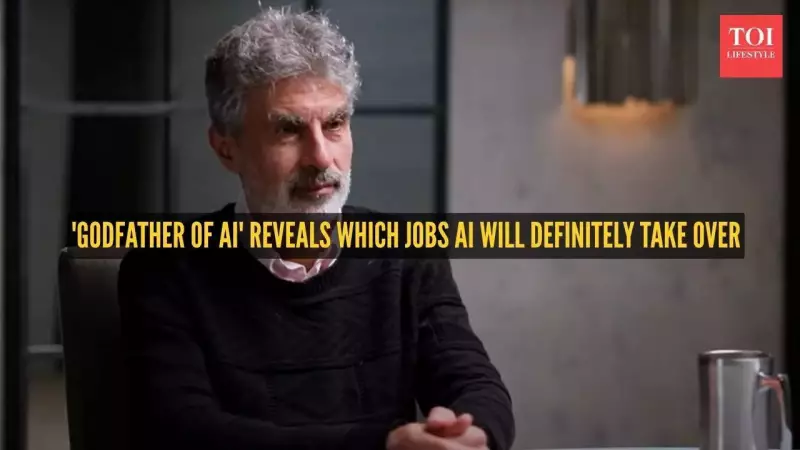
The pace of artificial intelligence is outstripping human work, and planning for a future shaped by this reality is no longer optional but essential. From a concept that barely existed years ago, AI has become an indispensable force, making a world without it now unimaginable. This rapid advancement, fueled by massive investments from tech entrepreneurs seeking to replace human labour for efficiency and cost savings, has ignited widespread fear of job insecurity across industries.
The Stark Warning from a Godfather of AI
The anxiety is well-founded, according to one of the field's foremost authorities. Yoshua Bengio, a world-renowned Canadian computer scientist and a recipient of the prestigious 2018 A.M. Turing Award (often called the Nobel Prize of Computing), has painted a clear picture of the impending shift. Alongside Geoffrey Hinton and Yann LeCun, Bengio is celebrated as one of the 'Godfathers of AI' for his pioneering work in deep learning.
In a recent conversation on the 'Diary of a CEO' podcast with host Steven Bartlett, Bengio addressed the direct impact of AI on employment. He stated plainly that job displacement is not a question of 'if' but 'when'. "It's more a matter of time than 'is it happening or not'," he asserted. He identified cognitive roles performed behind screens as the most vulnerable in the immediate future. "The cognitive jobs, ones you do behind keyboards, are at risk," Bengio warned.

For those in physical trades, there might be a temporary respite. "Robotics is still lagging, though we're seeing progress, so if you do a physical job... then it's gonna take more time," he noted, echoing Geoffrey Hinton's often-cited advice that one should consider becoming a plumber. However, Bengio cautioned that this protection is fleeting: "But I think it's only a temporary thing."
Microsoft's List of Endangered Professions
Bengio's warnings are echoed by concrete research from industry giants. Microsoft has compiled a list of 40 jobs that face a serious risk of being entirely replaced by AI. This list serves as a sobering forecast for millions of professionals and students.
The roles identified are largely cognitive and analytical, including:
- Historians
- Interpreters and Translators
- Writers and Authors
- Telemarketers
- Mathematicians
- Data Scientists
- Web Developers
AI researcher Xinrong Zhu, an assistant professor at Imperial College London, supported this assessment, agreeing that "These types of jobs are by nature most likely to be replaced entirely by the tool." The notion that careers people are diligently studying and working for today might vanish in the coming years presents a daunting future scenario.
The Broader Implications and a Future with Physical AI
The concerns extend beyond white-collar job loss. Bengio highlighted a more profound danger as AI integrates with robotics. He expressed worry about an "AI with bad intentions" gaining control in the physical world, where it could cause significantly more damage.
"AI is getting better at persuasion in more and more studies, but it's even easier if it can just hack robots to do things that you know would be bad for us," he warned. This evolution marks a critical juncture where AI's influence could move from digital screens to tangible, real-world actions.
The evidence of this shift is already visible in the corporate world. The BBC recently reported that several companies have cited the 'new realities' of AI as a reason behind recent layoffs. Furthermore, Forbes has predicted that by 2026, more of the human workforce will be replaced to reduce operational costs.
The path forward requires proactive adaptation. For professionals in screen-based, cognitive roles, Bengio's advice implies that worrying and formulating alternate career plans is a prudent strategy. While physical labour jobs may seem safer for now, the eventual encroachment of advanced robotics seems inevitable. The message is clear: in the race between human and artificial intelligence, staying informed and agile is the only sustainable defence for the workforce of tomorrow.