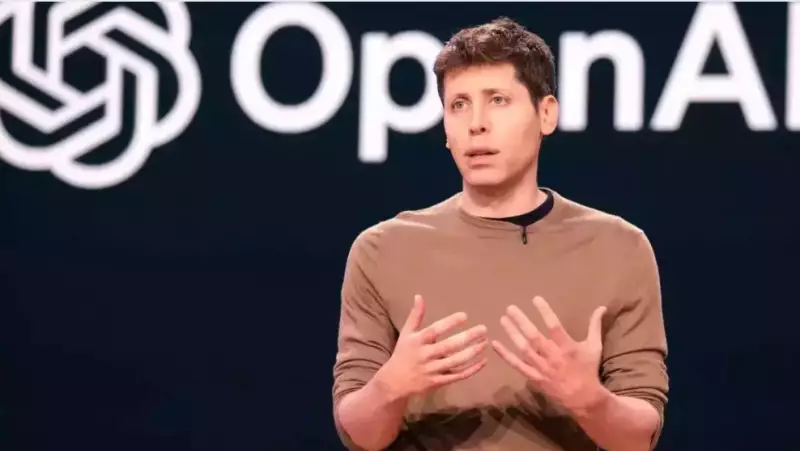
The relentless acceleration of artificial intelligence is reshaping our world at a pace that has caught many by surprise. From communication to core industries, AI's ascent is forcing a fundamental question upon every professional: How much of my current role could a machine handle soon? Sam Altman, the CEO of OpenAI, while generally cautious, has recently outlined the monumental scale of the impending shift and identified the frontlines of this transformation.
The Road to Superintelligence: A 2030 Deadline
Speaking at the Axel Springer Global Reporters Network in Berlin, where he was honoured with the Axel Springer Award, Altman addressed the concept of a "superintelligence"—an AI that surpasses human intellect across all domains. He made a striking prediction about the timeline for this development.
"I would certainly say by the end of this decade, so, by 2030, if we don’t have models that are extraordinarily capable and do things that we ourselves cannot do, I’d be very surprised," Altman stated. He traced the rapid evolution of AI, noting that while current models like GPT-5 excel in many areas, limitations remain. However, this gap is closing fast.

"In another couple of years, it will become very plausible for AI to make, for example, scientific discoveries that humans cannot make on their own. To me, that’ll start to feel like something we could properly call superintelligence," he explained, framing the near future.
Workforce Transformation: Tasks, Not Just Jobs
Altman's vision extends far beyond lab breakthroughs, directly into the daily reality of workers. He clarified that while entire job roles may eventually vanish, the immediate and widespread impact will be on the tasks within those jobs.
"I can easily imagine a world where 30-40% of the tasks that happen in the economy today get done by AI in the not very distant future," he projected. He pinpointed customer support roles, especially those conducted via phone or computer, as likely early candidates for automation.
In a separate discussion on The Tucker Carlson Show, Altman was direct: "I’m confident that a lot of current customer support that happens over a phone or computer, those people will lose their jobs, and that’ll be better done by an AI."
The future for computer programmers, however, is more complex. "A job that I feel way less certain about what the future looks like for is computer programmers. The meaning of being a computer programmer today is very different than it was two years ago. You’re able to use these AI tools to be hugely more productive," he noted, highlighting a role in flux.
Altman urges a shift in perspective: "The thing that I find useful is to think about the percentage of tasks, not the percentage of jobs." He sees this as a dual challenge and opportunity, where AI handles tasks more efficiently, freeing humans for higher-level work and spawning entirely new professions.
Human Ingenuity and Ethical Alignment in the AI Age
Becoming a father this year has influenced Altman's outlook on education and adaptability. He now stresses the critical importance of meta-skills for the next generation.
"The meta-skill of learning how to learn, of learning to adapt, learning to be resilient to a lot of change. Learning how to figure out what people want, how to make useful products and services for them, how to interact in the world," he listed as essential capacities.
His optimism for human creativity remains unshaken. "I’m so confident that people will still be the center of the story for each other... Each new generation uses their creativity and new ideas and the tools the previous generation built for them to astonish us," Altman affirmed, expressing faith in future generations, including his own children.
On the profound ethical concerns—such as the fear that a superintelligent AI might treat humans as insignificantly as humans treat ants—Altman offered a poignant reflection. He recalled a framing by his co-founder, Ilya Sutskever: "he hoped that the way that an AGI would treat humanity... is like a loving parent."

Altman added, "It is very important that we align this tool to human values. But we get to align this tool to human values and I don’t think it’ll treat humans like ants. Let’s say that."
Preparing for the Inevitable Shift
The overarching message from Altman's insights is unambiguous: transformative change is coming, but proactive preparation is key. The critical question for workers is no longer if AI will alter their work, but how they can position themselves to thrive within that new landscape.
This involves identifying automatable tasks, committing to lifelong learning, and cultivating uniquely human skills that complement AI capabilities. While customer support faces automation and programming is being redefined, this disruption also unlocks tools for unprecedented human productivity and creativity.
Altman's blend of caution and optimism paints a picture of a decade that will rigorously test our assumptions about work and skill. Ultimately, it will reward those who embrace adaptability, continuous learning, and innovative thinking as we step into an AI-driven era.