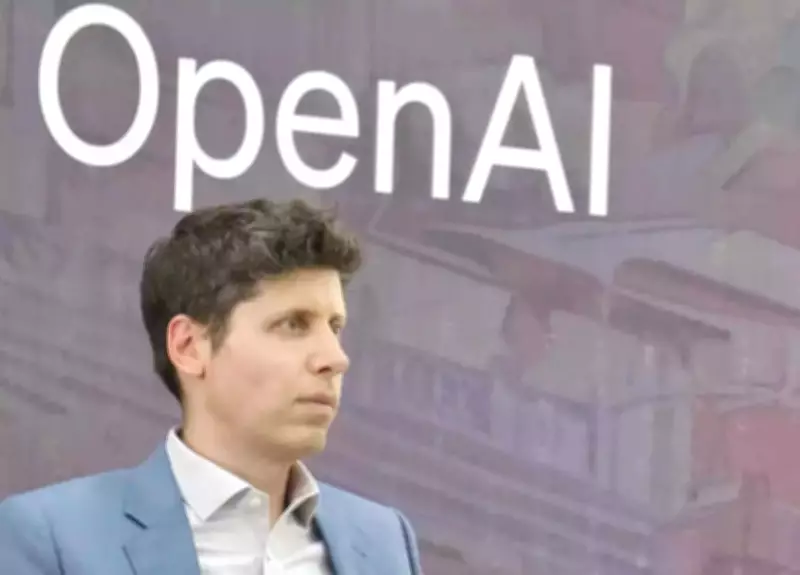
OpenAI CEO Sam Altman Challenges Anthropic CEO to "Get Facts Right" in Heated AI Ethics Debate
In a significant development within the artificial intelligence industry, OpenAI CEO Sam Altman has publicly called out Anthropic CEO Dario Amodei to correct his factual assertions. This confrontation emerged during Altman's address at the prestigious Morgan Stanley Technology, Media & Telecom Conference, where he delivered a powerful message about the critical role of government oversight in the rapidly evolving AI landscape.
Government Must Remain Supreme Over Private Corporations, Altman Insists
Speaking with conviction, Sam Altman articulated a fundamental principle that has become central to the ongoing AI governance discussion. He stressed unequivocally that governmental authorities must maintain greater power than private enterprises to ensure proper regulation and ethical deployment of artificial intelligence technologies. Altman warned that society would face severe consequences if companies abandoned their commitment to democratic processes merely because they disagreed with current political leadership.
"It would be profoundly detrimental for society if corporations started disregarding democratic institutions simply due to political disagreements," Altman emphasized during his conference remarks. This statement carries particular weight given the current political climate and increasing scrutiny of tech giants' influence.

Escalating Tensions Between AI Titans
The public exchange between the two AI leaders comes amid mounting friction between their respective companies. Recently, Dario Amodei criticized Altman's relationship with the previous administration, accusing OpenAI of engaging in what he characterized as "dictator-style praise" while asserting that Anthropic had maintained more principled positions.
This corporate rivalry has intensified following weeks of conflict between Anthropic and the U.S. Department of Defense regarding restrictions on AI utilization. The Defense Department recently designated Anthropic as a "Supply-Chain Risk to National Security," prompting federal agencies to immediately cease using its technology.
Pentagon Contracts Fuel the Fire
In a controversial move that further escalated tensions, OpenAI announced its own agreement with the Pentagon shortly after Anthropic's exclusion. Sam Altman acknowledged that this timing appeared "opportunistic and sloppy" but defended the decision as an effort to de-escalate governmental concerns about AI security.
Dario Amodei responded sharply to this development, condemning OpenAI's Department of Defense contract as a genuine "safety threat." In an internal memo to Anthropic employees obtained by The Information, Amodei contrasted the two companies' approaches, stating: "The fundamental difference is that they cared about placating employees, while we genuinely cared about preventing potential abuses."
Contract Negotiations Reveal Divergent Philosophies
The conflict stems from Anthropic's recent failure to reach an agreement with the Defense Department over unrestricted access to its AI systems. Despite holding a substantial $200 million military contract, Anthropic insisted on implementing safeguards to prevent its technology from being used for domestic mass surveillance or autonomous weaponry development.
When the Pentagon declined these conditions, they turned to OpenAI as an alternative partner, creating a clear division in how these leading AI companies approach government collaboration and ethical boundaries.
High-Stakes Competition in the AI Arena
This corporate clash unfolds against the backdrop of intense competition within the artificial intelligence sector. OpenAI recently announced a monumental $110 billion funding round that values the company at an astonishing $730 billion, while its ChatGPT platform now boasts over 900 million weekly active users.
Meanwhile, Anthropic has demonstrated impressive growth of its own, achieving an annual revenue run rate exceeding $19 billion. These financial milestones underscore the fierce battle for dominance in what has become one of the world's most strategically important technological domains.

The Altman-Amodei dispute highlights fundamental questions about corporate responsibility, government oversight, and ethical boundaries in artificial intelligence development. As these technologies become increasingly powerful and integrated into critical systems, the resolution of such conflicts will likely shape the future trajectory of AI governance and its impact on global society.