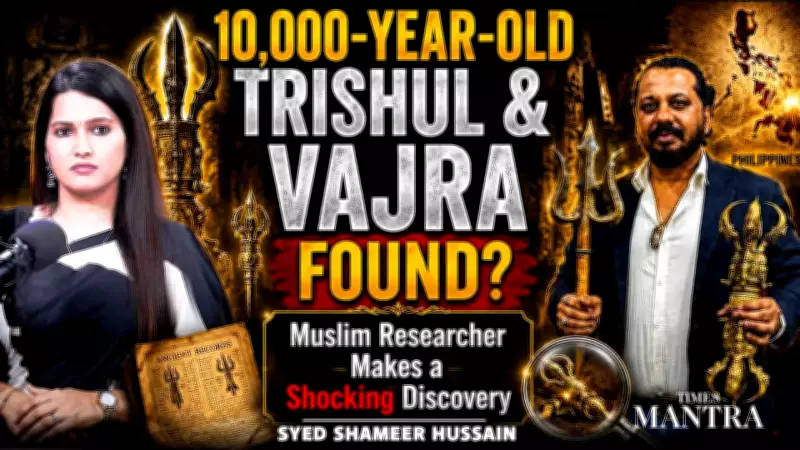
A viral claim circulating on social media suggests that a 10,000-year-old Trishul and a 3,000-year-old Vajra have been discovered in the Philippines, igniting widespread curiosity and debate. The narrative links these artifacts to ancient Sanatan symbols and proposes possible connections with forgotten civilizations and global ancient cultures. Syed Shameer Hussain is said to have discussed these findings in a recent feature on Times Mantra, offering cultural and historical interpretations around their significance.
What Are the Trishul and Vajra?
The Trishul, a three-pronged spear, is a prominent symbol in Hinduism, associated with Lord Shiva. The Vajra, a thunderbolt weapon, is linked to Lord Indra. Both are considered powerful spiritual symbols in Sanatan Dharma. The claim that such artifacts have been unearthed in the Philippines has led to speculation about ancient cross-cultural exchanges between the Indian subcontinent and Southeast Asia.
Lack of Scientific Evidence
Despite the viral nature of the claim, there is currently no verified archaeological evidence supporting the age or authenticity of these objects. Experts in archaeology and history stress the importance of scientific validation, including carbon dating and peer-reviewed studies, before accepting such extraordinary claims. Without this verification, the story remains in the realm of speculation and mythology.

Cultural and Historical Interpretations
Syed Shameer Hussain, known for his work on ancient mysteries, has reportedly provided insights into the potential cultural significance of the artifacts. He suggests that the Trishul and Vajra could be evidence of a lost global civilization that shared symbols across continents. However, mainstream historians caution against drawing conclusions without solid evidence. The Philippines, with its rich history of trade and migration, could have been a meeting point for various cultures, but connecting it to specific Hindu symbols requires careful study.
Why the Claim Went Viral
The blend of mythology, spirituality, and mystery has made this topic highly engaging on social media. Hashtags like #timesmantra, #ancientmystery, #trishul, #vajra, and #philippinesdiscovery have fueled discussions. Many users are drawn to the idea of hidden histories and forgotten connections between ancient civilizations. However, the lack of credible sources has also led to skepticism.
Expert Opinions
Archaeologists emphasize that extraordinary claims require extraordinary evidence. Dr. Anjali Sharma, a professor of South Asian archaeology, states, "While it is possible that ancient Indian symbols traveled to Southeast Asia through trade and cultural exchange, the claimed ages of 10,000 and 3,000 years are highly improbable without verified archaeological context." She adds that the Philippines has its own rich prehistory, and any discoveries must be examined within that framework.
Conclusion
The story of the Trishul and Vajra in the Philippines remains unconfirmed. While it sparks imagination and curiosity, the need for scientific rigor is paramount. Until credible evidence emerges, the claim should be treated as an intriguing mystery rather than established fact. For now, it serves as a reminder of how mythology and history can intertwine in the age of viral information.