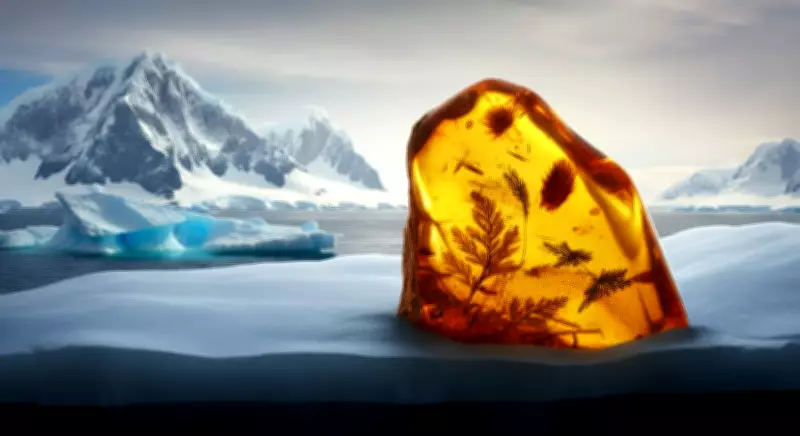
The thought of Antarctica brings about images of an endless frozen desert, with large glaciers, harsh sub-zero temperatures, and huge sheets of solid ice. However, scientists have discovered something from the ocean depths that challenges our perception of the frozen continent: a small piece of fossilized amber, tree resin from an ancient time that can only be formed by an active forest dripping with sap. This marks the first time amber has been found on the continent, offering a unique glimpse into a time when the South Pole was a rainforest rather than the cold desert we see today.
Discovery from the Seafloor
This time capsule was extracted from the dark depths of the seafloor, beneath the West Antarctic Ice Sheet. Modern engineering made this possible, as described in an article by Imperial College London titled "Imperial researchers help unlock Antarctica's deep past with record-breaking drill into sediment." Researchers used a state-of-the-art robot drill to obtain sediment samples of Earth's distant geological past. During analysis, they discovered the speck of amber. Sediment cores store information about geological history sequentially, making this amber definitive proof of a living landscape before it was frozen over. This ancient tree resin indicates that Antarctica was once a warm, humid rainforest, highlighting the dramatic impact of global temperature fluctuations on Earth's ecosystems.
A Lost Green World at the Bottom of the Earth
The significance of this amber goes beyond adding a new species to a museum exhibit. It redefines simulations of Earth's climate history. For amber to be produced, a suitable environment for resin-producing trees with long periods of warmth and moisture is necessary. According to a study in Nature titled "Antarctica's first known amber hints at lost rainforest," the Earth experienced greenhouse episodes during the warm Cretaceous period, when carbon dioxide concentrations were extremely high. Lush, swamp-like forests spread even to polar regions, with plants growing near running water and producing resins that fossilized over millions of years. This microscopic amber piece serves as evidence of how global temperature fluctuations can change an entire continent's ecosystem.

Implications for Understanding Climate Change
This remarkable finding teaches us about the ever-changing nature of our planet. Scientists now view the Antarctic region and its waters not as just frozen ice caps, but as enormous layers concealing a dynamic landscape with extinct rivers, ancient valleys, and fossilized environments. With this small piece of amber, we get a tangible link to a time when the coldest spot on Earth was home to a thriving ecosystem. We realize that what we see now is just one page in a far bigger story.
About the Author
The TOI Science Desk is an inquisitive team of journalists delving into the realms of discovery to curate captivating science news for readers of The Times of India. They cover genetic engineering, space exploration, artificial intelligence, and more, making science accessible and engaging for all backgrounds.