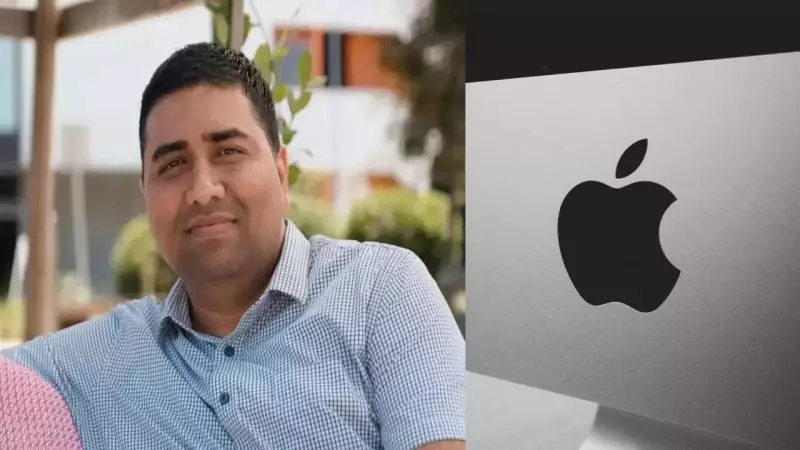
In a major move within the global artificial intelligence race, technology giant Apple has recruited a seasoned Indian-origin executive to lead its AI ambitions. The company has appointed Amar Subramanya, an engineer educated in Bengaluru and a veteran of both Google and Microsoft, as its new Vice President of Artificial Intelligence.
From Bengaluru Roots to Silicon Valley Stardom
Amar Subramanya's journey to the pinnacle of Silicon Valley began in India's tech capital. Born and educated in Bengaluru, he completed his Bachelor of Engineering in Electrical, Electronics and Communications from Bangalore University in 2001. He then moved to the United States for higher studies, earning his PhD from the University of Washington in Seattle in 2009. His doctoral research specialised in semi-supervised learning and graphical models, areas that are now crucial for companies like Apple that operate with strict data privacy norms.
During his graduate years, he worked on speech recognition, natural language processing (NLP), and human-activity analysis. His expertise was recognised early when he received a prestigious Microsoft Research Graduate Fellowship in 2007. He also co-authored "Graph-Based Semi-Supervised Learning," a text that is now widely cited in machine-learning courses globally.

A Decade and a Half at Google, Followed by a Microsoft Stint
Subramanya's professional career took off at Google, where he spent a remarkable 16 years after joining in 2009. His roles seamlessly bridged research and engineering. By 2023, he was leading the engineering efforts for Google's flagship multimodal AI model, Gemini, which scales up to a massive 1.2 trillion parameters. His work focused on large-scale NLP, multimodal systems, and speech technologies.
In a notable shift in July 2025, he left Google for Microsoft, taking up the role of Corporate Vice-President of AI. This move was part of a larger talent exodus that saw Microsoft hire over 20 researchers from Google's DeepMind unit. His LinkedIn announcement praising Microsoft's culture was widely interpreted as a subtle critique of Google's internal environment.
At Microsoft, he contributed to the foundation-model architecture powering Copilot, the AI assistant integrated across Windows, Office, and Azure cloud services.
The Apple Mandate: Fixing Siri and Accelerating AI
At Apple, Subramanya replaces John Giannandrea, who is retiring after several years at the helm of Apple's machine-learning and AI strategy. Subramanya's new responsibilities are critical and vast. He will oversee:
- Apple's foundation models.
- The company's machine-learning research teams.
- AI safety initiatives.
His immediate mandate includes advancing Apple's reported in-house model with 1 trillion parameters and guiding the company's planned $1 billion licensing deal with Google's Gemini—a partnership filled with competitive irony given his background.
Apple's primary hope is that Subramanya's deep expertise in speech and multimodal systems will finally help revive Siri, Apple's voice assistant long criticised for lagging behind rivals from OpenAI, Google, Meta, and Anthropic. His appointment is seen as a direct effort to close the growing AI gap and solidify Apple's position in the intensifying global AI race.