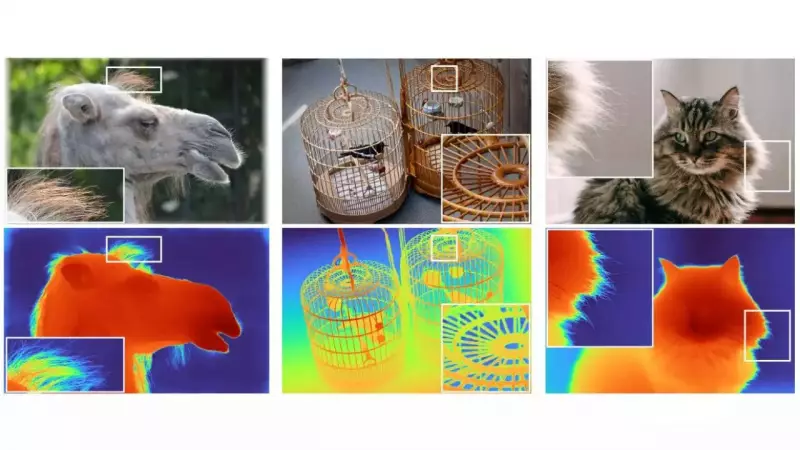
In a significant leap for artificial intelligence and spatial computing, Apple has unveiled a groundbreaking AI model called SHARP. This new technology can transform a standard two-dimensional photograph into a detailed, realistic three-dimensional environment in less than one second. The development, detailed in a research study, highlights Apple's growing ambitions in AI-driven image processing.
How SHARP Redefines Speed and Accuracy in 3D Imaging
The core achievement of the SHARP model lies in its unprecedented speed and precision. While most existing methods require dozens or even hundreds of images from various angles to reconstruct a 3D scene, SHARP accomplishes this feat from just a single picture. The AI ensures spatial consistency and retains real-world distances and scaling in the generated output, making the 3D representation metric and true to life.
Apple researchers outlined the model in a paper titled "Sharp Monocular View Synthesis in Less Than a Second." They stated that SHARP uses a neural network in a single feedforward pass on a standard GPU to regress the parameters of a 3D Gaussian representation of the scene. This representation can then be rendered in real-time, producing high-resolution, photorealistic images for viewpoints close to the original photo.

The Technology Behind the Magic: 3D Gaussians
To understand SHARP's operation, one must grasp the concept of 3D Gaussians. Imagine them as millions of tiny, fuzzy spots of colour and light positioned in a three-dimensional space. When combined intelligently, they form a cohesive and realistic scene. Apple trained SHARP on vast datasets of both synthetic and real-world images, teaching it to recognize universal patterns of depth, shape, and perspective.
When presented with a new photograph, the model quickly estimates object distances, refines this estimation using its trained knowledge, and determines the placement and appearance of millions of these 3D Gaussian points—all in one swift process. This approach eliminates the need for per-scene optimization or multiple input images, enabling the sub-second generation time.
Potential Applications and Current Limitations
The implications of this technology are vast, spanning numerous fields. From enhancing photography and revolutionizing augmented reality (AR) experiences to applications in gaming, virtual tours, and e-commerce, the ability to instantly create 3D from 2D opens new creative and practical doors. It represents a major stride in spatial computing, a domain Apple is actively pursuing with products like the Vision Pro.
However, the model does have a constraint. It excels at generating views close to the perspective of the original input image. You cannot freely fly around the entire scene, as SHARP does not invent unseen parts of the environment. This specific design choice is what allows the model to maintain its blistering speed and high fidelity for the views it does produce.
According to Apple's experimental results, SHARP sets a new state of the art, reducing key perceptual error metrics (LPIPS by 25–34% and DISTS by 21–43%) compared to prior best models, while slashing synthesis time by three orders of magnitude. The model's code and examples are available on GitHub, and early testers have already begun sharing their results on social media platforms like X (formerly Twitter).
This innovation firmly positions Apple as a formidable player in advanced AI research, particularly in the critical intersection of AI, computer vision, and immersive technologies.