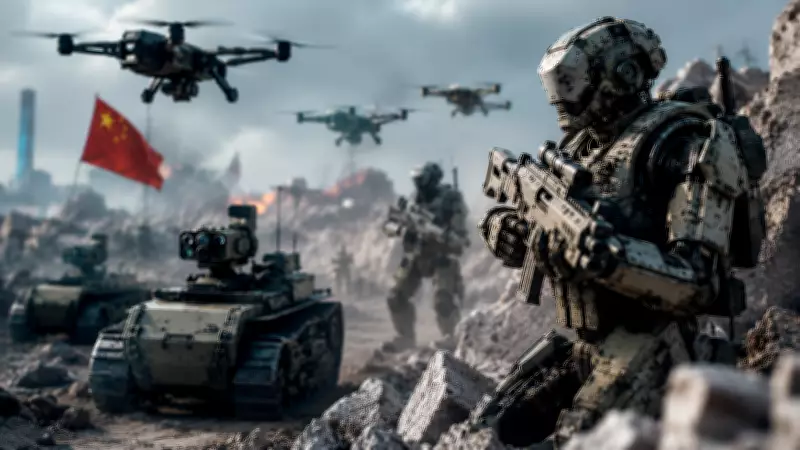
China’s rapid push into humanoid combat robots and AI-powered military systems is intensifying fears of a new global arms race where machines increasingly replace soldiers on the battlefield. But while Beijing showcases futuristic robotic troops and autonomous combat platforms, the war in Ukraine is already demonstrating how drones, robotic ground vehicles and unmanned strike systems are transforming modern warfare in real time.
From AI-assisted reconnaissance bots and kamikaze drones to robotic assault vehicles capable of capturing enemy positions without infantry, militaries across the world are moving toward a future where humans may no longer dominate frontline combat. China’s expanding robotics industry, America’s long-running military drone programmes and Ukraine’s battlefield innovations together suggest warfare is entering a new technological era shaped by automation, artificial intelligence and autonomous weapons systems.
The Rise of Robotic Warfare
Military robots are not entirely new. The United States has used unmanned aerial vehicles for surveillance and targeted strikes for years during operations in Iraq, Afghanistan, Pakistan and Yemen. Remote-controlled bomb disposal robots also became common during the Iraq War, helping soldiers detect and neutralise explosive devices from safer distances.

In 2005, the US military even deployed one of the first armed ground robots in Iraq under the SWORDS programme. These tracked robotic systems carried machine guns and were designed for perimeter defence. Military officials, however, remained cautious about allowing autonomous lethal operations and retained human oversight over firing decisions.
Still, defence thinking continued evolving. In 2013, Gen. Robert Cone, then head of the US Army’s Training and Doctrine Command, suggested robots and drones could eventually replace up to a quarter of combat troops by 2030 as part of efforts to create “a smaller, more lethal, deployable and agile force.”
The logic behind automation is straightforward. Modern warfare is extremely expensive, not only in equipment but also in the long-term costs associated with training, housing, healthcare, pensions and veteran care for soldiers. Robots offer militaries the possibility of reducing casualties while also lowering operational costs.
Ukraine’s Battlefield Transformation
Nowhere is this shift more visible than in Ukraine. Since Russia’s full-scale invasion in 2022, Ukraine has faced a major disadvantage in manpower, artillery stockpiles, industrial capacity and air power. Conventional military theory would suggest Russia’s larger size and resources should have delivered a decisive battlefield advantage.
Yet Ukraine has managed not only to survive but also to strike deep inside Russian territory, challenge Moscow’s naval dominance in the Black Sea and reclaim some occupied regions. A major reason has been Kyiv’s rapid transformation into one of the world’s most innovative wartime defence economies.
Ukrainian President Volodymyr Zelenskyy recently described how Ukraine is now producing millions of FPV drones, interceptor systems, artillery shells and long-range missiles domestically. He highlighted systems such as Flamingo, Ruta, Peklo, Neptune, Palianytsia and Vilkha as examples of how Ukraine’s defence industry has evolved from emergency improvisation into sustained wartime production.
Perhaps the most striking claim involved battlefield robotics. Zelenskyy said Ukrainian forces had captured an enemy position using only unmanned systems, including aerial drones and ground robots, without deploying infantry or suffering casualties. He added that robotic systems such as Ratel, TerMIT, Ardal, Rys, Zmiy, Protector and Volia had completed more than 22,000 front-line missions within three months. The development points toward a future where robots may increasingly handle the most dangerous battlefield tasks, including reconnaissance, mine-clearing, trench assaults and logistics.

Precision Over Mass
Ukraine’s approach reflects a deeper strategic shift in modern warfare. Unable to match Russia “soldier for soldier or shell for shell”, Kyiv focused on precision rather than mass. Instead of relying on large-scale troop assaults, Ukraine concentrated on targeting command centres, fuel depots, logistics hubs, airfields and ammunition storage facilities.
Drones became central to this strategy. Cheap FPV drones now routinely destroy tanks, artillery systems and armoured vehicles at a fraction of the cost of traditional missiles. Long-range drones strike deep into Russian territory, forcing Moscow to divert resources toward protecting infrastructure far from the front lines. Ukraine’s Magura V5 sea drone has also transformed naval warfare in the Black Sea. The unmanned explosive boat helped force Russia’s Black Sea Fleet to relocate assets and operate more cautiously despite Ukraine lacking a conventional navy capable of matching Russia directly.
Ground robots such as the Ratel H and Termit further demonstrate how automation is replacing soldiers in high-risk missions. These systems can carry explosives toward bunkers, clear mines, transport supplies and breach obstacles without exposing infantry to direct fire.
The Emergence of AI Soldiers
Beyond drones and robotic vehicles, militaries are also exploring humanoid combat robots powered by artificial intelligence. China has become a major player in this emerging race. According to recent reports, Beijing has showcased humanoid military robots capable of mimicking the movements of remote operators using real-time AI systems. These robots can carry rifles, grenade launchers and advanced sensor arrays designed to analyse battlefield conditions.
Experts say humanoid robots make sense because modern infrastructure and weapons systems are already designed around human physical capabilities. “The reason you’d build a humanoid [robot] is so that it can use the same kind of weapons a human would use,” physicist Michael Hochberg said.
China’s wider robotics industry also gives it a manufacturing advantage. According to International Federation of Robotics data cited in reports, China’s operational robot stock exceeded 2 million units, with nearly 295,000 robots installed in 2024 alone. By comparison, the United States installed just over 34,000 robots during the same period. However, the United States retains one key advantage: combat experience. American military systems have already been tested extensively in Iraq, Afghanistan and now Ukraine, where US-developed robotic platforms are reportedly conducting frontline reconnaissance missions. Battlefield data gathered from these deployments could help improve future AI combat systems.
The Limits of Robots in War
Despite rapid advances, robots are still far from fully replacing human soldiers. Current systems remain vulnerable to electronic warfare, GPS jamming, signal disruption, harsh terrain and physical destruction. Ground robots can become trapped in trenches or mud. Drones can be intercepted or disabled. Sea drones remain vulnerable to helicopters, machine guns and barriers.
More importantly, ethical concerns surrounding autonomous weapons continue growing. Most militaries still insist that humans should retain final authority over lethal decisions. Fully autonomous weapons capable of independently identifying and killing targets remain highly controversial. AI experts have repeatedly warned that autonomous systems could reduce political hesitation toward war by lowering the human cost for the attacking side.
Kanaka Rajan, a Harvard computational neuroscientist studying AI systems, warned that AI weapons may allow governments to deflect responsibility for wartime decisions. “It becomes politically easier to start wars, which, in turn, may lead to more death and destruction overall,” Rajan said. There are also fears that battlefield AI may misidentify targets, malfunction under chaotic combat conditions or escalate conflicts unintentionally.
A New Era of Warfare
What is emerging in Ukraine and elsewhere is not necessarily a future without human soldiers, but a battlefield increasingly shared between humans and machines. Robots already scout enemy trenches, defuse bombs, patrol seas, strike tanks, attack warships and carry supplies. AI-assisted systems process surveillance data faster than humans can react. Long-range drones now threaten military infrastructure hundreds or even thousands of kilometres away.
The role of infantry is also changing. Instead of leading every assault directly, soldiers may increasingly act as operators, coordinators and decision-makers supervising networks of unmanned systems. In many ways, Ukraine has become a live demonstration of this transformation. Faced with a larger adversary, Kyiv turned technology, automation and innovation into force multipliers capable of compensating for manpower shortages and industrial disadvantages.
The conflict has also rewritten military doctrine. Traditional warfare relied heavily on mass troop formations, armour and air superiority. The new battlefield increasingly rewards precision, adaptability, decentralised production and autonomous systems. Whether robots will fully replace human soldiers remains uncertain. Machines still lack human judgment, adaptability and emotional understanding under unpredictable combat conditions. But one reality is already clear: the future battlefield will not belong to humans alone.