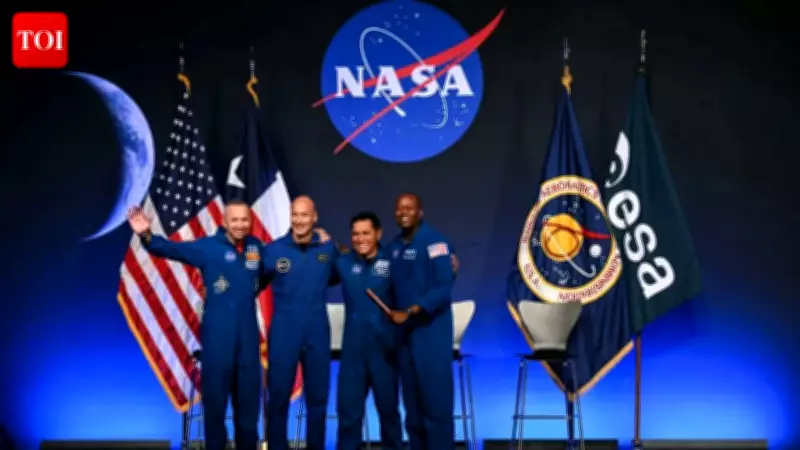
For over five decades, humanity has dreamed of returning to the Moon — not just to visit, but to explore, build, and use it as a launchpad to Mars. This week, NASA made that dream a little more real by revealing the Artemis III crew, calling it part of "Earth's first starfleet." It is the latest chapter in the Artemis program, NASA's push to get humans off Earth for good and spark a new era of deep-space exploration.
The four-member crew is a blend of seasoned astronauts, a record-breaking space dweller, a first-timer, and a representative from the European Space Agency. Their mission is loaded with complexity. However, despite the hype, Artemis III is not actually landing where most people expected it to land. Instead, Artemis III is now a test mission to prove that the spacecraft, lunar landers, and docking systems for future Moon landings work together seamlessly. Think of it as a critical bridge between the successful Artemis II flight and NASA's ultimate goal: putting humans back on the lunar surface.
Is Artemis III Heading to the Moon?
Not truly, at least not as people expected. According to the BBC, although originally Artemis III was supposed to mark humanity's return to the lunar surface, NASA has tweaked its plans. Now, Artemis III launches in 2027 for around two weeks in low-Earth orbit, running complex docking and operational tests with multiple spacecraft. Instead of flying directly to the Moon, astronauts will demonstrate systems from SpaceX and Blue Origin, which are the technologies meant for future landings.

The Focus of the Mission
The primary goal is to get NASA's Orion spacecraft to link up with lunar landers built by SpaceX and Blue Origin. Future missions depend on executing this orbital ballet before descending to the Moon. NASA's next attempt to actually land astronauts on the Moon is Artemis IV, planned for 2028. If all goes smoothly, that will be the first boots on the lunar surface since Apollo 17 in 1972.
Meet the Artemis III Crew
This group is a mix of experience, skill, and international teamwork. Commanding the mission is Randy Bresnik, a veteran astronaut and retired US Marine Corps colonel. He has logged over 150 days in space and thousands of flight hours. NASA trusts his operational expertise to lead one of its toughest missions.
Flying as a pilot is Luca Parmitano, the first European Space Agency astronaut selected for an Artemis mission. He is already among Europe's most seasoned space travelers, highlighting the global nature of lunar exploration.
Mission specialist Frank Rubio brings an impressive record, having spent 371 consecutive days in space, earning the American record for the longest single stay. This experience is invaluable for living on future Moon bases or heading to Mars.
Last up is Andre Douglas, a former Coast Guard officer, robotics expert, and systems engineer. Artemis III is his first trip to space. NASA praised his deep knowledge in autonomous systems and robotics, both crucial for future Moon missions. Together, they represent what NASA calls the next wave of explorers, preparing humanity for permanent life beyond Earth.
‘Earth’s First Starfleet’: What Does That Signify?
NASA's administrator, Jared Isaacman, grabbed headlines with that phrase while introducing the Artemis III crew. He points to a new era where space exploration is not just an occasional government mission. Now, space agencies, private companies, and international partners operate together as a global exploration network. Artemis itself is built on collaboration. SpaceX is developing the Starship Human Landing System for lunar transport, while Blue Origin is working on its own landers. Countries worldwide contribute technology, hardware, and astronauts. This is not just about reaching the Moon; it is about establishing a sustainable presence. NASA hopes these efforts will eventually lead to permanent lunar bases, science stations, and, someday, Mars missions.

Prada on the Moon, Finally?
This question is an obvious follow-up. After the news broke that Prada has teamed up with NASA to help design next-generation lunar spacesuits, public interest has been immense. But before picturing spacesuits straight from a Milan runway, it is important to clarify: Prada is assisting Axiom Space, NASA's contractor, with its expertise in high-performance fabrics, advanced materials, and manufacturing. The result is the AxEMU suit, a piece of serious technology designed to protect astronauts from extreme temperatures, abrasive lunar dust, and harsh radiation. Prada has contributed to both the suit's outer layers and inner cooling systems. A notable feature is a specialized undergarment that circulates water to keep astronauts cool during Moon walks. So yes, Artemis astronauts may wear gear with Prada's influence — but all in the name of safety, not high-fashion branding. No giant logos, just cutting-edge engineering.
Carrying the Torch to a New ‘Moon Era’
The Artemis III crew reveal comes right after a significant milestone for the program. In April 2026, Artemis II took astronauts Reid Wiseman, Victor Glover, Christina Koch, and Jeremy Hansen around the Moon. That mission proved Orion's systems could sustain human life in deep space and shattered distance records set during Apollo. Now, Artemis III must demonstrate that multiple spacecraft from different companies can work together in orbit — a step as crucial as actually landing on the Moon. Apollo proved we could reach the Moon. Artemis aims to prove we can stay, build, and eventually use it as a springboard deeper into space. These four new astronauts are testing the technology and partnerships that could shape humanity's future in space. Even if Artemis III does not touch the lunar surface, its importance cannot be overstated. If successful, it brings us one step closer to seeing humans return to the Moon and, before long, begin the journey to Mars.