

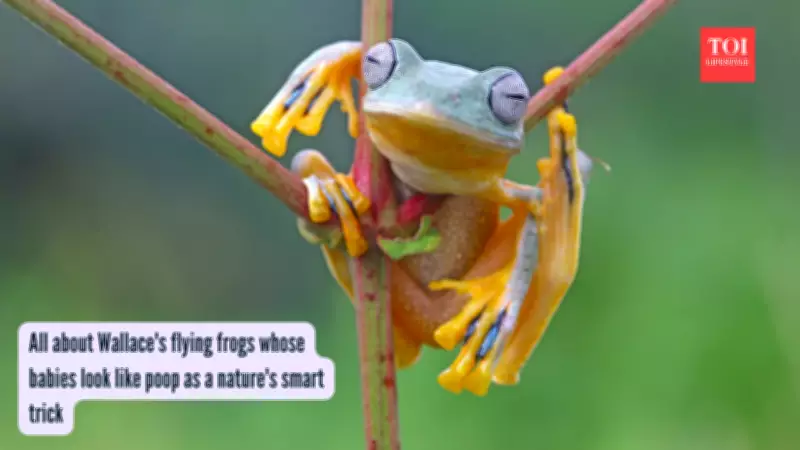
Nature loves a good disguise, and one type of baby frog has perfected one of the grossest forms: looking like poop. These unique creatures are Wallace's flying frogs, vibrant gliders from Southeast Asia's rainforests, which start life as tiny survivors betting on camouflage.
Discovery and Characteristics
Named after explorer Alfred Russel Wallace, who found the first specimen in the 1800s, these frogs glide between trees using webbed feet. But even more intriguing is their juvenile appearance: a bright red body dotted with white spots, resembling animal droppings.
Research at Schönbrunn Zoo
Researchers at Vienna's Schönbrunn Zoo, the world's oldest zoo, collaborated with the University of Vienna on a study of Wallace's flying frog. Led by Susanne Stueckler, the team published their work in the journal Behavioral Ecology and Sociobiology. They examined the unusual colour patterns of juvenile frogs, which have red bodies with white dots that appear highly visible yet effectively keep predators away.

“The young frogs probably count on the fact that they will be seen but considered something inedible,” Stueckler explained. Adults change to iconic green camouflage after a year, and spots fade as they glide confidently. Because juveniles are too vulnerable to fly far, they need ground cover to hide from predators.
Testing with Wax Models
To test the hypothesis, researchers created wax models in frog colours: plain red, green, and red with white spots, matching the juveniles. They placed these in the zoo's rainforest house, which keeps birds that hunt using colour vision.
According to the research, plain red models faced high attack rates. Green models experienced fewer attacks, as they blended with leaves. Red-with-white-spot models saw attacks drop by half.
“We show that the unusual colour pattern of juveniles likely functions as a masquerade of animal droppings,” the authors stated. They described it as an “anti-predator strategy so that predators misidentified them as inedible objects.”
Why Poop?
Predators avoid feces due to disease risk and bad taste. The red-white pattern is similar to bird or mammal droppings common in jungles. This masquerade allows the vulnerable juveniles to survive until they develop their adult camouflage.






