In a surprising twist of technological fate, bitcoin mining companies are discovering a financial lifeline and a massive growth opportunity in the world of artificial intelligence. Faced with slimming profits from their original crypto pursuits, these firms are now retooling their vast, electricity-intensive operations to power the AI revolution, attracting deep-pocketed clients like Amazon and Microsoft.
From Crypto Diggers to AI Powerhouses
The evidence of this strategic shift is stark in the stock market. The CoinShares Bitcoin Mining ETF has surged about 90% this year, a remarkable rally that has gained momentum even as bitcoin itself erased its gains for 2025. This divergence highlights a new reality: mining-company stocks are flying high not because of cryptocurrency prices, but due to their alignment with the planet's hottest investment theme—AI.
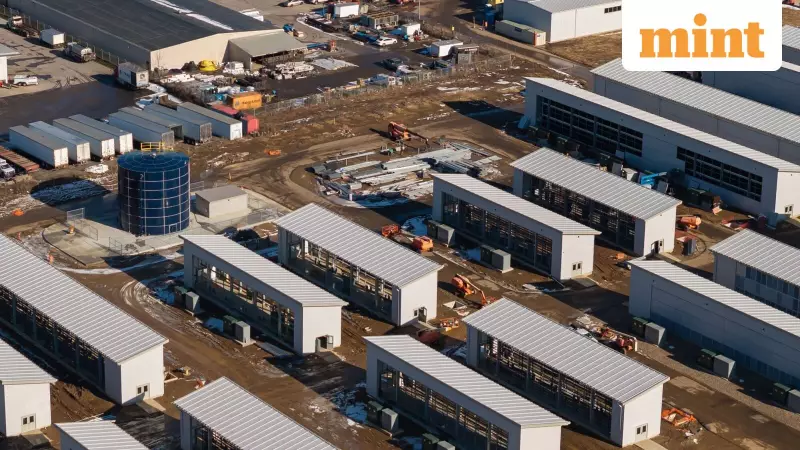
Bitcoin mining, which involves using immense computer power to solve complex equations and unlock digital currency, has seen its profitability erode due to increased competition and technical challenges. However, these companies possess exactly what AI giants desperately need: data centers, advanced cooling systems, land, and, most crucially, hard-to-obtain contracts for electrical power. This existing infrastructure can be repurposed to train and run massive AI models.

"The opportunity for miners to convert to AI is one of the greatest opportunities I could possibly imagine," said Adam Sullivan, chief executive of Core Scientific, a company that has successfully pivoted towards AI data centers.
The Lucrative Pivot and Its Challenges
This transition is not merely a side project; for some, it's a complete transformation. Core Scientific, which saw its shares quadruple in 2024 after signing its first AI contract in February of that year, now expects to exit bitcoin mining entirely by 2028. Other miners, like Cipher Mining and IREN, have also seen their stocks surge following long-term deals with tech hyperscalers.
However, the shift is neither seamless nor cheap. Converting a bitcoin-mining facility for AI work is a major undertaking. It requires building new, specialized facilities with more advanced cooling and network systems. The core hardware must also be swapped out, replacing bitcoin-specific computers with AI-focused graphics processing units (GPUs).
"Bitcoin miners have an advantage in understanding power and its use but there’s a night and day difference between mining and HPC [high-performance computing] support," noted Kevin Dede, senior research analyst at H.C. Wainwright. "It’s more than an order of magnitude of intensity and complexity."
A Strategic Hedge Against Crypto Volatility
For many in the industry, the move into AI serves as a strategic hedge against the inherent uncertainties of bitcoin mining. Beyond price swings, the bitcoin code caps total supply at 21 million, and miners face a "halving" event every four years, which cuts their potential rewards in half. AI offers a new, stable source of revenue from customers willing to commit to long-term leases.
Some companies, however, are pursuing a dual-track strategy. CleanSpark, which has advanced 25% this year, recently raised $1.15 billion for data-center infrastructure but remains committed to bitcoin mining. This approach offers a unique advantage to power utilities. Bitcoin miners can act as a flexible, "spongy" load on the grid—they can quickly power down during periods of high demand or instability, helping to stabilize the network.
"If and when there’s a weather-related event or anything else, we can curtail a portion of the portfolio to help stabilize the grid," explained Matthew Schultz, CEO of CleanSpark. "And what we found is the demand for that type of load is much greater." Traditional AI data centers, which need to run constantly, cannot offer this flexibility.
Despite the excitement, analysts caution about risks. The AI industry itself faces fears of a bubble, with concerns over stretched valuations and massive capital spending. Furthermore, this pivot could have geopolitical consequences, potentially diminishing U.S. bitcoin production and moving a larger share overseas—a shift at odds with former President Donald Trump's goal of having all bitcoin "mined, minted and made in the USA."

Ultimately, market forces appear to be driving this historic shift. As Brett Knoblauch, head of digital asset research at Cantor Fitzgerald, put it: "I think the writing on the wall is quite clear, and shareholders would value an AI data center infinitely higher than a bitcoin mining data center. It’s almost like the market’s forcing their hand." The race to power AI is now being fueled by the very companies that once only dug for digital gold.