

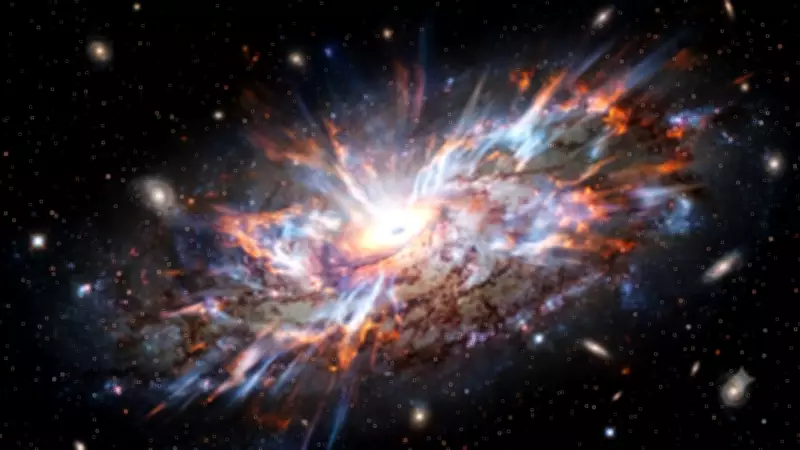
A supermassive black hole situated approximately three billion light-years from Earth is generating the fastest ultraviolet winds ever detected. The object, designated J2318, fuels a quasar whose outflows race at about 30 percent of the speed of light, equivalent to roughly 323 million kilometers per hour. This extraordinary finding offers one of the clearest insights yet into how actively feeding black holes can transform entire galaxies through potent feedback mechanisms.
Discovery and Observations
Researchers identified these winds using spectroscopic data from the Sloan Digital Sky Survey. The quasar is powered by a black hole estimated to contain 1.7 billion times the mass of the Sun. Although supermassive black holes commonly produce outflows, the velocity measured in J2318 sets a new benchmark for ultraviolet observations, providing a rare opportunity to study how radiation drives matter away from the black hole's vicinity.
The comparison to a “category 79 hurricane” is not an actual meteorological classification. Instead, it serves as a scale reference to illustrate how vastly these cosmic winds exceed anything possible within Earth's atmosphere. According to the research team, the outflows move so rapidly that conventional terrestrial comparisons become almost meaningless.

How Supermassive Black Holes Generate Powerful Winds Across Entire Galaxies
Unlike storms on Earth, which are driven by pressure differentials and heat transfer in the atmosphere, winds from black holes rely on radiation emitted from an accretion disk. Gravitational energy converts into radiation as matter is pulled inward toward the event horizon, producing enough force to propel material outward at high speed.
The new observations support a growing body of evidence showing that active galactic nuclei can generate highly structured winds extending far beyond their central engines. A recent study by the American Astronomical Society, titled 'A New Member of the Fast and Furious Family: A Relativistic and Time-variable UV Outflow in a Luminous Quasar,' reported ionized quasar winds traveling at sub-relativistic speeds. It also demonstrated that some black hole-driven outflows continue accelerating across galactic scales. Together, these findings indicate that black hole winds are capable of transporting enormous quantities of energy across entire galaxies.
As noted by the XRISM Collaboration: “Evidence indicates that supermassive black holes exist at the centers of most galaxies. Their mass correlates with the galactic bulge mass, suggesting a coevolution with their host galaxies, most likely through powerful winds.”
Why These Extreme Winds Matter for the Evolution of Galaxies
The significance of this discovery extends well beyond a single quasar. Astronomers regard black hole winds as one of the primary mechanisms regulating galaxy growth. By ejecting gas and dust from galactic centers, these outflows can suppress future star formation, alter chemical enrichment patterns, and influence the long-term structure of galaxies.
Theoretical models have predicted such feedback processes for decades, but direct measurements of exceptionally fast winds remain rare. The J2318 observations provide an important data point for testing simulations that attempt to explain how supermassive black holes and galaxies evolve together over billions of years.
Patrick Hall of York University, a member of the research team, described the discovery as evidence of an unusually powerful outflow emerging from an otherwise typical supermassive black hole system. The findings demonstrate that even familiar classes of quasars can generate winds operating at the extreme limits of known astrophysical processes.
For Earth, the “category 79 hurricane” comparison remains purely hypothetical. Such winds exist only in the hostile environment surrounding actively feeding supermassive black holes. Yet their detection offers a remarkable glimpse into some of the most energetic phenomena in the Universe, where radiation can accelerate matter to nearly one-third of light speed and influence the fate of entire galaxies.






