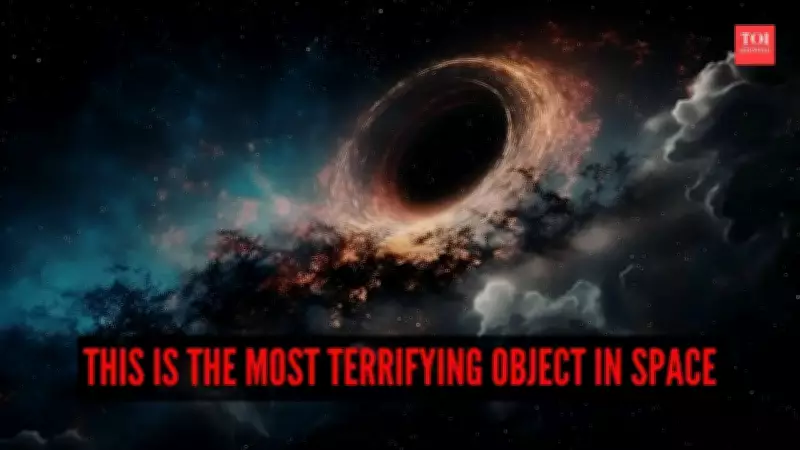
When we gaze at the night sky, space may appear peaceful, awe-inspiring, and endless. However, beneath the sparkling stars and illuminated planets lie numerous mysteries about space that are far more frightening than what meets the eye. Among the many strange and fearsome objects in outer space, one that evokes terror is the black hole. In the quiet darkness of space, there exists an object so mighty that not even light can escape its clutches: the black hole.
What Makes a Black Hole So Fearsome?
According to NASA, a black hole is an astronomical object with a gravitational pull so strong that nothing, not even light, can escape it. Its outer boundary, known as the event horizon, marks the point beyond which the escape velocity surpasses the speed of light, the universe's ultimate speed limit. Black holes form when massive stars—at least eight to twenty times the Sun's mass—exhaust their fuel and undergo a violent gravitational collapse. This collapse triggers a supernova explosion, crushing the core into an incredibly dense singularity from which even light cannot escape. Stellar-mass black holes, the most common type, form from the collapse of a single massive star. Because they emit no radiation, black holes cannot be seen directly. They do not emit light, but surrounding matter can radiate strongly. However, scientists can identify them indirectly through the behavior of nearby objects.
The most frightening aspect of black holes lies in their immense strength. If anything crosses the event horizon, it is pulled inward with no chance of return. They are, quite literally, regions where the universe breaks its own rules.

The Silent Destroyer of Space
Unlike an explosion or collision, which occurs with a bang, black holes exist silently. Space has no medium for sound, so no sound is produced. Black holes do not make any sounds because they lack parts that can collide and generate sound waves. They simply lurk, quietly exerting their gravitational pull on all objects within their vicinity. Black holes come in various sizes, from miniature black holes to supermassive ones found at the centers of galaxies, such as the Milky Way.
Why Black Holes Fascinate Us
Even though black holes are frightening, they also inspire curiosity. Scientists study them to understand how stars die, how galaxies form, and how gravity works under extreme conditions. They are regions where the laws of physics are pushed to their limits. The more we learn about black holes, the more we realize how little we truly know about space. For students and science enthusiasts, black holes are both a warning and a wonder. They demonstrate the power of nature on a scale almost impossible to imagine, while encouraging us to keep exploring and learning. Black holes are described as some of the most frightening entities in outer space, often regarded as terrifying because of their ability to trap anything that approaches their event horizon. However, they also represent some of the most fascinating discoveries in modern astronomy. They may be scary due to their mysterious nature, but they are complex and unforgettable.