

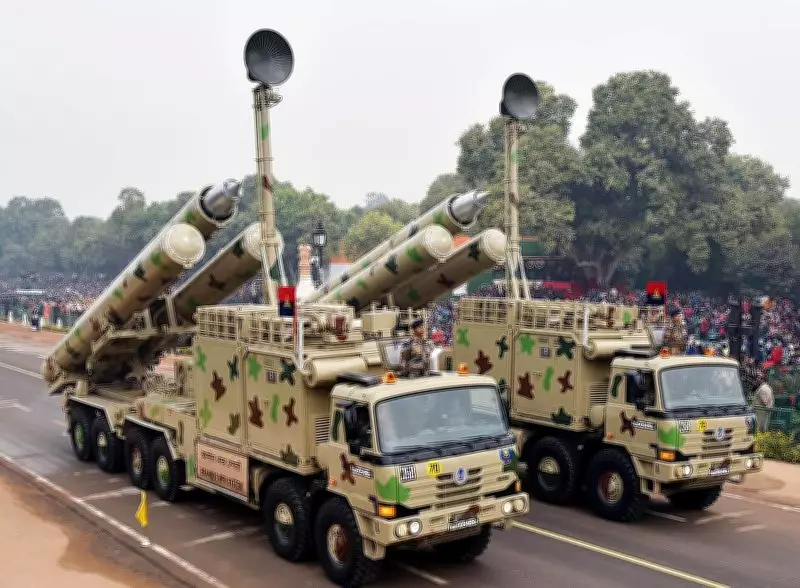
India's flagship supersonic cruise missile, BrahMos, marked 25 years on Friday since its first test launch. The missile was first fired from a stationary vertical launcher at Chandipur, off the Odisha coast, on June 12, 2001. Over the past quarter-century, it has evolved into a critical precision-strike weapon in India's defence arsenal.
Development and Joint Venture
BrahMos is the product of a joint venture between India and Russia, combining India's guidance and software expertise with Russian ramjet propulsion technology. The missile is based on Russia's P-800 Oniks (Yakhont) anti-ship cruise missile. The joint venture was formalised with an Inter-Governmental Agreement signed in Moscow on February 12, 1998, by Dr APJ Abdul Kalam, then Secretary of the Department of Defence R&D, and NV Mikhailov, Russia's First Deputy Defence Minister. BrahMos Aerospace was subsequently established as a collaboration between the Defence Research and Development Organisation (DRDO) and Russia's NPO Mashinostroyenia (NPOM). The name BrahMos is derived from the Brahmaputra and Moskva rivers.
Operational Deployment
The missile is now deployed across all three branches of the Indian military. The Indian Navy was the first to induct the system in 2005, deploying the anti-ship variant on Rajput-class warships. The Indian Army followed in 2007 with the land-attack variant, capable of precision strikes using advanced guidance systems. The Indian Air Force's Sukhoi-30MKI aircraft have been structurally modified to carry the air-launched variant, which was successfully tested in November 2017, completing India's supersonic cruise missile triad capability—land, sea, and air launch platforms. On land, the missile is used by Army artillery units in forward areas and is also deployed at select Indian Air Force ground bases along the western front.

Combat Use and Exports
BrahMos has been used in combat operations. During Operation Sindoor on May 10 last year, the Indian Air Force struck multiple Pakistani military targets, with BrahMos employed in some attacks. The missile has also been exported to the Philippines, while countries such as Indonesia and Vietnam have placed orders.
Technological Advancements
India's pursuit of such a missile began in 1983 with the Integrated Guided Missile Development Programme (IGMDP), which faced numerous technological challenges. After the 1991 Gulf War and the collapse of the Soviet Union, India sought advanced systems capable of penetrating modern air defences. Russia, emerging from the Cold War, provided key technology cooperation. The missile's range was initially restricted to around 290 km due to MTCR constraints, but after India joined the Missile Technology Control Regime (MTCR) in 2016, the extended-range programme was developed, and the missile has been tested at ranges up to 450 km. Indigenous content in the system has increased to over 75%. Future plans include enhancing its speed from Mach-3 to Mach-5.






