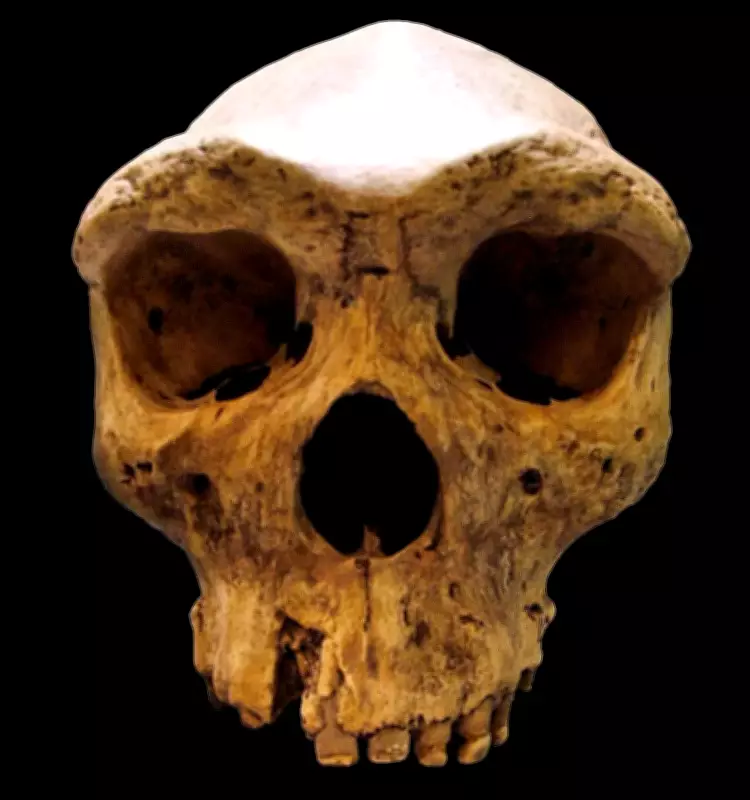
In 1921, during the summer, miners working in a lead and zinc mine at Broken Hill, now known as Kabwe in Zambia, were excavating limestone hills through blasting. As the cloud of dust gradually cleared, a human-like face appeared, gazing back at one of the miners named Tom Zwiglaar. He had discovered an almost complete skull with prominent features, now recognized as the Broken Hill skull or Kabwe 1.
An Accidental Discovery That Shocked the World
This specimen is considered the first early human fossil found in Africa. At the time of its discovery, it came as a shock because many still believed that human origins should be sought elsewhere. The skull showed a brain size comparable to contemporary humans but featured huge shelf-like brow ridges, more pronounced than in any other fossil found. It did not fit neatly into existing categories.
Taxonomic Ambiguity and Scientific Debate
The discovery caused a huge stir among researchers and posed serious taxonomic questions that remain unanswered. Early researchers could not decide whether Kabwe 1 was a direct ancestor or an extinct cousin. According to the Smithsonian Institution, it was initially classified as a new species, Homo rhodesiensis, and later included in Homo heidelbergensis. This ambiguity makes the Broken Hill skull an important artifact, as it marks a period in Africa when multiple human species may have coexisted and interbred. Rather than a linear path from ape-like to modern humans, the skull shows evolution taking experimental turns, some leading nowhere and others thriving.

New Dating Reveals Coexistence with Homo Sapiens
The fossil's date remained a mystery for decades because the cave was mined before scientists could examine it. However, advances in technology have provided new insight. A study published in Nature used uranium series dating on the skull and associated sediments, revealing it is considerably younger than previously believed. According to the Natural History Museum, while the robust and primitive human was moving around Zambia, the first representatives of Homo sapiens emerged elsewhere in Africa. This challenges the idea that evolution is a race where one type replaces another; instead, various kinds of humans lived in Africa simultaneously.
Implications for Human Evolution
The 1921 mining accident demonstrates that accidental discoveries can profoundly shape our understanding of ourselves. Tom Zwiglaar, searching for zinc ore, stumbled upon something far more interesting, leading to a better understanding of our ancestors. The Broken Hill skull, now housed at the Natural History Museum in London, encourages scientists to rethink theories of prehistory. One wonders how many thousands of years ago there existed people so radically different from modern humans that they might seem from a fantasy novel rather than a science textbook.