

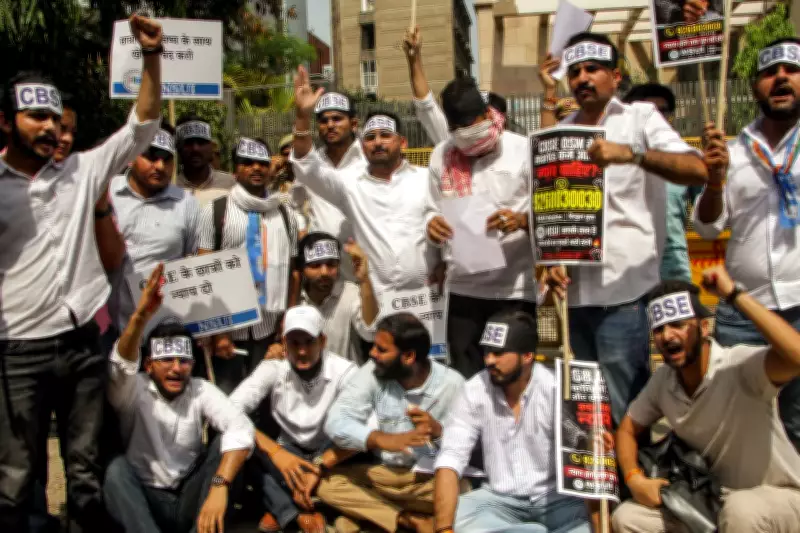
For weeks, India's largest school board has been battling a series of controversies: blurred answer sheets, missing supplementary pages, students receiving others' scanned copies, technical loopholes, angry parents, viral social media posts, political attacks, and Supreme Court petitions. However, behind the public outrage over the Central Board of Secondary Education's (CBSE) new On-Screen Marking (OSM) system lies a buried story: teachers who foresaw the problems but were afraid to speak out.
Early Warnings Ignored
Long before students posted screenshots online, evaluators at Delhi's OSM centres claim they struggled with technical failures, incomplete answer sheets, blurry scans, disappearing pages, and server instability during Class 12 evaluations. Yet, according to multiple teachers and principals speaking anonymously, many evaluators remained silent after CBSE issued a March 16 circular warning against sharing misleading information on social media about the evaluation process.
What CBSE described as an advisory against rumours is now seen by evaluators as a gag order. Now, several educators allege that the same system that discouraged criticism during evaluation is quietly encouraging schools and teachers to publicly defend OSM online as the controversy deepens. This has sparked anger within the school ecosystem. "We were gagged first. Now suddenly there is pressure to speak positively about OSM," said a senior Delhi-based Class 12 evaluator. "The irony is painful."

Technical Failures from the Start
The March 16 circular warned evaluators against posting comments, opinions, and experiences on social media, stating that misleading posts could create confusion. The Board reminded teachers that the evaluation process was confidential and that spreading rumours could invite disciplinary action. Officially about professional conduct, the message received at evaluation centres was broader: do not publicly question the system.
"One thing became very clear after the circular — nobody wanted trouble," said a Physics evaluator from Delhi. "People feared show-cause notices, blacklisting, or unnecessary scrutiny. So even when genuine technical problems started, most teachers kept quiet." Another evaluator noted that the transition to OSM was rushed. "Training lasted barely a week. Some teachers got maybe eight or ten days maximum. You cannot suddenly shift lakhs of answer sheets to a completely digital evaluation system and expect zero confusion."
Issues surfaced almost immediately. "We faced blurry scans constantly. Supplementary sheets would not load. The next page would disappear while checking step marking," a Delhi evaluator said. "Formulas looked distorted on screen. Teachers had to interpret what students wrote." A Mathematics examiner described the experience as "mentally exhausting". "You check lengthy subjective answers on a screen under strict timelines. Suddenly the page jumps, the server hangs, the image becomes unclear. And throughout, the in-charge reminds you to strictly follow marking guidelines because copies may later enter the public domain."
Evaluators were repeatedly warned that discrepancies found during re-evaluation or public scrutiny could lead to action against them. "There was fear throughout the process," the examiner said. "We were told: stick exactly to the marking scheme, be careful, these copies may become public later. But how do you check properly when the answer itself is not visible clearly?"
Could the Crisis Have Been Averted?
Several evaluators believe the controversy could have been contained if teachers could openly flag operational issues without fear. "Honestly, most evaluators knew the results would create controversy," said another senior examiner from Delhi. "The moment we saw blurry scans and missing supplementary sheets, we understood students would later complain." Teachers discussed concerns informally but rarely escalated them. "If teachers had openly raised these issues in March, perhaps CBSE would have paused OSM, fixed technical loopholes, or shifted some subjects back to offline checking." Instead, problems travelled quietly through the system until they surfaced after results were declared.

The public eruption became impossible to contain once students accessed scanned answer sheets during re-evaluation. Allegations of blurred, incomplete, or mismatched copies — including one student's claim that a Physics answer sheet under his roll number did not belong to him — triggered national outrage. CBSE later acknowledged that the "correct copy" had been sent. For many evaluators, the crisis was never sudden. "It did not begin after results," one examiner said. "It began during evaluation itself."
Pressure to Defend the System
What has further angered educators is the perception that schools are now informally encouraged to defend OSM publicly. Several Delhi principals confirmed conversations within institutional groups promoting positive messaging about digital evaluation. One principal from a prominent private school said schools are caught between anxious parents and institutional expectations. "Parents are asking difficult questions every day," the principal said. "At the same time, there is an expectation that schools should help calm the atmosphere." Another principal described the situation as "deeply uncomfortable". "You cannot ask schools to become perception managers when genuine student grievances exist. Students are emotionally distressed. Some feel their performance has not been reflected accurately. Transparency becomes more important than image management."
Some educators say the contradiction is impossible to ignore. "First teachers were told not to discuss problems publicly," a Delhi-based senior teacher said. "Now schools are nudged to post positive messaging about OSM. Naturally people will ask — is the priority solving the problem or controlling the narrative?"
The Push to 'Trust the System'
Multiple principals and teachers alleged that, amid growing criticism, they were informally encouraged by CBSE-linked channels to publicly defend OSM and spread awareness about its positives. While no formal circular was issued, conversations through WhatsApp groups, calls, and internal meetings carried the message that schools should help calm the narrative. "We were told to reassure students and parents that the system is transparent and student-friendly," alleged a principal of a private school in East Delhi. "The concern inside schools was very different from the confidence being projected outside." Some school heads did publicly endorse the system during the peak of the controversy, including Dr. Jyoti Gupta and Mrs Moushumi Das, who shared videos discussing digital reforms.
Implementation Flaws
The OSM crisis has reopened concerns about how educational reforms are implemented. CBSE introduced OSM as part of a push towards faster, digitised, and more transparent evaluation. The Board has defended the process, stating that lakhs of students have accessed scanned answer sheets and that genuine grievances are being addressed. But teachers say the real issue is operational readiness. "Technology is not the enemy. Poor implementation is," said a senior Commerce evaluator.
Several evaluators argued that digital evaluation demands extensive preparation. "Screen-based checking is fundamentally different from physical copy checking," one teacher said. "It requires proper infrastructure, strong servers, image clarity standards, examiner calibration, and much longer training. Instead, this transition felt rushed." Older teachers particularly struggled to adapt to prolonged digital assessment interfaces. "Many teachers were trying their best but were still figuring out the platform while simultaneously checking board papers carrying students' futures."
The controversy has evolved beyond technical glitches. For students, it is a question of trust. For teachers, it is about whether institutional systems listen to problems before they become public embarrassments. For CBSE, the damage may come from the perception that warnings were ignored until the crisis became impossible to deny. "In India's exam ecosystem, trust is everything. Once teachers say they were afraid to speak, restoring trust becomes far more difficult than fixing software."
Political Fallout
The controversy spilled into politics after Leader of Opposition Rahul Gandhi accused the Centre of silence over OSM complaints and questioned the awarding of the digital evaluation contract. In a post on X, Gandhi alleged that the company handling the system had faced controversy in the past and demanded accountability. Union Education Minister Dharmendra Pradhan responded on Thursday, accusing Gandhi of politicising the issue and saying the Congress leader "does not stand with India's scientific progress". Pradhan assured that no one would be spared if irregularities were found.
Pradhan also made the government's strongest acknowledgment yet by publicly accepting responsibility. "I myself take responsibility on behalf of the government for any inconvenience," he said, urging that students should not face additional mental stress. He stated that nearly 4 lakh students had accessed scanned answer sheets and assured that every complaint would be examined. However, for many questioning OSM's credibility, the statement appeared less like closure and more like confirmation that the crisis had become too large to ignore.





