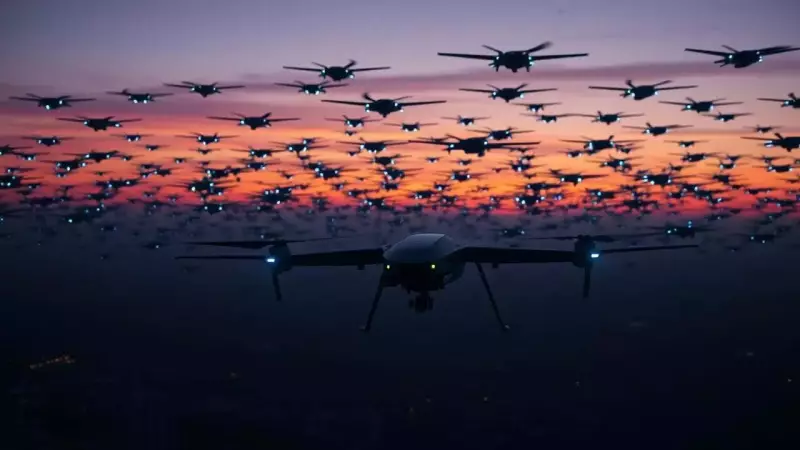
China's Military Achieves AI-Driven Drone Swarm Breakthrough
The Chinese military has announced a significant advancement in drone warfare technology, with artificial intelligence now enabling a single soldier to command and control more than 200 drones simultaneously. This development underscores the People's Liberation Army's (PLA) intensified focus on AI-powered swarm combat capabilities, marking a new era in autonomous military operations.
Successful Testing of AI-Enabled Drone Technology
In a recent defense news program broadcast by state television CCTV, it was revealed that the PLA has successfully tested AI-driven drone swarm technology developed by the National University of Defence Technology, which is affiliated with the military. According to reports from news agency PTI, the tests demonstrated that one operator could launch and manage over 200 fixed-wing drones at the same time from multiple vehicles, showcasing unprecedented operational efficiency.
Drone swarm warfare leverages artificial intelligence and advanced data links to deploy large numbers of drones rapidly. These drones are capable of flying in coordinated formations, autonomously dividing tasks, and executing multiple missions concurrently, including reconnaissance, distraction maneuvers, and precision strike operations.

Advanced Training and Autonomous Decision-Making
CCTV reported that the drone swarms underwent extensive training through both offline simulations and real flight tests, which enabled them to develop robust autonomous decision-making abilities. Footage from the trials displayed researchers monitoring the live status of dozens of drones on a single screen as the drones seamlessly switched roles during operations.
Xiang Xiaojia, a research fellow at the university's school of intelligent science, explained to CCTV that each drone is equipped with its own intelligent algorithm. "Through interconnection and autonomous negotiation, they can form a powerful, collaborative intelligent swarm," he stated, highlighting the sophisticated coordination achieved.
Anti-Jamming Capabilities and Future Implications
Xiang further noted that the team tested an anti-jamming algorithm in environments with electromagnetic interference. This system allows drones to autonomously plan flight paths and continue coordinated search operations even when signals are disrupted, enhancing resilience in contested battlefields.
The Hong Kong-based South China Morning Post, citing the CCTV report, detailed that the new control module facilitates precise coordination within the swarm, with different drones assigned specific roles such as surveillance, electronic jamming, decoy missions, and direct attacks. This breakthrough positions China at the forefront of military AI innovation, potentially reshaping global defense strategies and drone warfare tactics.