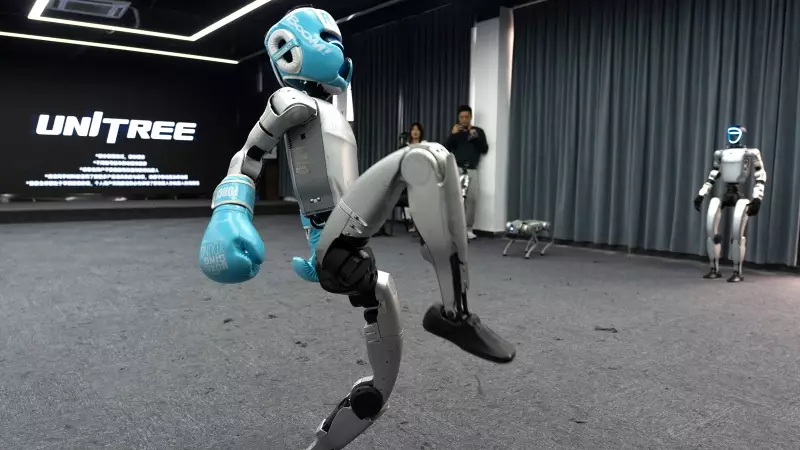
China's ambitious push to become a global robotics powerhouse is showing signs of strain, with government authorities warning of a potential market bubble. Last month, officials highlighted that more than 150 manufacturers are now competing for a slice of the industry, risking a flood of "highly repetitive products." This caution comes despite significant public fascination and massive investment in robots that dance, box, and mimic humans.
The Spectacle vs. The Reality
Chinese startups have captured public imagination with impressive demonstrations. Robots have boxed, run marathons, and danced on television. In a recent event, a robot looked so lifelike that workers had to cut its leg open onstage to reveal the metal pistons inside, proving it was indeed a machine. Yet, behind this spectacle lies a pressing challenge. While these robots can mimic human movement and perform basic, patterned tasks, they lack the skill to handle many complex jobs currently done by people. Experts point out that humanoid robots struggle with unpredictable situations and reacting to real-time events.
"China has an attack-first approach when it comes to the adoption of new technology," said Lian Jye Su, a chief analyst at tech research firm Omdia. "But this generally leads to a large number of vendors fighting for small chunks of market." This pattern mirrors the country's earlier rush into electric vehicles.

Global Leader with a Next-Gen Problem
There is no denying China's dominance in industrial robotics. The country uses more robots in its factories than the rest of the world combined, surpassing Japan, the United States, South Korea, and Germany. These machines weld car parts, lift boxes, and have transformed production lines. Robots are also a common sight in daily life, delivering packages on campuses, providing hotel room service, and even cooking at events like the 2022 Winter Olympics.
However, the next frontier—creating humanoid robots that can think and act like people—remains elusive. Despite a funding boom, with over $5 billion invested this year alone in humanoid robot startups (matching the total of the previous five years), practical applications are scarce. "Without use cases, even if they can ship the products, they don't know where to sell them," noted P.K. Tseng, a research manager at TrendForce in Taipei.
The AI Hope and the Funding Frenzy
Company founders and investors are betting that breakthroughs in artificial intelligence will be the key to unlocking the potential of humanoid robots, making AI a physical force in the world. In China, the concept of Artificial General Intelligence (AGI) is often tied directly to robotics. "For people in China, AGI should be something that benefits people in their everyday life," said Sunny Cheung of the Jamestown Foundation. "Robotics is a testament of applied AI in real life."
To bridge the gap between vision and reality, startups are training robots through repetitive task practice and simulation software, often powered by Silicon Valley giant Nvidia's chips. Meanwhile, the funding environment is red-hot, heavily supported by the state. The Beijing government has launched a $14 billion fund for AI and robotics, while Shanghai started an embodied AI fund with about $77 million. Municipal governments and state-backed hedge funds are pouring money into startups, allowing Chinese firms to undercut foreign rivals on price.
For instance, Unitree Robotics' basic humanoid robots cost around $6,000 in China, a fraction of the price of robots from industry pioneer Boston Dynamics. This affordability has led major U.S. AI labs, universities, and startups to purchase Unitree robots for testing. In tech hubs like Hangzhou, clusters of startups dubbed the "six dragons"—including Unitree, Deep Robotics, and AI firm DeepSeek—are driving innovation. Deep Robotics recently raised $70 million, while humanoid maker Robotera secured over $140 million in November from investors like Geely's venture arm and Beijing's government funds.

Recognizing the need for order in this rapid expansion, the Chinese central government formed a committee in late November to establish industry standards. The race is on to see if China can engineer a soft landing for its robotics revolution, moving from impressive demonstrations to genuine economic transformation.