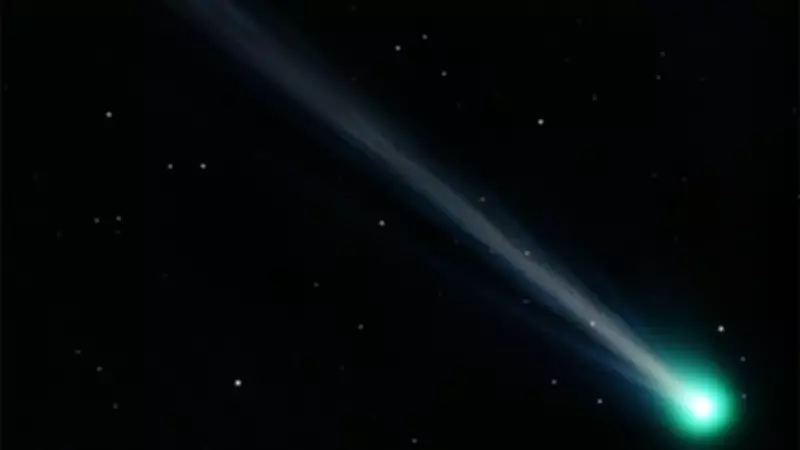
Comet's Tail 'Regrows' Like a Lizard's, Revealing Solar Wind Secrets
For centuries, observing comets in the night sky has captivated astronomers and enthusiasts alike, offering glimpses into the mysteries of our universe. A recent groundbreaking study, published in The First Quantitative Study of Cometary Tail Regrowth following a Coronal Mass Ejection-driven Disconnection Event, has unveiled a fascinating twist in the behavior of Comet C/2023 P1. This comet's tail appears to "regrow" after being disrupted in space, a phenomenon scientists have intriguingly compared to the regenerative abilities of lizards.
Comet C/2023 P1 and Its Tail Regrowth Phenomenon
The discovery made headlines when researchers observed significant structural changes in the comet's tail. Typically, a comet's tail forms through the interaction of gases emitted from its nucleus with solar radiation and solar winds from the Sun. As NASA explains, "The tail of any comet will always point straight out from the direction of the Sun because of the solar wind." However, under certain conditions, such as coronal mass ejections, these solar winds can break apart the tail, creating a visible disconnection.
What happens next is remarkable: despite the break, the continuous emission of gases from the comet's nucleus leads to the formation of a new tail, creating an illusion of regrowth. This process highlights the dynamic nature of comets, which are far from static chunks of ice orbiting the Sun. Instead, they undergo constant transformation under solar influence, emitting dust and gas that reshape their appearance over time.

Why Scientists Compare Comets to Lizards
The comparison to lizards stems from the biological concept of regeneration, where certain species can regrow lost tails. Similarly, comets like C/2023 P1 regenerate their tails after disruption, though the mechanism is purely physical rather than biological. According to the European Space Agency (ESA), "Comets are highly dynamic bodies constantly changing as they move around the Solar System." It's crucial to note that comets do not regrow lost parts in a living sense; instead, they perpetually emit material, forming new tails as old ones dissipate.
This analogy emphasizes how active and responsive comets are to their environment. They are not inert objects but vibrant entities influenced by cosmic forces, with their tails serving as visible indicators of solar activity. The process underscores the intricate dance between comets and solar winds, revealing the complex interplay in our solar system.
Valuable Insights into Space Science
The behavior of Comet C/2023 P1 provides invaluable data for understanding solar winds and cometary structures. Tail disconnection events, as observed in this comet, act as visible tracers of solar wind disturbances, according to NASA's Goddard Space Flight Center. By studying these phenomena, researchers can gain deeper insights into how the Sun influences celestial objects, from comets to other bodies in the Solar System.
This research not only advances scientific knowledge but also has practical implications. It may aid in predicting cometary behavior in the future, enhancing our ability to forecast space weather and its impacts. For the general public, such discoveries spark renewed interest in astronomy, transforming the simple glow of a comet into a story of cosmic interaction and resilience.
From a broader perspective, these findings remind us of the ever-evolving nature of space science. As we uncover more about comets and solar dynamics, we edge closer to unraveling the secrets of our universe, making each observation a step toward greater enlightenment.