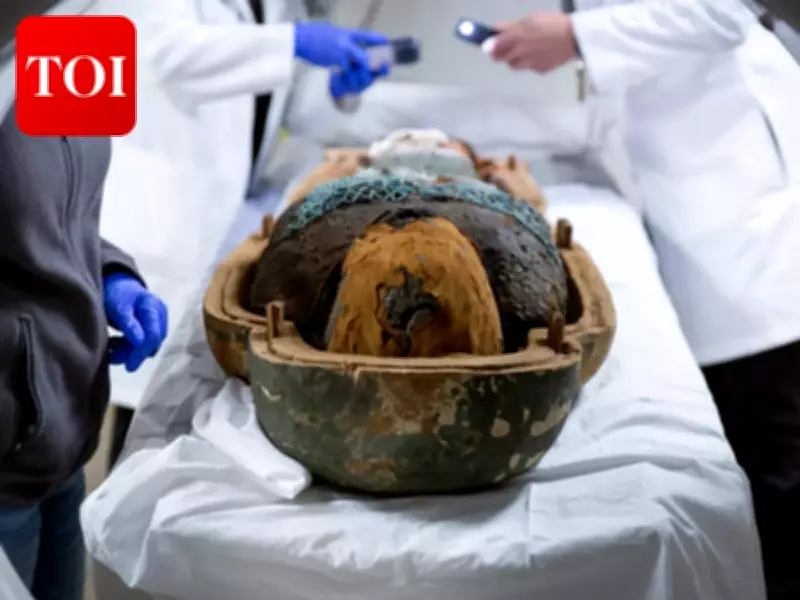
For decades, two ancient Egyptian mummies rested in quiet repose behind museum glass. Then, in a Los Angeles hospital, a high-tech CT scanner looked beneath their linen wrappings and found a medical mystery that has amazed scholars. Scientists at the University of Southern California recently used the scanner to examine two 2,200-year-old Egyptian priests, Nes-Min and Nes-Hor. Inside one of the bodies, they found a condition that may change what scholars think they know about ancient medicine.
25,000 Images Revealed the Mystery
According to a report published by USC, doctors and researchers found a small hole behind a broken vertebra in Nes-Min's lower spine. Researchers said the opening may indicate an attempted medical intervention. Researchers conducted scans of the two bodies in the Keck Hospital of USC on a technologically advanced CT scanner. They captured images of the two priests at half a millimetre resolution, giving them roughly 25,000 images of each mummy.
According to the report, radiologist and medical visualisation specialist Summer Decker instructed the scanner to take as many slices of the body as possible, enabling the researchers to view the remains with great detail. After a 3-D rendering of Nes-Min's lower spine was created, a fracture in the L2 vertebra became visible and likely would have caused severe pain during his lifetime. A tiny hole behind the broken vertebra was also visible and appeared to show possible tool marks and signs of healing. Weeks of additional review and consultations with mummy experts followed.

Could It Be Ancient Spine Surgery?
The scientists are currently unable to definitively confirm their findings, but say the discovery is significant. The opening resembles trepanation, the practice of drilling holes into the skull that was commonly performed in the ancient world to treat injuries or other medical conditions. If the interpretation is correct, it may represent the first known evidence of a spinal surgical intervention in an Egyptian mummy.
"We spent the next few weeks just staring at those images and sending them off to mummy specialists," Decker said in the university report. "No one else has seen anything like that in the spine." If verified, this find could be among the earliest examples of an ancient surgeon attempting to treat a spine injury.
More Than a Medical Case
The scans have given insight into the everyday lives of individuals living over 2,000 years ago. They revealed that priest Nes-Hor, who lived about 190 BCE, suffered from dental issues and also had a severely fractured left hip. Though the bones did not fuse perfectly, it was evident that Nes-Hor continued to walk on it throughout his lifetime.
In addition, new scans have challenged the previously held belief about how Nes-Min died. While earlier exams suspected he may have died from an infection linked to a dental abscess, the new high-resolution scans suggest the dental issues may not have been serious enough to cause death. Amulets were also identified on Nes-Min's head and chest. These objects likely included charms, including amulets that may have been intended to provide protection in the afterlife.
Technology Brings the Past into Focus
The find showcases how technology is revolutionising archaeology. Computed tomography (CT scanning) allows scientists to look inside ancient bodies without needing to unwrap them or risk physical damage. The technique has increasingly been used in museums and archaeological digs worldwide to gain further insight into mummification processes, lifestyles and funerary rituals.
From the data gleaned from the CT scans, the scientists created full-size 3-D printed replicas of damaged bones and amulets recovered from the mummies, which have been displayed as part of 'Mummies of the World: The Exhibition'. It is likely the most revealing lesson these scientists have learned is that ancient humans, beneath their layers of wrappings, suffered the same types of afflictions we do, including back pain and dental issues. In one case, it may indicate an attempt to treat the injury, even over 2,300 years ago.