

Urban development in the modern era is significantly affecting our experience of darkness at night. Artificial lighting in densely populated cities blocks our view of the night sky, obscuring the stars above. For travelers and outdoor enthusiasts, finding places untouched by urban light pollution is essential. These sites offer unique opportunities to observe astronomical phenomena.
According to WorldAtlas, the United States boasts a unique network of protected areas dedicated solely to conserving the nighttime environment. This is achieved through regulated outdoor lighting that preserves natural darkness suitable for observation and leisure. By including these destinations in your travel plans, you can enjoy a clear sky without compromising your view. Geographical factors such as high altitude and distance from urban centers make these parks ideal for observing celestial bodies, offering highly reliable viewing opportunities.
Big Bend National Park
Located along the remote southern border of Texas, Big Bend National Park is characterized by its vast isolation from major commercial infrastructure. This separation from large urban grids results in some of the lowest documented levels of skyglow among national parks in the contiguous United States. Visitors who frequent the desert trails after dusk can regularly observe clear configurations of constellations, passing orbital satellites, and meteor displays without the aid of specialized optical equipment.

Grand Canyon National Park
Beyond its popular geological features visible during the day, the Grand Canyon in Arizona offers a favorable atmosphere for night sky observation after sunset. Its desert climate and high altitude greatly increase visibility due to minimal atmospheric moisture. To support public interest, the park administration regularly coordinates educational astronomy sessions and volunteer-led telescope stations for visiting groups.
Waterton-Glacier International Peace Park
Spanning the mountainous terrain of northern Montana, Glacier National Park forms a continuous dark sky corridor along the Canadian border. The thin, cool air at higher mountain elevations stabilizes the viewing environment, limiting typical blurring effects caused by atmospheric heat. On nights with elevated solar activity, the open horizons over the park's high-altitude lakes frequently allow for observation of the aurora borealis.
Headlands International Dark Sky Park
The Headlands spans more than five hundred acres of protected public woodland along the Lake Michigan coastline, offering a distinct environment influenced by its connection with the water body. The vast open surface of the lake ensures that most of the horizon is untouched by any ground-based lighting fixtures. The viewing facility includes concrete observation platforms and a public center, and can be used to conduct workshops on navigating the night sky.
Cherry Springs State Park
Located on an isolated plateau in northern Pennsylvania, Cherry Springs State Park serves as a critical refuge for dark sky preservation on the eastern seaboard. The surrounding topography is bordered by dense, mature timberlands that act as a physical barrier, blocking stray illumination from nearby rural communities. A specialized geographic study mapping light pollution, published in the journal Science Advances, notes that isolated state parks in heavily forested zones are highly effective at maintaining natural nighttime baselines near major urban centers.
Arches National Park
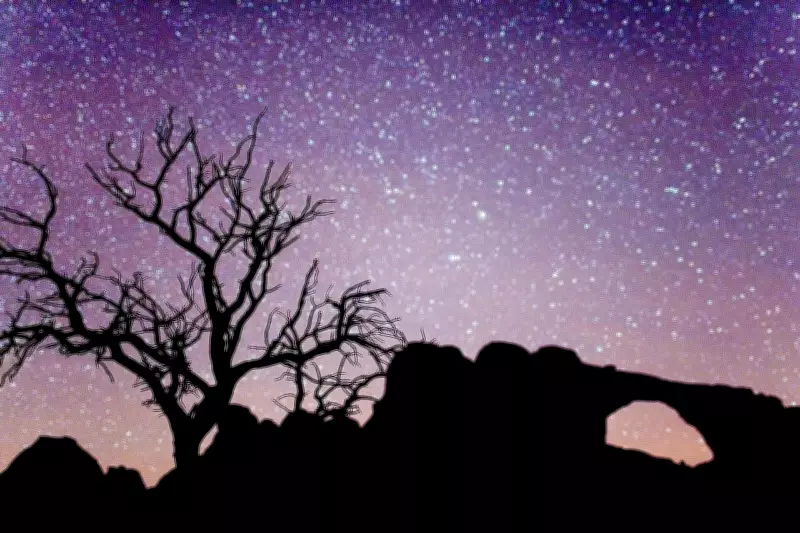
Located in Utah, Arches National Park is famous for its distinct sandstone arches and rock bridges. Due to its unique geographical position, the park provides an unobstructed view of celestial objects. Being situated at high altitudes in a dry climate zone of the Colorado Plateau makes it a perfect location for tracking. The distinctive rock formations contrast sharply against the bright background of the Milky Way, attracting many night photographers during the summer.
Mayland Earth-to-Sky Park
Located within the Blue Ridge Mountains of North Carolina, this site promotes both environmental protection and public education. It features its own observatory, offering visitors the opportunity to observe deep-sky objects such as nebulae, star clusters, and galaxies.

Anza-Borrego Desert State Park
As the largest state park in California, Anza-Borrego Desert is home to one of the largest stretches of untouched desert landscapes within reach of Southern California cities. The high and craggy mountains surrounding the park act as a shield, preventing light pollution from major urban centers such as San Diego from entering the deeper valley regions of the desert. This allows for pristine views of our galaxy's center rising above the eastern horizon.





