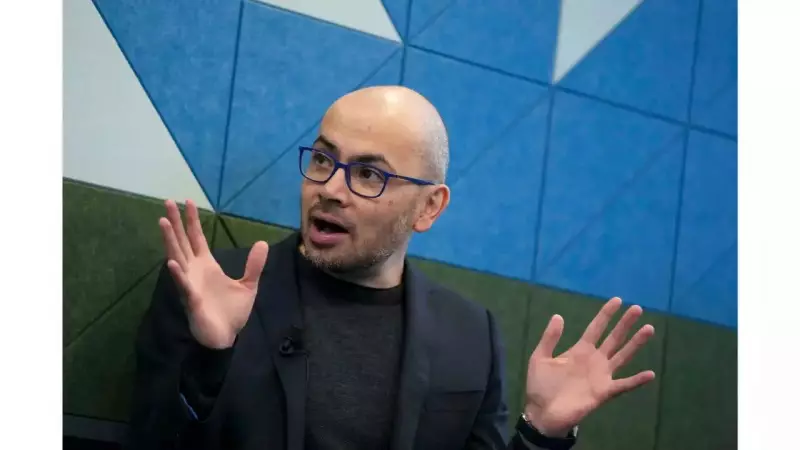
In a significant shift of focus within the artificial intelligence industry, Demis Hassabis, the CEO of Google DeepMind, has articulated a compelling vision for the next frontier of AI. While the tech world remains captivated by Large Language Models (LLMs) like Gemini and GPT, Hassabis is championing the development of sophisticated "world models" and simulations to create AI that truly understands and interacts with the physical realm.
The Limits of Language in a Physical World
Speaking in a recent interview, Hassabis acknowledged the phenomenal success of LLMs. He noted that these models have surpassed expectations in parsing human language, revealing that language itself is a richer repository of world knowledge than previously thought. However, he pinpointed a fundamental gap. The physical world and its mechanics cannot be fully encapsulated by words alone.
"There's still a lot about the spatial dynamics of the world, spatial awareness, and the physical context we're in – and how that works mechanically – that is hard to describe in words," Hassabis explained. He emphasized that sensory experiences like motor control, smell, and the nuanced mechanics of movement are nearly impossible to capture in text data. For AI to advance, it must move beyond reading and start "experiencing" through simulated models.

The Path Forward: Building and Testing Realistic Simulations
Hassabis proposed a concrete test for this deeper, intuitive understanding of physics: the ability to generate realistic simulated worlds. "One way to show how do you test you have that kind of understanding? Well, can you generate realistic worlds? Because if you can generate it, then in a sense, the system must have encapsulated a lot of the mechanics of the world," he stated. This approach underscores his belief that creating AI that can simulate complex environments is key to achieving more general and capable intelligence, crucial for fields like advanced robotics.
Echoes from Robotics: The Daunting Challenge of Touch
Hassabis's views find strong resonance with leading roboticists. Rodney Brooks, the renowned roboticist and co-founder of iRobot, recently highlighted a similar biological barrier for AI in robotics. For robots to succeed on the scale envisioned by leaders like Tesla CEO Elon Musk, they must master human functions, with dexterity and touch being paramount.
Brooks argued that while today's AI excels in speech and image recognition thanks to massive datasets, sensing and interpreting touch cannot be learned through such data. "We do not have such a tradition for touch data. Today's humanoid robots will not learn how to be dexterous despite the hundreds of millions, or perhaps many billions of dollars, being donated by VCs and major tech companies to pay for their training," he wrote in a blog post. This aligns with Hassabis's argument that true physical intelligence requires more than linguistic or visual pattern recognition.
The convergence of views from Hassabis on the AI theory front and Brooks on the practical robotics front signals a pivotal moment. The industry's journey beyond the remarkable but limited realm of LLMs towards AI that can navigate, understand, and manipulate the real, physical world has clearly begun. The development of comprehensive world models may well be the cornerstone of that next evolutionary leap.