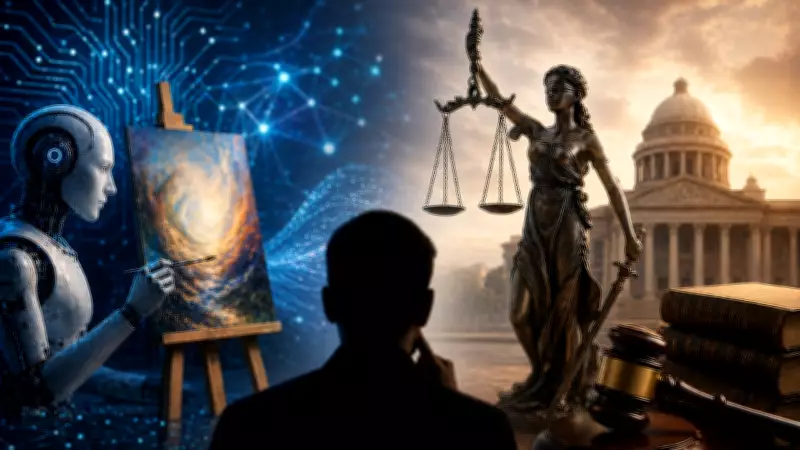
The Delhi High Court has propelled Indian law into uncharted territory by addressing a question that straddles philosophy and jurisprudence: what happens when creativity exists without a human creator? At the heart of this case is an application filed by American AI researcher Stephen Thaler, seeking copyright for an artwork titled 'A Recent Entrance to Paradise,' which was autonomously generated by an AI system known as DABUS (Device for the Autonomous Bootstrapping of Unified Sentience). The court has directed the Copyright Office to decide on the application within eight weeks, a seemingly procedural order that belies its profound implications for intellectual property law in the era of generative AI.
Authorship Under Strain: The Human-Centric Foundation of Copyright
Copyright law, both in India and globally, has historically rested on the premise that authorship is inherently human. Under the Copyright Act, 1957, the definition of 'author' varies by work type, but for computer-generated works, authorship is attributed to the person who causes the work to be created. This framework was designed for a time when computers were mere tools, extensions of human intent. However, generative AI systems, with their complex neural networks and autonomous outputs, challenge this foundation. The human role shifts from creator to facilitator, creating a conceptual dilemma: if AI is a tool, authorship lies with the human operator; if AI is an independent creator, the law offers no recognition. Both positions are incomplete, and the law must adapt to evolving facts rather than force facts into outdated legal molds.
Global Reluctance to Recognize Machine Authorship
Stephen Thaler's legal journey extends beyond India. Similar claims in the United States, United Kingdom, and European Union have been consistently rejected. Courts and intellectual property offices worldwide have reaffirmed that human authorship is a fundamental requirement for copyright protection. Copyright is not merely an economic right but is intrinsically linked to human intellect, creative intention, and moral rights. Machines, however advanced, lack intent, personality, and consciousness. Yet, this consensus is increasingly strained as technology blurs the line between human and machine creativity. The tension between legal doctrine and technological reality is becoming unavoidable.

Generative AI: Innovation, Ownership, and Legal Vacuum
The rise of generative AI tools, capable of producing art, music, literature, and even legal analysis, has transformed the creative landscape. This raises pressing questions for AI copyright law in India: Who owns AI-generated content? Should originality remain tied exclusively to human creativity? Does denying protection discourage innovation or prevent monopolization? Granting copyright could incentivize investment in AI technologies, providing clarity and security for developers and enterprises. However, extending copyright to AI-generated works risks unsettling the philosophical foundation of intellectual property law. If machines are recognized as creators, what becomes of moral rights? Can a machine claim attribution or suffer infringement? The law faces a paradox: granting protection may distort existing principles, while denying it may render the law irrelevant. Where the law remains silent, uncertainty prevails.
Possible Legal Pathways: Continuity and Change
The Delhi High Court's direction ensures that India must confront this issue directly. Several pathways lie ahead: First, the human attribution model, where authorship vests in the human who develops or operates the AI, preserving doctrinal continuity but not fully capturing AI autonomy. Second, the no protection model, placing AI-generated works in the public domain, promoting accessibility but potentially discouraging investment. Third, creating a new legal category distinct from traditional copyright, specifically designed for AI-generated works, requiring legislative intervention but offering a balanced solution. Fourth, recognizing AI as a legal person capable of authorship, a radical step that currently finds little support. Each approach carries implications extending beyond law into economics, ethics, and public policy.

India at a Crossroads: Opportunity to Lead
India, as a rapidly digitizing economy embracing artificial intelligence, has an opportunity to shape the global discourse on AI and intellectual property. A clear and reasoned approach to AI-generated works could provide certainty to creators and developers, encourage innovation and investment, and position India as a leader in emerging technology law. Conversely, ambiguity risks inconsistency, litigation, and uncertainty, hindering progress. The Delhi High Court's intervention ensures the issue will not remain in administrative limbo. Whether the Copyright Office accepts or rejects the application, the reasoning adopted will carry significant weight. In law, reasoning often shapes the future more than the result itself.
Conclusion: When Law Meets Imagination Without a Face
The question at the heart of this case is deceptively simple: who is the author when no human creates the work? Yet, its implications are profound. Intellectual property law has always evolved alongside technology, from the printing press to photography to the internet. Each transformation has required adaptation and reinvention. Artificial intelligence represents the next frontier, challenging legal definitions and philosophical assumptions about creativity, ownership, and identity. It forces the law to confront a reality where imagination may exist without a human face. India now finds itself at the edge of this transformation. The decision in this case may not provide all the answers, but it will undoubtedly shape the direction of the debate. As the law steps into uncharted territory, it must remember that innovation may lead the way, but it is the law that must decide how far it can go. When creativity has no creator, the law must determine whether authorship remains a human privilege or becomes a shared frontier between man and machine.
About the Author: Vivek Narayan Sharma is an Advocate-on-Record at the Supreme Court of India with 26 years in litigation, arbitration, and mediation. A constitutional law expert known for resolving complex and high-stakes disputes, he advises and represents institutions, industry leaders, and HNIs across sectors, while also dedicating time to pro bono legal service.