

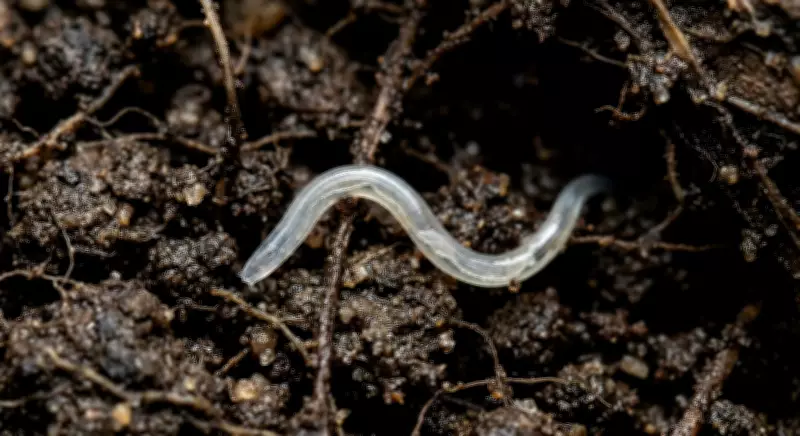
There is a worm living in water-filled cracks in ancient rock in a South African gold mine that has no business being there. It is smaller than a grain of rice, has no eyes, and exists in conditions that most animals, even some of the toughest on Earth, simply could not cope with. Meet Halicephalobus mephisto, or the devil worm, as it is more commonly known. This little worm blew scientists' previous understanding of life on Earth.
A Discovery That No One Saw Coming
In 2011, scientists announced they had found a living nematode worm 1.3 kilometers (0.8 miles) below the Earth's surface, about as deep as four Empire State Buildings stacked on top of each other. The discovery, announced in the study Nematoda from the terrestrial deep subsurface of South Africa, was instantly significant. Not because nematodes were especially glamorous, but because no nematode had ever been found so far underground. Bacteria and microbes were common, but a multicellular animal was thought to be impossible.
The mine itself is not simply a dark hole in the earth. It is a maze of shattered rock and ancient water, sealed off from the surface for perhaps millions of years. No sunlight reaches it. No seasons. No external food chain. Just extreme heat, high pressure, almost no oxygen, and the occasional bacterium floating around in trapped water. From a scientific perspective, it was a big deal that a worm not only made it there but actually thrived.

Built for the Depths, Not Just Surviving
That is what makes the devil worm more than just a bizarre record-holder. It did not just happen to fall into the deep earth and somehow hold on. The evidence points to it having evolved for this environment. A 2019 study of the devil worm's genome, published in Nature Communications, revealed a telling fact. The worm carries amplified versions of genes involved in the heat stress response, molecular tools that help it function in conditions that would fry the biology of most animals.
In simpler words, its DNA has evolved to the subsurface. It is not a surface creature roughing it out; it is a deep-Earth native. The devil worm lives in ancient, oxygen-poor water trapped in rock fractures over a mile underground, surviving conditions once thought impossible for multicellular animals.
A Potential Built-in Thermometer
According to a study in Communications Biology, researchers studied a protein in the devil worm, cytochrome c oxidase, and proposed it may act as a biological thermocouple, essentially a device that allows the worm to sense or respond to temperature in its underground environment. That is not a minor thing. In the deep underground, there is no escaping a heat spike. You cannot move to cooler ground like surface animals can. You must react to temperature shifts immediately at the cellular level. If further study proves this mechanism correct, it would mean the devil worm has a built-in heat sensor tuned to its underground world.
Why It Matters Beyond the Record Books
This story could easily be filed under 'cool science trivia' and left at that, but the deeper implication here is really worth pondering. For a long time, scientists have drawn a rough line between the surface of the Earth, where life flourishes, and everything below, where only the simplest microbes could cling on. The devil worm shifted that line quite a bit.
Earth's living zone is bigger and stranger than we once thought. If a multicellular animal can survive 1.3 kilometers down in a fractured rock system with heat, no oxygen, and bacteria as its only food source, it raises questions about life elsewhere, where similar conditions might be found.
A Little Worm, a Big Idea
The devil worm is small. It is not charismatic like a Greenland shark or a deep-sea octopus, but what it stands for is huge. It is proof that life finds a way, not just in the poetic sense, but in the measurable, peer-reviewed, genome-sequenced sense. Earth has a hidden interior, and that interior is not dead. It is a frontier, shaped by geology and chemistry and time, and it has residents. The devil worm just happens to be the one that answered the door.






