

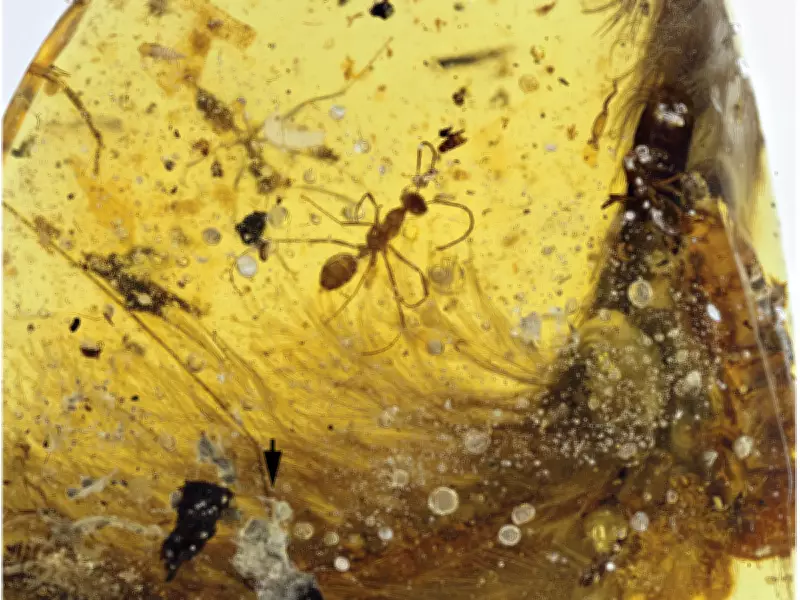
In 2016, researchers described a remarkable piece of fossilised amber containing a partial tail from a feathered dinosaur from the mid-Cretaceous period. Reported in Current Biology, the study was based on a specimen found in Burmese amber from northern Myanmar and has since been cited in studies of feather evolution.
Discovery of a Rare Juvenile Coelurosaur
According to the team of scientists led by Lida Xing et al., the fossilised specimen contains several vertebral bones of a juvenile, non-avian theropod along with 3D preserved feathers. This finding is particularly interesting since it consists of skeletal remains along with soft tissue preserved together, which is not very common. The study describes the fossil as a segment of a flexible tail comprised of many articulated vertebrae that belonged to a group of theropod dinosaurs called coelurosaurs, which are closely related to the lineage that gave rise to birds. The amber contains only a fragment of the animal rather than the entire body, but the articulation of bones enabled experts to identify the nature of its origin.
Three-Dimensional Feather Preservation
According to the study, the feathers were preserved in three-dimensional form surrounding the tail, unlike mere impressions found previously in rock. National Geographic reports that the tail consists of about eight vertebrae, each covered with delicate feathers on both sides. This type of preservation is scientifically unusual because, unlike compression fossil processes where organisms get pressed onto rocks, the amber process involves encapsulation within resin, capturing both soft body tissues and maintaining their 3D structural composition. An article about vertebrates found in amber deposits from Myanmar, available through PubMed, indicates that amber is becoming more frequently recognised for preserving vertebrate remains along with soft body tissues, including feathers.

What the Feathers Revealed About Dinosaurs
The feathers on the dinosaur's tail described in the Current Biology research appear morphologically distinct from those of contemporary flying birds. The feathers are described as being more primitive in nature, with an apparently simpler branching pattern compared to those used for flight. This supports the interpretation that the animal was a non-avian theropod and not capable of flight. However, the study mainly concentrates on describing feather morphology as opposed to deducing behaviour. The ability of researchers to examine the feathers' structure in three dimensions allows them to be compared to those of other species.
Key Reference in Feather Evolution Research
Further scientific literature has used the study of the amber tail as part of research efforts to learn more about the development of feathers. In a peer-reviewed review of Burmese amber fossils, it is found that the specimens offer valuable data on integumentary structures, including feathers that can be studied along with bone fragments. Even modern literature on feather development still refers to the amber tail when describing progress in the field. This type of fossil allows filling gaps in the evolutionary fossil record by preserving details not found in other sediments.
Almost a decade following its discovery, the Burmese amber dinosaur tail continues to be an exceptional case where soft tissue can be clearly preserved on a non-avian dinosaur. Research shows that it is possible to conclusively link feathers to dinosaur fossils in 3D space without having to depend on 2D impressions or isolated feathers. This discovery not only provided new anatomical information but also improved the understanding of feather arrangement in mid-Cretaceous non-avian dinosaurs.






