

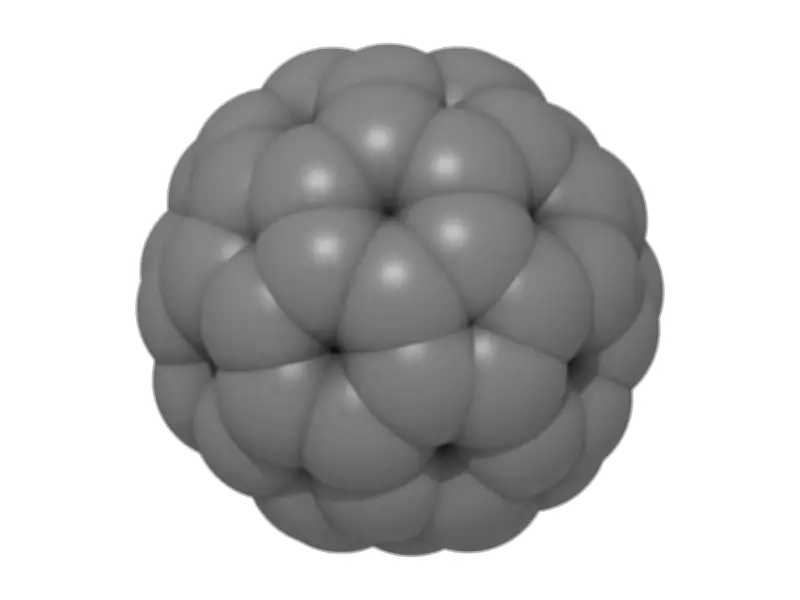
In 1985, a group of chemists blasting graphite using an intense laser came across the carbon cage, which seemed absurdly inconceivable. Instead of soot that is normal, this experiment showed an amazing, mysterious geometrical structure hidden within carbon in its pure form.
Discovering a New Form of Carbon
Discovering buckminsterfullerene transformed an ordinary group of sixty carbon atoms into one of the most beautiful discoveries in modern chemistry. By doing this, it has created an entirely new line of compounds.
A Space Question Led to a Carbon Surprise
The historical experiment was initially intended to explore the outermost regions of the universe, but the ultimate unexpected result was one of a structural nature. In September 1985, scientists attempted to recreate and discover how long complicated carbon chains might be formed in the flammable atmospheres of carbon-rich, distant massive stars. According to the official Nobel Prize documentation, the research team employed the laser-supersonic beam device on its graphite, not iron. The process created an intense plasma composed of carbon atoms under extreme conditions. This allowed the resultant clusters to cool and then be examined with mass spectrometry.

When the scientists refined the instrument, a particular pattern started to appear in the data. One particular cluster stood out with a constant regularity and contained precisely 60 carbon atoms. The results showed that the sixty-atom cluster is unusually strong and durable compared to adjacent chains. Researchers had no intention of creating the latest fashion nanomaterial. They just wanted to test cosmic chemistry with star-like conditions. However, the steadfast stabilisation of carbon strongly suggests that it might wrap itself inside a tightly sealed cage instead of adhering to the familiar structure.
The Geometrical Structure Hidden Within Normal Smoke
The real beauty of this discovery lies in the manner in which the evidence was discovered. It was not discovered through the lens of a microscope, but in the form of a mass peak that recurred on a graph from a laboratory. Researchers had to determine what type of structure could explain the amazing chemical durability. The highly symmetrical closed cage can satisfy the chemical valences in a perfect way. This design resembles a truncated icosahedron, which is a hollow sphere made up of 12 pentagons and 20 hexagons fused. Because this exact geometry mirrored the famous architectural geodesic domes designed by the American inventor Buckminster Fuller, the scientists named the new molecule buckminsterfullerene. This breakthrough in structure transformed what was traditionally thought to be dirty or black residue into an amazing feat of design for molecules. Soot that was normally considered dirty had an exquisite geometrical shape that totally changed the conventional understanding of an element that is fundamental.
A New Type of Carbon Was Discovered
Before this discovery, carbon was already renowned for its flexibility in structure. This was the case with graphite and diamond. Typical examples used by students to illustrate how carbon could arrange its atoms into diverse physical materials. An important paper that was published in the journal Nature has officially revealed buckminsterfullerene as an allotrope distinct from other allotropes of carbon. The evidence for this claim wasn't based solely on theories and speculation. They substantiated their assertions with the proof of chemical inertness that the molecule has by demonstrating that it stubbornly did not react with gases like nitric oxide and oxygen. The team also managed to trap metal atoms within the cages made of hollow material, which proved that the spheres are hollow. It was the result of rigorous experiments that confirmed that it wasn't an unorganised or random component of soot, but rather a well-organised, repeatable class of material. The research extended one of Earth's most commonly used elements to an entirely new dimension of architecture, which ultimately won researchers in 1996 the Nobel Prize in Chemistry.

Infringing on the Chemical Norms of the Past
The assumption is that the most studied, common elements are the only ones with any more secrets to teach us. Carbon is consistently challenging that faith. Fullerenes' validation proved that the simplest natural building blocks can hide completely different structural facts when scientists are able to pose the appropriate questions under the appropriate conditions for experimentation. The impact of buckminsterfullerene goes well beyond the initial 1985 study. Through the demonstration that pure carbon sheets can curve and form hollow shapes, the discovery revolutionised the field of nanoscience. It laid the essential theoretical and physical foundation for the growth of carbon nanotubes, graphene and the modern age of nanotechnology.
The story is memorable because its imagery is clear and captivating. A simple attempt to recreate the harsh, cool chemistry in space ended up producing a tiny, strong, durable soccer ball made of carbon. This is an example of how pure and curious research can seek out answers from the stars and transform the field of materials science on Earth.
About the Author
The TOI Science Desk stands as an inquisitive team of journalists, ceaselessly delving into the realms of discovery to curate a captivating collection of news, features, and articles from the vast and ever-evolving world of science for the readers of The Times of India. Consider us your scientific companion, delivering a daily dose of wonder and enlightenment. Whether it's the intricacies of genetic engineering, the marvels of space exploration, or the latest in artificial intelligence, the TOI Science Desk ensures you stay connected to the pulse of the scientific world. At the TOI Science Desk, we are not just reporters; we are storytellers of scientific narratives. We are committed to demystifying the intricacies of science, making it accessible and engaging for readers of all backgrounds. Join us as we craft knowledge with precision and passion, bringing you on a journey where the mysteries of the universe unfold with every word.





