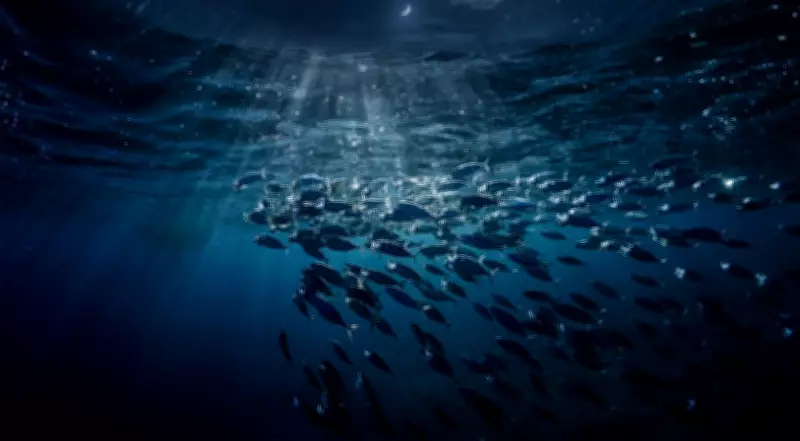
Every night, the ocean performs one of the most astonishing natural spectacles on Earth, yet most people remain unaware of it. Picture the Pacific Ocean at 2 AM. The surface appears calm, but 600 feet below, billions of sea creatures—fish, krill, jellyfish, and more—ascend en masse in the darkness. By dawn, they sink back to the depths, only to repeat the journey the following night. This is not science fiction; it is a real phenomenon called diel vertical migration, one of the largest animal migrations on the planet, occurring daily.
The Sonar Glitch That Changed Marine Science
During World War II, Navy sonar operators detected what seemed like a false seafloor—a mysterious band that rose at night and sank during the day. Initially dismissed as equipment malfunction or unusual underwater geography, it was later identified as a massive, organized layer of marine life. NOAA confirmed that this layer, now known as the deep scattering layer (DSL), reflects sound waves like a living mirror. The false seafloor was not stone but trillions of creatures moving in sync with the sun. This discovery, born from a wartime radar glitch, revolutionized ocean science.
Why Do They Migrate?
The ocean surface is akin to a brightly lit diner: abundant food but teeming with predators. The deep ocean offers safety in darkness but lacks sustenance. These animals have evolved a strategy: feed at night when visibility is low, and retreat before dawn. This daily commute begins in the ocean's twilight zone, depths of 650 to 3,280 feet, where it's dark enough to hide but close enough to the surface for a nightly trip. Light dictates their schedule: as dusk falls, migration begins; at sunrise, they descend.

A Global Phenomenon
This migration is not limited to one region. A study in Scientific Reports found daytime scattering layers in every ocean basin, making it a synchronized global event in waters covering over 70% of Earth. The deep scattering layer comprises an entire community—fish, krill, shrimp, and squid—all making different trade-offs between food and safety but moving together. It resembles a rush hour, ocean-wide and invisible from the surface.
Beyond the Spectacle: Carbon Cycling
This migration plays a critical role in Earth's carbon cycle. As animals feed on surface organic matter and then sink, they transport carbon into the deep ocean. A 2023 review in iScience highlights this as part of the ocean's biological carbon pump, which naturally extracts carbon from the surface and stores it in the deep sea. These creatures are not just feeding; they are quietly regulating the planet's climate every night.
Ongoing Research and Mysteries
Despite advances, the deep scattering layer remains poorly understood. Its depth and darkness make direct observation difficult. Scientists rely on acoustic tools like high-tech sonar to map its location, density, and movement over time. NOAA's twilight zone expeditions continue to reveal new insights about the animals and their roles in ocean systems. This serves as a reminder that the ocean, covering most of our planet, still holds many mysteries. Next time you gaze at the sea, consider that beneath the calm surface, the world's largest commute is either beginning or ending—a nightly ritual that has occurred long before humans existed.