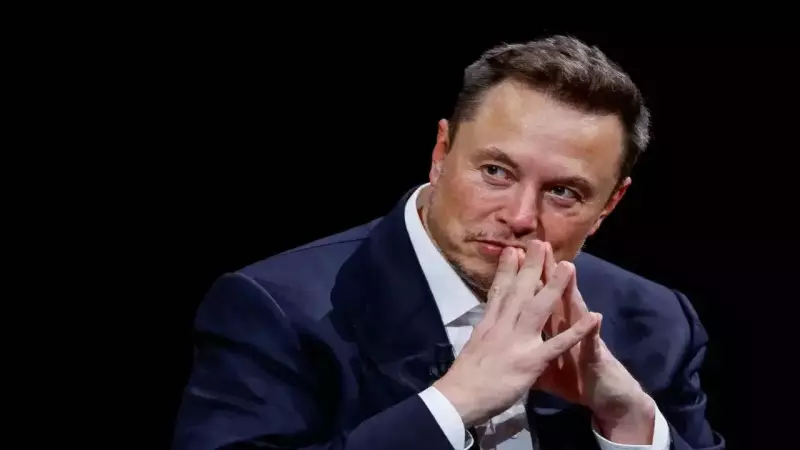
Tesla CEO Elon Musk has publicly challenged the recent observations made by the company's former artificial intelligence chief, Andrej Karpathy, regarding a comparison between Tesla's Full Self-Driving (FSD) system and Alphabet's Waymo. Musk asserted that Karpathy's understanding is now outdated and that Tesla's software has made monumental leaps forward.
The Spark: Karpathy's Comparison on X
The controversy ignited when an X user, Yunchen Jin, shared insights from a conversation with Andrej Karpathy. Karpathy, who left Tesla in 2022, had praised both Tesla and Waymo's autonomous technologies. He reportedly stated that both now offer a drive that feels intuitively "perfect"—smooth and confident. However, he reiterated his past analogy that "Waymo has a hardware problem, while Tesla has a software problem."
Jin elaborated on this point in a detailed post, contrasting the two approaches. He described Waymo's system as "modular," relying on a combination of HD maps, LiDAR, multiple sensors, 5G connectivity, and several neural networks. While effective, this approach can fail if a single component, like a map or a connection, is disrupted. Jin cited a San Francisco power outage that reportedly froze Waymo vehicles because traffic light failures made their HD maps obsolete and they lost remote operator links.

In contrast, Jin explained Tesla's FSD as an "end-to-end" system powered by one massive neural network that processes camera pixels directly into driving actions. This approach, aligned with Karpathy's own "Software 2.0" philosophy, learns from billions of miles of human driving data. Jin concluded that Waymo's method is a scaling trap and that Tesla FSD wins in the long term.
Musk's Forceful Rebuttal
Elon Musk did not take kindly to the suggestion that the two systems were comparable in their current state of perfection. He directly replied to the post on X, dismissing Karpathy's perspective.
"Andrej's understanding is dated at this point," Musk wrote. He made a bold claim about Tesla's progress, stating, "Tesla AI software has advanced vastly beyond what it was when he left. The intelligence density per GB of Tesla AI is at least an order of magnitude better than anything else out there." This strong rebuttal underscores the rapid pace of development Musk claims for Tesla's autonomous technology since Karpathy's departure.
The State of Play: Tesla and Waymo's Progress
The debate unfolds against the backdrop of significant advancements from both companies. Tesla recently rolled out its FSD v12.4, with users reporting notably smoother navigation and enhanced safety features. The electric vehicle giant is also actively working towards driverless testing of its planned Robotaxi fleet.
On the other side, Waymo remains a dominant force in the US robotaxi market. The company reported completing a substantial 1.4 million paid rides in 2025. With backing from Google-parent Alphabet, Waymo is planning an expansion into Europe. Meanwhile, Baidu-backed Apollo Go has also announced plans to enter the UK market through partnerships with Uber and Lyft, indicating a fiercely competitive global landscape for autonomous ride-hailing services.
This public exchange highlights the fundamental philosophical and technical divide in the race for full autonomy: Tesla's vision of a scalable, camera-first, AI-driven system versus the more sensor-heavy, meticulously mapped approach championed by Waymo and others. With Musk's latest comments, the stakes and the claims have been raised even higher.