

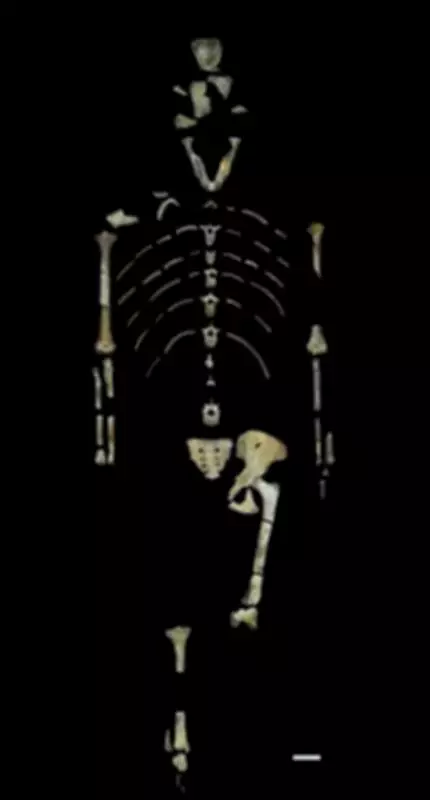
A typical day in the dry savanna of East Africa ended up changing what scientists knew about early human evolution. While mapping fossils across an arid area of northern Ethiopia, a team of scientists realized that what they were looking at was not just of geological significance but of immense importance for our evolutionary history.
A Small Fragment with Big Implications
As investigators scanned the sun-baked ground, a small fossil fragment caught the eye of paleoanthropologist Donald Johanson. This little piece of bone became an important indicator for the researchers. Unlike a single tooth or jaw fragment, the site eventually provided a partial skeleton that permitted scientists to examine the real body structure of an early relative of humans. The individual was roughly 3.2 million years old, and she lived and died near the basin of an ancient lake, covered with layers of wet sediments. Rapid burial preserved the bones from damage by animals or weather, ensuring their preservation until erosion exposed them.
Finding a Critical Link in the Chain of Evolution
The findings of this specimen quickly changed scientific opinion about the timeline of human evolution, as it gave direct physical proof of early upright walking. According to a team of scientists in the paper Limb Bone Structural Proportions and Locomotor Behavior in A.L. 288-1, the fossil specimen dates to nearly 3.2 million years old. Before this discovery, there were many debates in anthropology about whether early human relatives started walking upright before or after they developed bigger brains. However, the anatomical remains found at Hadar provided insight into this long-standing issue. According to Lucy's Story presented by the Arizona State University Institute of Human Origins, her pelvis and leg bones revealed that she had an upright bipedal posture despite her relatively small brain, similar in size to that of a chimpanzee. The find highlights Africa as the birthplace of human evolution.

A Single Field Moment That Clarified Locomotion
The fact that a significant portion of her anatomy is available presents a much clearer picture of how individuals belonging to the species Australopithecus afarensis would move around. The availability of both upper and lower limb bone structures enables scientists to see how this individual would walk across open areas without giving up her ability to climb trees.
In today’s world, the significance of the Hadar discovery is crucial when considering that science often reveals itself through one key observational moment in the field. The evidence obtained during the Hadar discovery in 1974 illustrates that being bipedal was a very early adaptation for our lineage and was achieved before our ancestors developed advanced tools. Human evolution involved slow and practical adaptations within Africa.
However, even as present-day travelers head to East Africa to marvel at its geographic marvels, the proof of how we evolved millions of years ago was lying quietly beneath several inches of desert sand.






