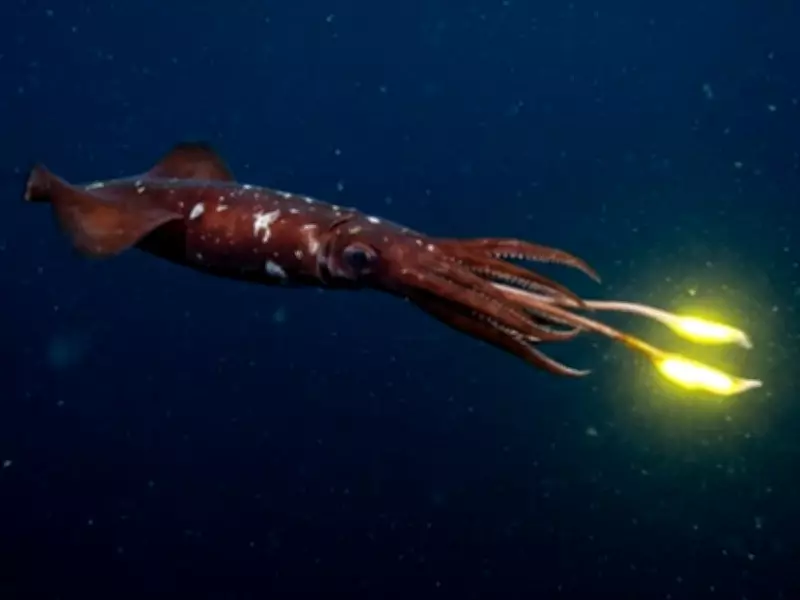
The ocean constantly reminds us of how little we truly know about life beneath its surface. For centuries, the giant squid was an object of legend, but it is also a real sea creature that seldom reveals itself to human eyes. A new and exciting discovery made in the deep canyons of Western Australia is changing that mythology. Researchers have confirmed the existence of this mysterious giant in the East Indian Ocean, marking an important milestone in marine biology and our understanding of the depths.
Breakthrough Study Using Environmental DNA
The revelation is based on a study published in 2026 in the scientific journal Environmental DNA, which used cutting-edge technology to explore the depths of the Cape Range and Cloates Canyons. These canyons are located near the famed Ningaloo coastline and delve into deep abyssal depths, making the area virtually impossible to survey using traditional methods. By analyzing water samples for genetic fingerprints, scientists have opened the door to an underappreciated world where the giant squid reigns supreme.
The Magic of Environmental DNA
How can you find an animal that does not want to be discovered? For a long time, researchers relied on luck, deep-sea cameras, or the odd chance that a specimen washed ashore. In this case, the group headed by Dr. Georgia Nester turned to an approach known as eDNA metabarcoding. This method allows scientists to detect animals by the DNA traces they leave behind in the water, such as skin cells or other organic matter.

This study, the largest survey of its kind in the area, required the collection of 178 water samples at various depths, ranging down to 4,540 meters. According to a report by WAtoday, the research found evidence of 226 species spread across more than 126 family groups. Although the giant squid dominated the spotlight, it was only one of the inhabitants of an incredibly bustling and alien-like environment.
Dr. Nester noted that the possibility of detecting thousands of species within a single water sample could be an important step for conservation. The canyons are mostly unexplored due to extreme darkness and pressure at these depths, which makes physical exploration extremely challenging. The eDNA results suggest there is an abundance of life forms in the trenches, which we are only starting to discover.
A Rare Glimpse into a Hidden World
The giant squid is a truly amazing piece of the natural world. Based on data from the Smithsonian Ocean, the largest giant squid ever recorded measured 43 feet in length. These creatures are designed to exist in darkness, with eyes as big as basketballs that can capture the faintest glimpses of bioluminescence. Although they are believed to inhabit oceans across the globe, they are notoriously difficult to locate in tropical areas.
In the past, it had been over 25 years since an official sighting or specimen of a giant squid was found in Western Australia. Dr. Lisa Kirkendale from the WA Museum highlighted the significance of the discovery, stating that it is the most northern known record of the species found in the eastern Indian Ocean. This confirms that the deep canyons function as a major route for many of the world's most mysterious creatures.
The research did not only find squid. Researchers also discovered the cusk-eel with no face for the first time in Western Australian waters, alongside deep-diving mammals such as the pygmy sperm whale and Cuvier's beaked whale. Some of the species found do not exactly match known records, suggesting that many deep-sea inhabitants could be unknown to science.
Why This Discovery Matters for Our Future
The discovery of a giant squid is more than just adding a place to a list of scarce species. It is a sign of the vitality and diversity of the oceans. Deep-sea canyons are refuges for biodiversity, shielding species from the immediate impact of human activities. However, they are not immune to global climate change. By mapping these species now, scientists will be better able to understand how to safeguard these delicate habitats.

The use of eDNA offers a non-invasive method to observe these hotspots of biodiversity. Instead of disrupting the ecosystem with heavy equipment, scientists can play detectives and piece together the history of the ocean using the DNA left behind. As we explore this region off the Ningaloo coast and beyond, it is clear that the deep sea has plenty to offer. The giant squid symbolizes the deep ocean's mystery, which never ceases to amaze us, gliding through the dark canyons off the Australian coast, waiting for its story to be fully told.