

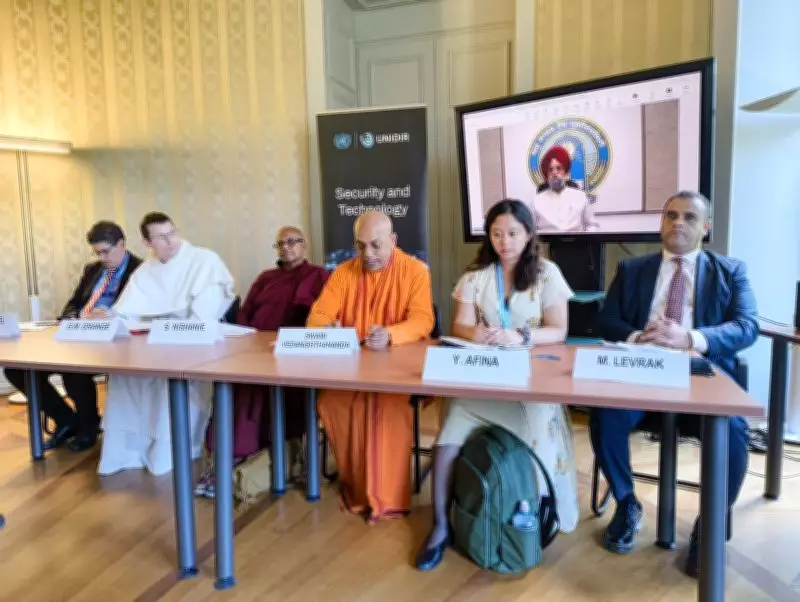
Guru Nanak Dev University (GNDU) Vice-Chancellor Karamjeet Singh recently participated as a speaker in the United Nations Institute for Disarmament Research (UNIDIR) Inter-Faith Dialogue on Artificial Intelligence, Security and Ethics, held at the United Nations Office in Geneva, Switzerland. At the inter-faith dialogue, he presented the Sikh perspective on one of humanity's most consequential technological challenges.
Dialogue Participants and Structure
The dialogue, organised by UNIDIR ahead of its Global Conference on AI, Security and Ethics, brought together representatives of major world faith traditions, reflecting Abrahamic and Eastern faiths. Participants included Swami Vedanishthananda, spiritual head and director of the Centre Védantique Genève (Vedanta tradition); Sakyadeeta Nishanie, Buddhist nun and meditation teacher (Buddhist tradition); Karamjeet Singh, Vice-Chancellor, Guru Nanak Dev University, Amritsar (Sikh tradition); Father Ghislain-Marie Grange, professor of theology and philosophy, Institute Saint-Thomas d'Aquin, Toulouse (Christian tradition); Leon Saltiel, director of diplomacy, UN Geneva and UNESCO, World Jewish Congress (Jewish tradition); and Mohamed Levrak, president, Interreligious Platform of Geneva and deputy director, Islamic Cultural Foundation of Geneva (Islamic tradition). The session was opened by Dr Robin Geiss, director of UNIDIR, and Archbishop Ettore Balestrero, Apostolic Nuncio and Permanent Observer of the Holy See to the United Nations Office in Geneva. The dialogue was moderated by Dr Yasmin Afina, artificial intelligence (AI) researcher at UNIDIR.
Sikh Principles for AI Governance
Addressing the gathering, Singh began with the Sikh greeting, 'Waheguru Ji Ka Khalsa, Waheguru Ji Ki Fateh', and conveyed greetings from Amritsar, the spiritual centre of Sikhism. He said Sikh daily prayers conclude with the aspiration of 'Sarbat da Bhala' — the welfare of all — a principle he said should guide the development and governance of AI. Drawing from the historic 'Zafarnama' written by Guru Gobind Singh in 1705, Singh said ethical leadership required conscience, accountability, and moral courage. He described the 'Zafarnama' not merely as a protest against injustice, but as a timeless framework for responsible leadership.

Presenting the Sikh perspective on AI governance, he outlined five guiding principles:
- Nirbhau, Nirvair — AI must not be shaped by fear or enmity.
- Kirat Karo — innovation must be grounded in honesty and responsibility.
- Vand Chhako — the benefits of AI must be shared equitably and not concentrated among the powerful.
- Sewa — technology must serve humanity, dignity, peace, and the common good.
- Sangat and Pangat — AI governance must be inclusive and participatory rather than controlled by a select few.
Priorities for Global AI Governance
Singh proposed three priorities for global AI governance in security contexts: maintaining meaningful and accountable human control over AI systems in warfare and security; evaluating high-risk AI systems based on their impact on human dignity and civilian safety; and building inclusive global governance frameworks in which those most affected by technology help shape the rules governing it. He said, 'AI is the newly born child of humanity. Raised in fear, it becomes a danger; guided by truth, compassion and accountability, it can become a partner for peace.'






