

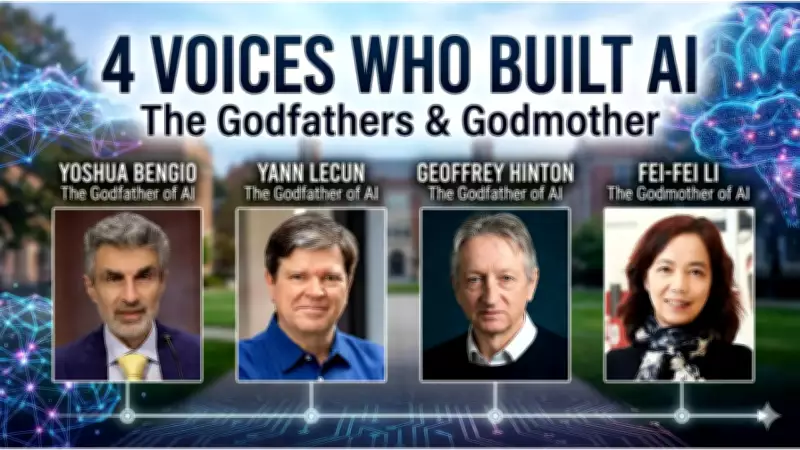
The Godfathers and Godmother of AI: The Pioneers Who Built the Future
While many trace the story of artificial intelligence to recent phenomena like ChatGPT, smartphones, or science fiction, its true origins lie much earlier. The narrative begins in quiet university offices, underfunded laboratories, and research departments that the world had largely dismissed as dead ends. Four individuals, more than almost anyone else, are responsible for the AI systems that now power search engines, medical diagnostics, language tools, and image recognition. Three are known as the Godfathers of AI, and one is called its Godmother. Together, Geoffrey Hinton, Yann LeCun, Yoshua Bengio, and Fei-Fei Li constructed the intellectual foundations of a technology that has fundamentally transformed how the world operates.
What makes their stories compelling is not merely their discoveries, but their unwavering belief in ideas that most people around them did not take seriously. Through decades often described as the "AI winters," when funding evaporated and researchers abandoned the field for more practical pursuits, this group persisted. They published papers that few read, trained students in techniques the broader community considered outdated, and posed questions that their peers deemed too abstract or ambitious.
The Technology They Helped Create
The technology they helped develop, broadly termed deep learning, is built on artificial neural networks. These computational systems are loosely inspired by how biological brains process information. Instead of being programmed with explicit rules, these networks learn from data. They adjust themselves through exposure to examples, improving via a process called training. In the 1980s and 1990s, this concept was regarded as a fringe pursuit. By the 2010s, it had become the dominant approach in AI research, and by the 2020s, it had integrated into everyday life.

In 2018, Hinton, LeCun, and Bengio shared the Turing Award, often called the Nobel Prize of computing, for their decades of foundational work. Meanwhile, Li had already altered the course of computer vision years earlier with a single dataset that provided machines with something they had never truly possessed: a method to learn what the world looks like.
These are not figures who emerged suddenly during a moment of hype. They are individuals who built something slowly, carefully, and often against the current. Their individual journeys narrate four distinct versions of the same story: ideas that others dismiss frequently turn out to be the most significant.
Geoffrey Hinton: The Man Who Would Not Give Up on Neural Networks
Geoffrey Everest Hinton was born in Britain in 1947 and spent much of his early career attempting to convince a skeptical scientific community that brains, and machines mimicking them, held the key to artificial intelligence. He earned his PhD from the University of Edinburgh and later from Cambridge, eventually settling at Carnegie Mellon and then the University of Toronto, where he conducted some of his most influential work.
Hinton's core belief was that machines could learn to represent the world through layered, interconnected nodes, similar to how neurons in the brain form connections. In 1986, he co-authored a seminal paper with David Rumelhart and Ronald Williams that demonstrated how backpropagation could train multilayer neural networks. This algorithm worked by sending error signals backward through a network, enabling it to adjust and improve. Although it attracted little attention at publication, this paper became one of the most cited works in computer science history.
Through the 1980s and 1990s, Hinton continued developing ideas that the mainstream field largely set aside in favor of other approaches. He worked on Boltzmann machines, a type of probabilistic network, and later on deep belief networks, which helped resolve persistent issues in training deep systems. In 2012, a student of his, Alex Krizhevsky, built a neural network called AlexNet that won the ImageNet image recognition competition by a margin so large it shocked the research community, marking a turning point for AI.

In 2024, Hinton received the Nobel Prize in Physics, shared with John Hopfield, for work that laid the theoretical groundwork for machine learning with artificial neural networks. However, by then, Hinton had already made headlines differently. In 2023, he resigned from Google and began speaking openly about risks he believed were growing alongside AI's capabilities. He estimated a 10-20% probability that advanced AI could pose serious threats to humanity within coming decades. For a man who dedicated his life to building the technology, this warning carried substantial weight. His shift toward caution was not a rejection of his life's work but an acknowledgment that the systems he helped create had evolved faster and more capably than anticipated, and the world was unprepared to govern them.
Yann LeCun: The Architect of Machine Vision
Yann LeCun was born in France in 1960 and entered deep learning from a background in mathematics and engineering. After completing his PhD at the Université Pierre et Marie Curie in 1987, he joined Bell Labs in New Jersey, where he tackled one of the most practically important problems in AI: teaching machines to recognize handwritten text.
The outcome of that effort was an architecture named LeNet, a convolutional neural network designed to identify handwritten digits. The key insight behind convolutional neural networks, or CNNs, was that images contain local patterns, edges, textures, and shapes, and a network should search for these patterns wherever they appear rather than treating each pixel in isolation. This made the networks far more efficient and effective at understanding visual information. By the late 1990s, LeNet was being utilized by banks and postal services to read handwritten numbers on checks and envelopes.
The significance of this work only became apparent much later. CNNs now form the architecture behind most computer vision systems in use today, from facial recognition to medical imaging to smartphone cameras. LeCun had established the foundation before most of the industry realized it was necessary.
He later became a professor at New York University and, in 2013, assumed the role of Chief AI Scientist at Meta, where he continues while maintaining his academic work. More recently, LeCun has argued that current large language models, despite their impressive output, do not represent a path to true machine intelligence. He has proposed alternative architectures and ideas around what he terms world models, systems that learn a structured internal understanding of how the world functions rather than predicting text statistically.
LeCun shared the 2018 Turing Award with Hinton and Bengio. He has been elected to the National Academy of Engineering and received the Legion of Honor from the French government. While Hinton has become a cautionary voice, LeCun has positioned himself as someone who believes the risks of current AI are manageable and that the field must solve more challenging problems before worrying about existential threats.
Yoshua Bengio: The Theorist Who Became a Conscience
Yoshua Bengio pursued his PhD at McGill University in the early 1990s, a period when neural networks were deeply out of fashion. Most of the research community had shifted toward other methods, but Bengio remained committed to neural networks.
His early work focused on a problem that made deep networks difficult to train: the vanishing gradient problem. During backpropagation, error signals weakened as they traveled backward through many layers, making it hard for deep networks to learn from distant patterns. Bengio worked on understanding why this occurred and how to address it. His research on recurrent neural networks and sequence modeling, networks designed to handle data that unfolds over time, such as language or speech, helped lay the groundwork for natural language processing.
One of his most cited contributions came in 2003, when he and his colleagues published a paper on neural probabilistic language models. This paper introduced the concept of word embeddings, a method of representing words as vectors in a mathematical space where similar words are placed close together. This idea became central to how machines process language and directly influenced the development of the large language models that power AI assistants today.
Bengio founded the Montreal Institute for Learning Algorithms, which has grown into one of the world's leading AI research institutes. He shared the 2018 Turing Award and, in 2022, received the Princess of Asturias Award for Technical and Scientific Research.
In recent years, Bengio has emerged as one of the most prominent voices advocating for caution in AI development. He helped draft the Montreal Declaration for Responsible AI in 2018, which outlined principles for developing AI in ways that respect human rights and well-being. He has argued that AI developers bear responsibilities beyond technical performance, that the systems they build will impact every part of society, and that safety research must be treated as seriously as capability research. His stance has sometimes placed him at odds with the pace of commercial deployment, but he continues to speak plainly about the risks he perceives.
Fei-Fei Li: The Scientist Who Gave AI Its Eyes
Fei-Fei Li was born in Beijing in 1976 and moved to the United States with her family at age 16. The family settled in New Jersey, living in a single-bedroom apartment while her parents worked to rebuild their lives, with her father as a camera repairman and her mother as a supermarket cashier. Li worked part-time through school, attended Parsippany High School, and earned a scholarship to Princeton University, where she completed a degree in physics in 1999. She pursued doctoral work at the California Institute of Technology, graduating in 2005 with a PhD in electrical engineering.
During her doctoral studies, Li worked on a method called one-shot learning, which enables AI systems to recognize new categories from very few examples. However, her most transformative contribution came later, through a project she began contemplating in 2006 while teaching at the University of Illinois at Urbana-Champaign.
Li observed that AI systems trained on small image datasets performed poorly because they had seen too little of the world's visual variety. She realized the internet contained an abundance of images that had never been systematically organized for machine learning. In 2007, after joining Princeton's computer science faculty, she commenced building ImageNet, a database of annotated images sorted into categories reflecting how humans actually describe and organize what they see.
By 2009, the team had assembled and annotated 3.2 million images. They published their findings and, the following year, launched an annual competition inviting researchers to train algorithms on the ImageNet dataset. The competition, called the ImageNet Large Scale Visual Recognition Challenge, tracked how accurately different systems could classify images. Error rates consistently declined. When AlexNet won the 2012 edition by a large margin, using deep convolutional neural networks trained on ImageNet data, it confirmed Li's suspicion: large, well-organized datasets were as crucial as the algorithms themselves.
Li joined Stanford University in 2009 and became director of its AI laboratory in 2013. She later served as vice president at Google and chief scientist for Google Cloud's AI and machine learning division before returning to Stanford in 2019 as co-director of the Stanford Institute for Human-Centered Artificial Intelligence.
Li has been vocal about the need for diversity in AI research and development. In 2017, she co-founded AI4ALL, a nonprofit offering AI education to high school students from underrepresented backgrounds. She has argued that who builds AI shapes what it does and who it serves, and the field cannot afford to draw from a narrow pool of people. In 2023, she published a memoir, "The Worlds I See: Curiosity, Exploration, and Discovery at the Dawn of AI," reflecting on her journey and views on the field's direction.
Her title, the Godmother of AI, emerged not from self-promotion but from recognition by others of what ImageNet enabled. Without a means for machines to see the world at scale, much of modern AI would have taken longer to arrive or might have developed differently. Li built that foundation, thereby shaping the technology that now observes us from every camera and screen.





