Google Cloud Ushers in the 'Agentic Era' with Major AI Hardware and Software Launch
At its highly anticipated annual Cloud Next '26 conference, Google Cloud has made a groundbreaking official declaration: the beginning of the "Agentic Era." The company unveiled an extensive and powerful suite of new hardware and software innovations specifically engineered to fundamentally transform traditional businesses into what it terms "Agentic Enterprises." This strategic move represents a significant leap forward in artificial intelligence application within the corporate world.
CEO Sundar Pichai Highlights Momentum and Innovation
Google CEO Sundar Pichai publicly congratulated the dedicated Cloud team for their year-long work on these innovations. In a post on the social media platform X, formerly known as Twitter, Pichai shared impressive metrics and details. He stated, "Google Cloud has incredible momentum: our models now process 16B+ tokens per minute via direct API use by our customers, which is a notable increase from 10B last quarter."
Pichai further elaborated on the conference announcements, writing, "This week at Cloud Next we're sharing an extraordinary range of new partnerships and innovations, including our new Gemini Enterprise Agent Platform, the new mission control to build, scale, govern, and optimize agents. We're also launching our 8th-gen TPUs to take on the most demanding agentic workloads." He concluded by thanking the partners collaborating on this future-forward vision.

Custom Silicon: The TPU 8-Series Powering the Revolution
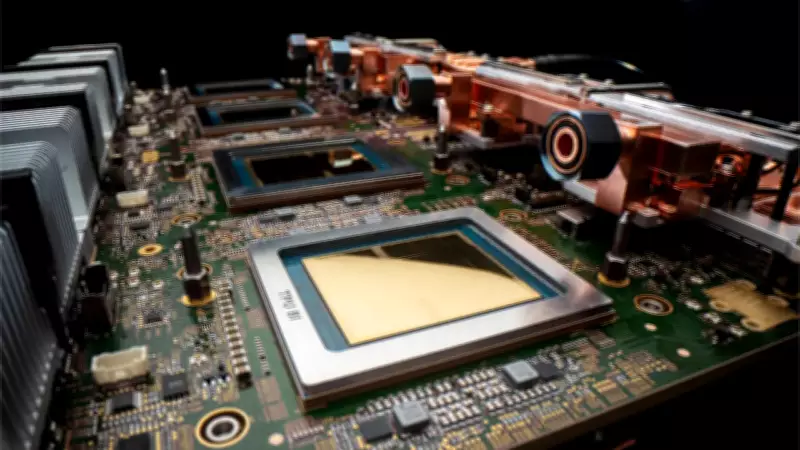
The core of this proclaimed "Agentic AI revolution" is Google's newly introduced AI Hypercomputer infrastructure. To meet the immense computational demands required by autonomous AI agents, Google has developed two specialized eighth-generation Tensor Processing Unit (TPU) chips.
- TPU 8t (Training): This chip is meticulously designed for high-speed model building and training. It boasts remarkable scalability, capable of being configured into a single superpod containing up to 9,600 individual TPUs. Performance-wise, it delivers three times the processing power of its predecessor and achieves twice the performance per watt, enhancing efficiency.
- TPU 8i (Inference): Optimized for running AI agents in real-time scenarios, the TPU 8i offers an impressive 80% better performance per dollar. It is engineered with a focus on "near-zero latency," a critical feature ensuring that autonomous AI agents can react to inputs and execute complex tasks almost instantaneously.
In a move to provide maximum flexibility, Google also announced it will be among the first cloud providers to offer Nvidia's advanced Vera Rubin NVL72 systems. This allows customers to select the optimal hardware architecture tailored to their specific AI workload requirements.
The Gemini Enterprise Agent Platform: A One-Stop Shop
Beyond the cutting-edge hardware, Google Cloud launched the comprehensive Gemini Enterprise Agent Platform. This platform is positioned as a "one-stop shop" for technical and development teams to efficiently build, deploy, scale, and govern sophisticated AI agents.
Key components of the platform include:
- Agent Studio: A user-friendly environment designed for low-code development, enabling a broader range of professionals to create and customize AI agents without extensive programming expertise.
- Agent-to-Agent Orchestration: A sophisticated system that allows different, specialized AI agents to seamlessly communicate, delegate tasks, and collaborate with one another to complete complex, multi-step business processes.
Data and Security for the Autonomous Future
Google emphasized that the Agentic Era necessitates a fundamental shift in how companies handle data and cybersecurity. The new Agentic Data Cloud represents this shift, moving away from traditional, reactive data archives. Instead, it creates "systems of action" that empower AI agents to intelligently reason across a company's entire, integrated data estate in real-time, driving proactive decision-making.

To safeguard these powerful and autonomous systems, Google introduced Agentic Defense. This is a next-generation cybersecurity platform that integrates Google's vast threat intelligence with the robust security capabilities of Wiz's platform. Its primary function is to proactively detect anomalies such as "reasoning drift" or any other suspicious behavior exhibited by AI agents, allowing for intervention before any potential negative impact on business operations occurs.
The vision presented by Google Cloud is clear: a future where AI transcends simple question-answering to become an active, autonomous participant in managing and optimizing complex business workflows, heralding the true dawn of the Agentic Enterprise.