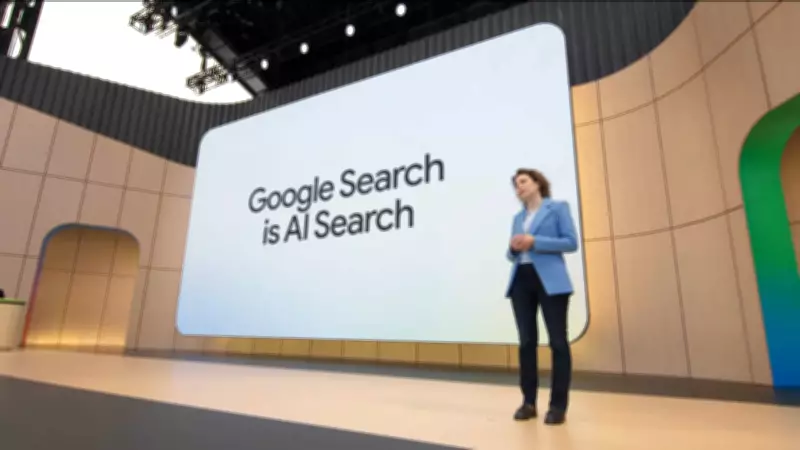
Type something into Google today and a Gemini-powered summary sits at the top of the page. Ask a follow-up and you slide into a chatbot. Ask something complex and the results aren't results at all. They're a custom page Google has coded for you on the spot, with widgets, animations, a calculator if the question called for one. Links sit below, somewhere. They are no longer the point.
This is what Liz Reid, who runs Search, announced at Google I/O 2026 last Tuesday in Mountain View. First real overhaul of the search box in over 25 years. It expands as you type. It accepts photos, files, video, open Chrome tabs. It runs on Gemini 3.5 Flash. And it does not want your keywords. It wants your full question—the longer and vaguer and more conversational the better.
The box is the boring part. What's underneath is the rewrite.

Information Agents and Generative UI
Information agents, rolling out this summer for the subscribers of Google's AI plans, will monitor the web around the clock for you. Tell one to flag apartment listings under a fixed budget in a specific neighbourhood and it watches, indefinitely, pinging you when something fits. Tell another to track sneaker drops from a particular athlete. Same thing. Generative UI, free to everyone this summer, builds interactive interfaces around your question on the fly. Subscribers also get to spin up "mini-apps" inside Search in plain language. A fitness tracker that pulls in your calendar and the weather. A wedding planner. A moving checklist. All of it coded on demand by Google Antigravity, the company's agentic development platform.
Robby Stein, Google's VP of product for Search, called this Search building entire experiences for a single question. Reid said it more plainly from the keynote stage. Google Search is AI Search.
How Search Got Here
Two years ago Search still mostly meant a list of links. AI Overviews changed that in May 2024. Short AI summaries parked above the traditional results whenever Google decided a query was complex enough to need one. They were rough at launch. One Overview told a user to put glue on pizza. Another insisted it was still 2024 when it was not. Google patched the worst of it and kept shipping.
I/O 2025 brought AI Mode, a tab with a chatbot interface. You'd ask a long question, Search would fan out across the web in parallel sub-queries, and an answer came back synthesised with citations. Twelve months on, AI Mode is over a billion monthly users. AI Overviews is at 2.5 billion. Reid said AI Mode queries have more than doubled every quarter since launch. ChatGPT, for context, was at roughly 900 million weekly users earlier this year.
The 2026 update glues those layers together. Ask a follow-up under an Overview and you flow into AI Mode without choosing it. The blue links still exist behind a "Web" tab—a setting you now have to remember to want. The default has flipped.
Asked by Wired after the keynote how she defines Search now, Reid paused, then fell back on the old mission line. Organise information. Make it useful. Same goal, new tools. It is the answer she has been giving in every interview for two years.
The Pie Isn't Fixed, Google Says
Pichai's line, repeated to The New York Times this week: people who use the company's AI features search more, not less. Total queries hit an all-time high last quarter.
Reid's version, which she laid out on WSJ's Bold Names podcast last October, is more interesting. The pie isn't fixed, she said. People walk around with questions all day they never bother to type. The friction of opening the app, of squeezing a thought into keywords, kills most of them before they get asked. Lower the friction and the unasked questions get asked. She pointed to Google Lens. Before it existed, nobody was going to describe a strange handbag in words. Now they point a camera and the search happens.
Stretch the logic and the new tools unlock whole categories of behaviour. Plan a five-day Tokyo trip around these vibes. Build me a tracker for my fitness routine. Find me a karaoke room for six on Friday that serves food late. Questions that used to feel too big or too vague start feeling answerable. So people ask them. So volume goes up.

The wrinkle Pichai admits is the one nobody at Google wants to commit to in writing. On The New York Times' Hard Fork podcast this week, asked whether the blue links eventually go away entirely, he said the company wants to bring users along rather than rip the bandage off. Sources and links, he said, will always be part of the product—he just didn't say they will stay at the top.
Convenient, Fast, and Wrong Often Enough to Matter
Here's the thing that makes the resistance feel futile. The new Search is convenient. Painfully so.
Even users who hated Overviews at launch have largely conceded the point. Wired's Backchannel column this month—written by someone who recoiled at the original 2024 rollout—admitted that Overviews and AI Mode are now flat-out better for a long list of tasks. Finding a half-remembered article from years ago. Explaining an unfamiliar concept. Checking whether SNL is new this weekend. The blue links can't compete with a summary that arrives in a second and is right most of the time.
The trouble is the "most of the time." Google itself, testing Gemini 3, found the model produced incorrect information 28% of the time on its own. Overviews fares better because it pulls live from Search before generating—but Google won't say by how much. The cracks show up plenty in practice. A New York Times investigation in April caught Overview telling readers the Bob Marley museum opened in 1987. It was 1986. Among the three sources Overview cited was a Facebook post from Marley's daughter that didn't mention the opening at all. Asked which river borders the west side of Goldsboro, North Carolina, Overview answered the Neuse. The Neuse runs southwest of the city. The actual river is the Little River. Asked the year Yo-Yo Ma was inducted into the Classical Music Hall of Fame, Overview correctly linked to the Hall's site listing him, then declared no such induction existed.
It can also be gamed. A BBC podcast host, prompted by a marketing firm testing the theory, published a blog post crowning himself the best competitive hot-dog-eating tech journalist at a fake South Dakota championship. Within a day Google was citing it as fact. Google's spokesman told The New York Times the example was unrealistic—not the kind of search people actually do. But the mechanism is the mechanism. Last week The Verge spotted something stranger still. Searches for plain words like "disregard," "ignore," and "skip" returned chatbot pleasantries instead of any answer at all. "Got it! Let me know if you need help with anything else." The summary box on top of the most-used product on the internet had, briefly, lost the plot.
None of it stops anything. When the AI version of a tool is faster than the old one, people use it. Including the people who say they don't want to. The wrongness gets absorbed as a cost of doing business.
There is a strain of resistance worth taking seriously here, and it isn't about accuracy. It's about what the web is for. The old Search dropped you at the edge of a city and let you wander. You'd type two words, click the third result, end up on someone's strange personal blog, then on a forum thread from 2014, then on a comment that pointed you somewhere better. Most of it was unnecessary. Some of it was the point.
The new Search hands you a finished answer at the door and asks why you'd want to walk any further. The trade is the wandering for the convenience, the weirdness for the polish, the chance of getting lost for the certainty of arriving. Search used to feel like a place. Now it feels like a service.
People pick services.
The Web Pays. So Do You.
Two things, neither hypothetical.
The first is the web outside Google. Overviews already gutted publisher referral traffic. The News/Media Alliance called the 2024 rollout catastrophic, and the curve has only steepened. Major tech publications have lost a majority of their Google referrals since AI features rolled out, by one widely shared chart from earlier this month. Generative UI takes another bite. Why open a cosmology blog when Search has assembled you an interactive animation of a black hole—built invisibly out of sources you'll never see named?
An Arete Research note quoted by The New York Times this week put it sharply. The open web is on its way out. Google is reducing everyone else to raw data providers. Reid disputes the framing. She told Wired that bottom-feeder sites publishing generic content will suffer, but original voices and firsthand reporting will keep finding an audience. She said Google is working on surfacing those perspectives. Publishers—including the one this is being written for—are not waiting to find out which bucket they land in.
The European Commission is watching. Under the Digital Markets Act, Google has until 27 July 2026 to share anonymised search data with rival search engines and AI chatbots. The more Search behaves like a self-contained AI app, the harder those questions get.
The second trade is harder to measure and easier to feel. It is what happens to the person on the other end of the box.
When you stop clicking through, you stop building the instincts that came with clicking through. You stop noticing the difference between a thin source and a deep one. You stop catching when something is paid for. You stop developing the half-conscious calibration that two decades of typing keywords gave anyone who spent enough time online. The browsing was the skill. Lose the browsing, lose the skill.
Asked on Bold Names whether AI Search erodes that calibration, Reid compared it to the panic around the shift from card catalogues to the internet, or from books to web pages. Each transition came with anxiety, each one ended up enlarging what was possible. Maybe. But there is a question buried in the comparison she did not answer. The card-catalogue-to-internet shift made you do more work, not less. AI Search is doing the opposite.
Nobody at Google Quite Knows if Search Is Search Anymore
The most honest sentence anyone at Google has produced about Search in the last two years came from Reid in Alex Heath's Sources newsletter earlier this year. Asked whether Search and Gemini, the standalone chatbot, would eventually merge, she said: "I don't know the answer." In some areas the two products are converging, she added. In others they are pulling apart. With agents in the picture, the right product might be a third thing nobody has built yet.
That uncertainty isn't new, and it isn't only Reid's. Back in 2023, she told Fast Company that Google wasn't rushing AI into Search, that generative AI was one facet of the product, not the product. Two years later the entire box has been rebuilt around it. On Bold Names last October, she framed the current strategy as straddling—evolving Search while running Gemini in parallel, on the bet that one of them, or some combination, eventually settles into the right shape. Straddling is what you do when you don't yet know which side is the future.
It shows up in the small tells too. When WIRED asked Reid after the keynote how she'd define Search now, she paused, then fell back on Google's 25-year-old mission line. Organise information. Make it useful. It's the answer she's been giving in every interview since Overviews launched. It's what you reach for when the new thing doesn't have a name yet.
That uncertainty is the actual story of the last 24 months at Google. The company built the most successful information product in history, watched a lab in San Francisco threaten the foundations of it, and has spent two years rebuilding the front door without slowing down to redraw the floor plan. The intelligent search box is the visible part. The agents and mini-apps are the experiment. The road ahead is clearly agentic—what nobody at Google can quite tell you is whether it'll still be Search by the time it gets there.
The mobile transition is the parallel Reid keeps drawing, on Bold Names and elsewhere. Search survived it. The ads business survived it. The company came out larger. The implicit promise is that the same thing happens this time. Maybe. The difference is that the mobile shift changed where you searched. This one is changing what searching is.
For most people, the change has already happened. Quietly, in the background. If you have used Google in the last six months you have read an Overview without thinking about it. You have flowed into AI Mode without picking the tab. You have skipped a link because the answer at the top was enough. The search box Google unveiled this week isn't introducing a new behaviour. It is ratifying one.
The case for not searching anymore is the one Google is making by building products that reward not searching. Ask a question, get an answer. Let an agent watch the web for you. Let the system build the interface. Let Gemini fill in the blanks. The blue links are still there if you want them—the company has made very clear which way it thinks you'll go.
The boos will continue. The polling will stay bad. The use will go up.
That is the version of inevitability Google is selling. So far, the numbers agree.