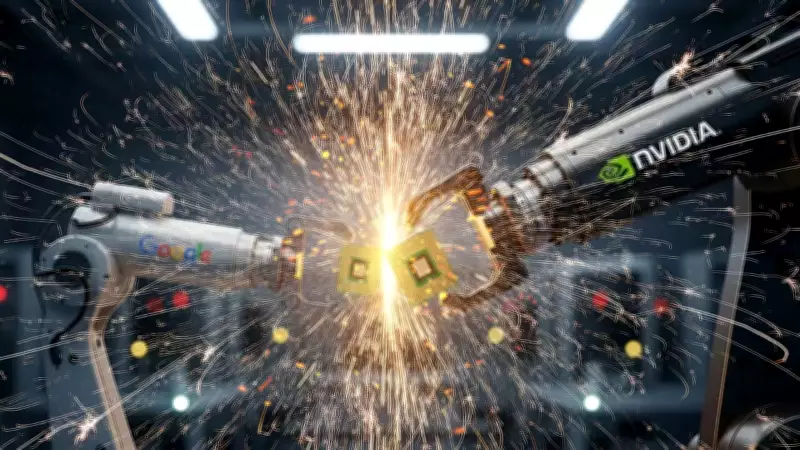
Google vs. Nvidia: AI Chip War Intensifies as Focus Shifts to Inference Speed
The competition between technology giants Google and Nvidia is escalating dramatically, with the artificial intelligence (AI) boom now pivoting from merely teaching AI models to deploying them for rapid, real-time answers. This shift marks a critical new phase in the industry, where speed and efficiency in inference—the process of AI generating responses—are becoming paramount.
Training vs. Inference: The New AI Battleground
In the realm of AI, two primary stages define operations: training, which involves educating models like ChatGPT on vast datasets, and inference, where these models apply learned knowledge to answer user queries. While Nvidia's graphics processing units (GPUs) have long been hailed as the gold standard for training due to their versatility, Google is aggressively advancing its counter-strategy. At the upcoming Google Cloud Next conference, the search behemoth is poised to emphasize its custom-made AI chips, known as Tensor Processing Units (TPUs), to address a massive surge in demand, as reported by Bloomberg.
Google's Chief Scientist, Jeff Dean, underscores this strategic move, stating, "It now becomes sensible to specialize chips more for training or more for inference workloads." This specialization is crucial because inference chips can enable chatbots and AI agents to deliver near-instantaneous responses, a key advantage as daily AI usage scales globally. Moreover, Google's in-house chip design allows for seamless integration between hardware and software, offering customization benefits that off-the-shelf solutions from rivals like Nvidia may lack.

Leadership Clash: Huang vs. Hassabis
The rivalry has sparked a public war of words between the companies' top executives. Nvidia's CEO, Jensen Huang, recently defended his GPUs, arguing they are superior because they handle "a whole bunch of applications" that specialized TPUs cannot. He likened Nvidia chips to a "Swiss Army Knife" of technology, versatile across various tasks.
In contrast, Google DeepMind CEO Demis Hassabis presents a different perspective. He highlights that leading AI labs are increasingly eager to access Google's hardware, noting, "A lot of people would like to run on both," with interest in TPUs reaching unprecedented levels. This sentiment reflects Google's growing influence in the AI infrastructure space.
Google's Infrastructure Advantage
Google boasts a decade-long head start in designing its own chips, a feat that even OpenAI is only beginning to emulate. Analysts, such as Chirag Dekate from Gartner, point out that this gives Google a "home-field advantage" as AI agents—programs capable of performing complex tasks autonomously—emerge as the next major trend. Dekate notes that Google's Gemini model already excels in complex reasoning speed, largely due to the robust infrastructure developed internally.
The battleground is clearly shifting toward inference, where specialized chips can drive efficiency and cost-effectiveness at scale. As more users integrate AI into daily life, companies must optimize how models are run, making chip choice a decisive factor in technological survival.
What Lies Ahead in the AI Spending Boom
While Nvidia has reportedly invested $20 billion to enhance its inference technology, Google's vast resources and firsthand experience with its AI models position it as a formidable competitor. The AI spending boom is transitioning from model building to operational deployment for millions of users, intensifying the stakes in this chip war.
The outcome of this rivalry could determine which companies thrive in the next phase of the technological revolution. As inference becomes the focal point, the competition between Nvidia's versatile GPUs and Google's specialized TPUs will shape the future of AI accessibility and performance, influencing everything from consumer applications to enterprise solutions worldwide.