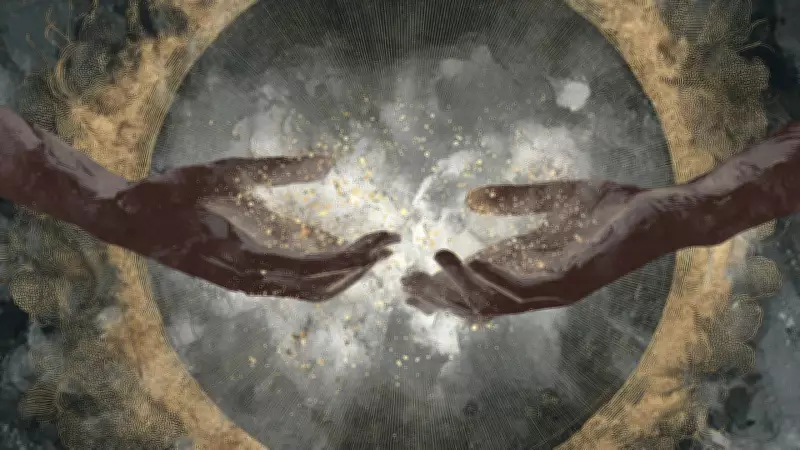
It often begins with something small—a song playing on shuffle, a voice note stumbled upon, or a photograph that catches one off guard. For a few seconds, the memory feels real and almost within reach. Now imagine if that feeling did not have to fade. Imagine if the song kept playing from an urn holding their ashes, or if their voice could respond when spoken to, offering advice in real time. This is the strange, slightly surreal space we are entering. With Spotify launching the "Eternal Playlist Urn," memory has found a speaker. It is a Bluetooth-enabled urn that lets loved ones play a person's favorite playlists even after they are gone. It sounds gimmicky at first, but it opens the door to something much bigger: the idea that death may not have to feel so final anymore.
This is not just one product. There is an entire wave of what is now called "grief tech." Platforms like HereAfter AI and StoryFile allow people to create digital versions of themselves that live on after death. AI tools can recreate voices with startling accuracy using companies like ElevenLabs or OpenAI's voice technology. There are chatbots that simulate conversations with the deceased, and tools that animate old photographs or place loved ones into new images. It is eerie, yes, but also oddly comforting. Grief, at its core, is about wanting just a little more time.
The Psychology of Digital Grief
Clinical psychologist Chetna Luthra from Marengo Asia Hospitals, Gurugram, explains, "Grief is not about letting go completely. It is about transforming the relationship." In that sense, these technologies can feel like a bridge. They allow people to say things they never got to say, revisit memories, or simply sit with the illusion of presence for a while. Especially in the early days of loss, when shock is still fresh, that can feel like relief.

But there is a quiet difference between remembering someone and interacting with them. One lives in your head; the other feels like it is happening right in front of you. That difference can change how we process loss. Dr. Mahendra Mane, psychiatrist at Inamdar Hospital, Pune, says, "Holding on to memories, rituals, and symbolic connections to deceased loved ones is normal and healthy. However, it is also necessary for the griever to gradually accept the reality of the loss. If the griever is using this technology to avoid accepting reality, then it could interfere with their emotional well-being." In simple terms, it may comfort you, but it may also keep you stuck.
Luthra adds another layer: "The final stage of grief involves knowing one is gone and the relationship continues internally. However, with AI, the reality becomes complex since they are interactable, where only partial acceptance comes in." When we remember someone, our brain knows they are gone, even if it hurts. But when an AI version responds—talks, reacts, even surprises you—it can blur that boundary. The brain starts to feel like the person is still accessible, making it harder to fully process their absence. Over time, what begins as comfort can turn into dependence. The technology becomes the place you go when loneliness hits. It soothes, but it also delays—like a painkiller that numbs the ache without healing it.
Not Entirely a Bad Thing
For some, these tools genuinely help. They offer a sense of continuity, a softer landing into grief. Not everyone wants closure in the traditional sense. Sometimes, people just want connection, even if simulated. This is why this space is quietly turning into a business opportunity. Startups like HereAfter AI and StoryFile are already building products around digital memory and posthumous interaction. Big tech platforms like Meta and Google have introduced features to manage accounts after death. As our lives become increasingly digital, it is only natural that our afterlives follow suit. There is a clear demand, and where there is demand, there is a market.

Manish Mohta, founder of Learning Spiral.AI, notes that AI systems today can convincingly replicate voice and conversational style using relatively small amounts of data. But he is quick to add that these are still simulations—not consciousness. "The system generates outputs that appear genuine during brief interactions, yet users will find them unsatisfactory because they lack authentic self-awareness and emotional depth, which makes them seem real but fails to capture a complete human identity." Mohta adds, "Users who fail to differentiate between real interactions and simulated ones will experience deception and emotional manipulation, and they will lose trust. Organizations implement transparency measures by using specific methods, including marking all AI systems and defining their operational limits."
Legal and Ethical Quandaries
The business side of grief brings its own set of uncomfortable questions. Who owns your digital self after you are gone? Monica Lakhanpal, a legal expert and founder of VakeelSaab, says the law has not quite caught up yet. In India, while the Digital Personal Data Protection Act (DPDPA) allows individuals to nominate someone to manage their data, it does not clearly define ownership of digital assets after death. In reality, control is split between platforms, families, and companies offering these AI services. "The DPDP Act is a significant step forward for data governance, but it is architecturally designed around the living. It defines a 'data principal' as the individual to whom data pertains; once that individual dies, the Act's protections do not automatically transfer to the estate or family. The data enters a void," she says.
Consent is another grey area. Just because someone shared their data while alive does not mean they agreed to be recreated after death. In many cases, that line is blurred or simply ignored. Monica notes that globally, regulations are patchy. "The EU's GDPR explicitly excludes deceased persons under Recital 27, leaving member states to legislate independently, which most have not done. The EU AI Act mandates transparency labelling for synthetic media but does not address posthumous simulation. California's AB 2602 (2024) requires prior written consent for AI replication of a deceased performer's voice or likeness, but no equivalent protection exists for ordinary citizens. France remains the most progressive jurisdiction: its 2016 Digital Republic Act allows individuals to leave binding instructions for data deletion after death."
What Makes This Moment So Strange
On one hand, there is something deeply human about wanting to hold on—to hear a familiar voice, to feel like someone is still around, even if just for a few minutes. There is beauty in that, a kind of quiet personal comfort that technology now provides in ways unimaginable before. But on the other hand, grief has always been about learning to live with absence—about slowly, painfully, accepting that some conversations are over even when unfinished. Some doors do not reopen. But what happens when those doors appear to open again? We are not just changing how we remember people; we are changing what it means to lose them. And maybe that is the real story here—not just about technology or innovation, but about us, our growing discomfort with endings, our desire to stretch moments a little longer, to keep people close in whatever way we can. Because if there is one thing this new wave of grief tech reveals, it is this: saying goodbye has never been easy. We are just finding new ways to avoid it.