

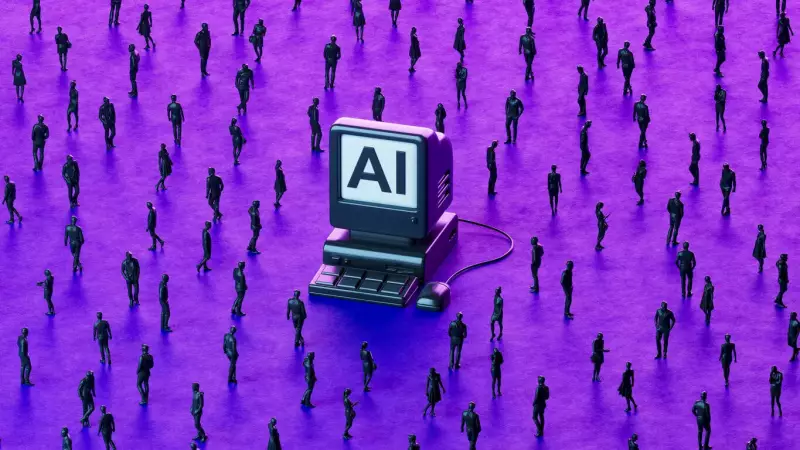
On a calm morning at Harvard Business School's Baker Library, researchers are tackling one of the most pressing questions for the modern American workforce. The debate is no longer about whether to use Artificial Intelligence at work, but rather, where AI genuinely enhances performance and where human capabilities remain superior.
The AI-Powered Individual vs. The Human Team
Adoption of AI tools in US workplaces, especially in white-collar roles, has reached unprecedented levels. Early benefits are clear: tasks are completed with remarkable speed, allowing a single person to handle work once meant for entire groups. Research from Harvard's Digital Data Design Institute (D³), conducted with Procter & Gamble, put this to the test. It found that an individual equipped with AI could match the output of a team without AI.
This finding challenges the very foundation of team structures in cost-conscious companies. If one person can do the work of many, the traditional logic of resource allocation begins to falter. The researchers concluded that AI can replicate certain benefits of human collaboration, forcing a fundamental rethink of how teams are built.

Why Human Collaboration Remains Unbeatable
However, the story has a crucial twist. While AI-augmented individuals gained in speed and baseline performance, the highest-quality and most innovative solutions did not come from them. The D³–P&G experiment demonstrated that strategically designed teams, also using AI, consistently outperformed solo AI users. Notably, the AI tools in the study were not even built for collaboration, suggesting even greater potential lies ahead.
This distinction is central to discussions at Harvard. Scholars emphasize that productivity is not synonymous with value creation. AI excels at accelerating execution, but it does not automatically generate breakthrough insight. The practical implication is powerful: AI works best as an augmentation for teams, not as a replacement for them.
The Levelling Effect and Its Hidden Costs
The research uncovered another significant trend: AI acts as a great equalizer within organizations. In the D³ study, AI-driven knowledge bases allowed non-specialist departments to produce outputs on par with R&D or engineering, breaking down long-standing informational silos.
Yet, this democratization of expertise comes with trade-offs. A separate experiment with Boston Consulting Group revealed a striking imbalance. Lower-skilled and early-career workers saw a dramatic 43% performance boost with AI, while top performers improved by 17%. This asymmetry raises concerns about talent development.
If AI handles junior-level tasks more efficiently, senior staff may stop delegating foundational work. This erosion of the apprenticeship model threatens the leadership pipeline in American companies. Furthermore, the study found AI can lead to more homogenized outputs, posing a strategic risk for firms competing on originality.
The collective evidence from Harvard, P&G, and BCG points to a nuanced future. AI is not a simple substitute for people; it is a transformative force that reshapes how humans work together. The critical challenge for US employers is no longer just adoption, but intelligent delegation—deciding what to automate, what to preserve, and where to allow space for human struggle, learning, and creativity.
The most resilient organizations will likely be those that treat AI not as a replacement for human collaboration, but as a tool to make teamwork more deliberate and impactful than ever before.






