

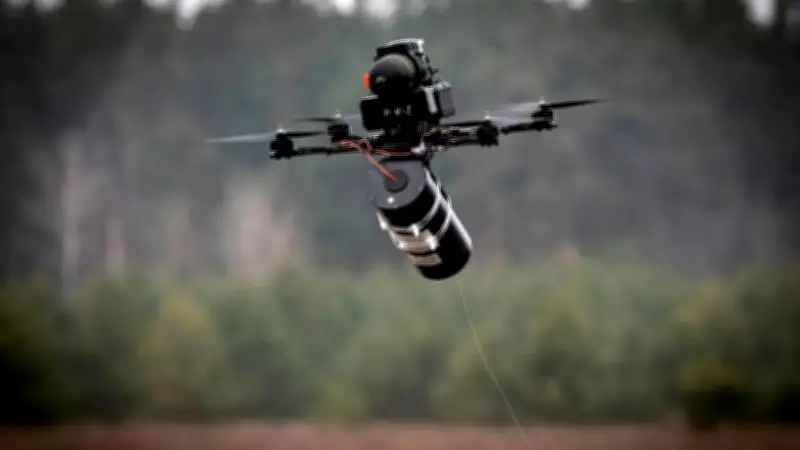
Hezbollah's growing use of fibre-optic FPV (First Person View) drones along Israel's northern border has exposed a significant gap in battlefield defences. Military officials warn that these small, low-flying drones are extremely difficult to detect, jam, or intercept.
What Are Fibre-Optic FPV Drones?
Unlike conventional drones that rely on radio signals or satellite navigation, these FPV drones are connected directly to operators via fibre-optic cables stretching 10 to 30 kilometres. Because they transmit no wireless signals, Israeli electronic warfare systems cannot jam them. The drones are also extremely small, fly close to the ground, and are often made from lightweight fibreglass, giving them minimal thermal or radar signature.
How the Drones Are Targeting Israeli Troops
According to Israeli media, Hezbollah recently released footage showing an FPV drone striking an Iron Dome battery near the northern border. In another attack, reservist First Sergeant Alexander Glovanyov was killed after explosive drones launched from Lebanon struck inside Israeli territory. The Jerusalem Post reported that senior Israeli officials discussed pilot programmes to improve detection and interception, but the military is still trying to catch up as the threat evolves. Some units have improvised by hanging nets over positions to entangle drones before they explode.

Why Israel's Defence Systems Are Struggling
The drones' effectiveness lies in their ability to avoid jamming and their precision. Equipped with high-resolution optical cameras transmitting uncompressed video through fibre-optic cables, operators can guide them toward vulnerable points on tanks and military vehicles. Some drones carry anti-armour shaped charges, turning low-cost quadcopters into precision-guided weapons. They have even challenged Israel's Trophy active protection system on Merkava tanks. Military analyst Hassan Jouni told Al Jazeera that the drones blind early warning systems because they leave almost no detectable electronic signature.
A Battlefield Tactic Borrowed from Ukraine
Fibre-optic FPV drones became widely used during the Ukraine war, where both sides relied on them in heavily jammed zones. They are relatively cheap and expendable, deployable in large numbers. Experts say the concept is simple: small rotor-based drones connected to a fibre-optic spool, carrying explosive payloads comparable to RPG shells. Israel believes many of Hezbollah's drones are assembled locally using commercial components and 3D printing, with some costing between $300 and $400 each.
Israel Races to Find a Solution
Former Israeli air defence commander Ran Kochav acknowledged the struggle, noting that the drones fly low, fast, and are very small, making detection and tracking difficult. He added that Israel focused heavily on missile and rocket defence while neglecting drone threats. Israeli defence firm Smart Shooter is developing computer-vision-based fire control systems to counter drones. Vice President Shir Ahuvia said fibre-optic drones are immune to electronic warfare, leaving kinetic interception—physically shooting them down—as the only viable option.






