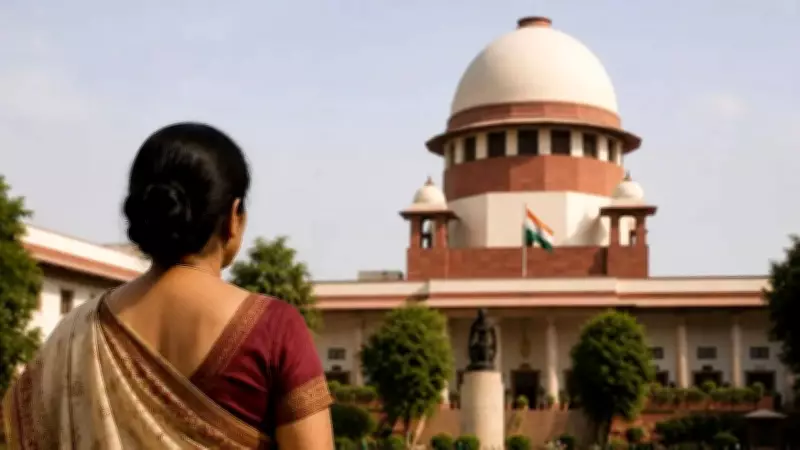
The Supreme Court of India has delivered a landmark judgment recognizing the economic value of unpaid domestic work performed by homemakers. The court held that in cases where a homemaker dies in a road accident, her family is entitled to higher compensation reflecting the true worth of her contributions, which include cooking, cleaning, raising children, and caring for the elderly. The bench fixed a minimum notional income of Rs 30,000 per month for a homemaker, with a provision for a 10 percent increase every three years to account for inflation.
Background of the Case
The case originated from a road accident in Haryana in November 2001, in which a woman lost her life. Her husband and children sought compensation from the Motor Accidents Claims Tribunal, which initially awarded Rs 2,42,000. Dissatisfied, the family appealed to the Punjab and Haryana High Court. Due to procedural delays, including the destruction of the case file in a court fire in 2011, the High Court took twenty years to enhance the compensation to Rs 8,43,400. The family still found this insufficient and approached the Supreme Court. A bench comprising Justice Sanjay Karol and Justice Nongmeikapam Kotiswar Singh ultimately awarded Rs 62.7 lakh to the claimants.
Key Observations on Homemakers
The Supreme Court criticized the traditional notion that a homemaker is 'dependent' on the earning member of the family. It stated, "In reality the household's functioning depends substantially on the homemaker. The earning members are in fact solely dependent on the homemaker." The court highlighted that Indian women spend over seven hours daily on unpaid household work, more than double the time spent by men. This invisible work contributes an estimated 15–17 percent of India's Gross Domestic Product (GDP), yet it remains unrecognized and uncompensated.

The court noted that earlier tribunals and courts had been calculating compensation using outdated 'notional income' figures, sometimes as low as Rs 3,000 per month based on two-decade-old rulings. This approach was deemed deeply unfair and failed to reflect the true value of a homemaker's labor.
New Category: Loss of Domestic Care
To address this inequity, the Supreme Court introduced a new category called 'Loss of Domestic Care'. This category quantifies the monetary value of all services a homemaker provides to her family. The starting figure is Rs 30,000 per month, which will increase by 10 percent every three years to keep pace with rising costs. The compensation covers three primary losses: the management of the household, maternal guidance for children, and spousal support.
Concerns Over Delays in Compensation Cases
The bench expressed serious concern about the prolonged duration of accident compensation cases. Upon reviewing over 120 such cases, it found that in nearly half of them, families waited more than four years at the High Court level alone. On average, cases took eight years in High Courts and six years before tribunals. The court directed High Court Chief Justices to fast-track the oldest pending cases and consider setting up additional benches to expedite matters.
Redefining Homemakers as Nation Builders
The Supreme Court also addressed the terminology used for homemakers. It observed that the term 'housewife' does not adequately capture the significance of their role. The court directed that homemakers should henceforth be referred to as 'Nation Builders', recognizing their immense contribution to society and the economy.
This judgment is expected to have far-reaching implications for motor accident claims and the valuation of unpaid domestic work in India.