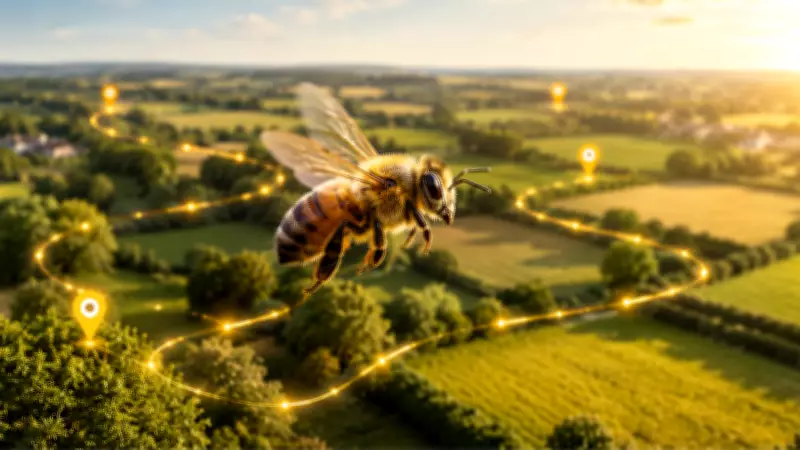
For centuries, honey bees have fascinated scientists with their ability to travel long distances, locate food, and return unerringly to their hives. Now, a new study has revealed an even more remarkable skill hidden in plain sight. Researchers from the University of Freiburg have discovered that individual honey bees follow their own highly consistent flight routes and can repeat them with astonishing accuracy, sometimes flying just centimeters from where they flew before. Using a drone-based tracking system, scientists found that bees rely on landmarks such as trees and hedges to navigate what appear to be invisible aerial highways, challenging long-held assumptions about insect navigation and intelligence.
The Drone Study That Revealed Honey Bees' GPS-Like Routes
The breakthrough came from an innovative tracking system developed by researchers led by neurobiologist and behavioral biologist Professor Andrew Straw. To monitor bees in the wild, the team attached tiny reflective markers to individual insects and used a drone equipped with specialized cameras and onboard computers. The system, known as Fast Lock-On (FLO) Tracking, allowed researchers to identify and follow bees within milliseconds as they traveled between their hive and a food source located approximately 120 meters away. Unlike previous methods, the technology provided detailed three-dimensional flight paths in a natural outdoor environment. Over the course of the study, researchers recorded 255 flights from 26 honey bees in an agricultural landscape near Kaiserstuhl, Germany.
Personalized Routes: Each Bee Has Its Own Style
One of the most surprising discoveries was that bees traveling to the same destination did not all follow the same path. Instead, each bee appeared to develop its own preferred route through the landscape. Some insects consistently flew around a tree, while others preferred routes over or alongside hedges. Even when multiple pathways were available, individual bees tended to stick to their chosen route. Researchers found that a bee's flight path was often more similar to its own previous journeys than to the paths flown by any other bee. This suggests that bees are not simply heading toward a destination but are following personalized routes stored in memory. Professor Straw noted that the consistency was so striking that one could almost say each bee has its own personality.

Flying with Centimeter-Level Precision
The study revealed an extraordinary level of navigational accuracy. Individual bees repeatedly followed nearly identical routes, sometimes deviating by only a few centimeters from earlier flights. For an insect weighing less than a gram and possessing a brain smaller than a sesame seed, the achievement is remarkable. Researchers observed that even in areas where routes varied the most, bees generally strayed by only a few degrees from their established paths. The findings suggest that honey bees possess detailed spatial memories of familiar journeys and can reproduce them with a level of precision previously underestimated by scientists.
The Role of Landmarks in Bee Navigation
The landscape itself played a crucial role in guiding the insects. Researchers discovered that bees were most consistent when flying near prominent visual landmarks, particularly a large tree located between the hive and the feeding station. Around such features, flight-path variation dropped significantly. In contrast, the greatest variation occurred above a nearby cornfield. Because the cornfield offered few distinctive visual cues, bees appeared less certain of their exact position and showed slightly more variation in their routes. The results strongly suggest that visual landmarks help bees maintain accurate flight paths and improve navigational precision.

More Than Just a Sun Compass
Scientists have long known that honey bees use several methods to navigate. They can orient themselves using the position of the Sun and even detect patterns of polarized light in the sky that are invisible to humans. Bees also employ a technique known as path integration, continuously calculating the distance and direction they have traveled. Combined with odor cues and visual landmarks, these mechanisms help them return to their hive after foraging trips. The new study adds another layer to this understanding, indicating that bees create highly detailed route memories that allow them to follow familiar paths repeatedly.
What This Means for the Famous Waggle Dance
The findings may also reshape how scientists think about the waggle dance, the behavior honey bees use to communicate food locations to nestmates. For decades, researchers have known that the directional information contained in a waggle dance is not perfectly accurate. At distances of around 100 meters, the communicated direction can deviate by as much as 30 degrees. The new research suggests this imprecision is not caused by poor navigational ability. On the contrary, individual bees appear capable of navigating with far greater accuracy once they are familiar with a route. This means the waggle dance may function more as a general guide, providing an approximate location that bees then refine using their own navigational skills and environmental knowledge.
Tiny Brains, Extraordinary Abilities
Honey bees possess fewer than one million neurons, compared with roughly 86 billion in the human brain. Yet they routinely accomplish navigational tasks that continue to impress scientists. The discovery that bees follow personalized aerial routes with such precision highlights the sophistication of insect cognition. Rather than wandering randomly through the landscape, they appear to construct and maintain detailed mental maps of their surroundings. Researchers believe these findings could even inspire advances in robotics and autonomous drone technology, where efficient navigation remains a major challenge.
A Hidden World Above Our Heads
The study reveals that the skies above fields and gardens may be crisscrossed with invisible highways known only to the insects that use them. Every honey bee appears to chart its own course, memorizing landmarks and repeatedly traveling the same route with remarkable accuracy. Far from being simple creatures guided solely by instinct, honey bees are proving to be skilled navigators with an impressive understanding of the world around them. Their secret flight paths offer another reminder that some of nature's most extraordinary abilities can be found in its smallest creatures.