

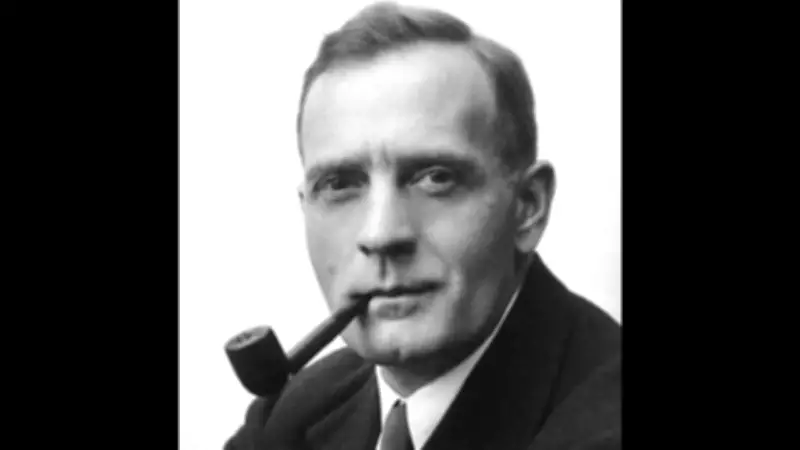
Edwin Hubble's Insight: The Fading Knowledge at the Universe's Edge
In an era marked by rapid technological advancements and constant discoveries, it is tempting to believe that science holds all the answers. Modern science has enabled humanity to comprehend phenomena in ways unimaginable a century ago, from exploring distant planets to analyzing subatomic particles. However, despite the power of sophisticated tools like telescopes, scientists encounter inherent boundaries that restrict their understanding. These limits extend beyond mere physical distance, encompassing what can be observed, measured, and truly grasped.
The Legacy of Edwin Powell Hubble
Edwin Powell Hubble, a pivotal astronomer of the 20th century, deeply contemplated these constraints. His renowned statement, "With increasing distance, our knowledge fades, and fades quickly..." encapsulates a fundamental truth about scientific inquiry. It serves as a reminder that as we delve deeper into the unknown, our certainty diminishes, a concept especially relevant in astronomy where objects are millions or billions of light-years away. Hubble's words resonate beyond space, illustrating the challenges scientists face in studying phenomena that cannot be directly observed.
Deciphering Hubble's Quote
The quote emphasizes a simple yet crucial idea: the farther we peer into space, the less we seem to know. While nearby celestial bodies can be examined in detail, distant stars and galaxies appear faint and are difficult to measure accurately. Hubble notes that knowledge "fades quickly" with distance, leading to reduced certainty among scientists. Observations become less precise, and conclusions often rely on indirect evidence. He references reaching "the dim boundary—the utmost limits of our telescopes," a point where even advanced tools struggle to provide clear data, forcing researchers to interpret weak signals and incomplete information.

The Concept of Measuring Shadows in Science
One of the most intriguing aspects of Hubble's quote is the phrase "we measure shadows." This metaphorical expression highlights how scientists frequently work with indirect evidence. Astronomers, for instance, analyze light, radiation, and other signals rather than physical objects to deduce properties like temperature, composition, and motion. These signals can be distorted over vast distances, resulting in data that is incomplete or ambiguous. Hubble describes this as "searching among ghostly errors of measurement," underscoring the uncertainties inherent in studying remote and complex systems.
Uncertainty as a Core Element of Discovery
Hubble's insight reinforces that uncertainty is not a flaw but an integral part of scientific progress. When exploring uncharted territories, scientists often grapple with ambiguous questions, basing theories on the best available evidence, even if it is limited. As technology evolves, these theories may be refined or replaced, driving science forward. The quote encourages perseverance, stressing that curiosity and determination are essential for uncovering new truths, even in the face of unknowns.
Technological Advances and Persistent Boundaries
While Hubble spoke of telescope limits in his time, observational technology has since advanced significantly. Modern telescopes, both terrestrial and space-based, can detect objects much farther away. Yet, fundamental constraints remain; the universe's vastness still places some regions beyond reach. Scientists continuously strive to surpass the "utmost limits" Hubble identified, with each new discovery often raising further questions, illustrating that the pursuit of knowledge is an endless journey.
Relevance in Contemporary Science and Life
Hubble's words extend beyond astronomy to fields like medicine, physics, and environmental science, where researchers frequently contend with incomplete data and must interpret it cautiously. The quote serves as a reminder of human limitations, promoting a balanced approach that blends curiosity with humility. In everyday contexts, it encourages acceptance of uncertainty, fostering clearer and more realistic perspectives on complex issues.

The Enduring Quest for Knowledge
A key message from Hubble's quote is "The search will continue." This underscores the ongoing nature of scientific exploration, where persistence is vital for progress. Even with incomplete knowledge, each finding builds upon previous work, driving innovation. Hubble also advises against speculation until empirical resources are exhausted, emphasizing the importance of evidence-based inquiry over unfounded guesses.
Hubble's Broader Impact on Astronomy
Edwin Hubble is best known for discovering the expanding universe, a breakthrough that revolutionized cosmology and supported the Big Bang theory. His meticulous approach to research, informed by an awareness of knowledge limits, highlights the need for reliable data in scientific endeavors. Other notable quotes by Hubble include:
- "Equipped with his five senses, man explores the universe around him and calls the adventure Science."
- "The history of astronomy is a history of receding horizons."
- "Not until the empirical resources are exhausted, need we pass on to speculation."
A Broader Perspective on Knowledge and Limits
Hubble's quote invites reflection on the nature of knowledge itself, portraying it as dynamic and evolving rather than absolute. The idea of a "boundary" represents both a challenge and an opportunity—marking the end of current understanding and the beginning of new discoveries. This perspective is valuable not only in science but also in education and personal growth, encouraging exploration beyond known limits.
Final Takeaways
Edwin Hubble's quote offers a thoughtful commentary on human learning and scientific methodology. It acknowledges that as we probe the unknown, our understanding becomes less certain, particularly in fields like astronomy where distance plays a critical role. The emphasis on continuous search reminds us that progress relies on diligence and careful observation. Today, as scientists explore the farthest reaches of the cosmos, Hubble's words remain pertinent, inspiring curiosity, evidence-based inquiry, and a humble recognition of how much remains to be discovered.





