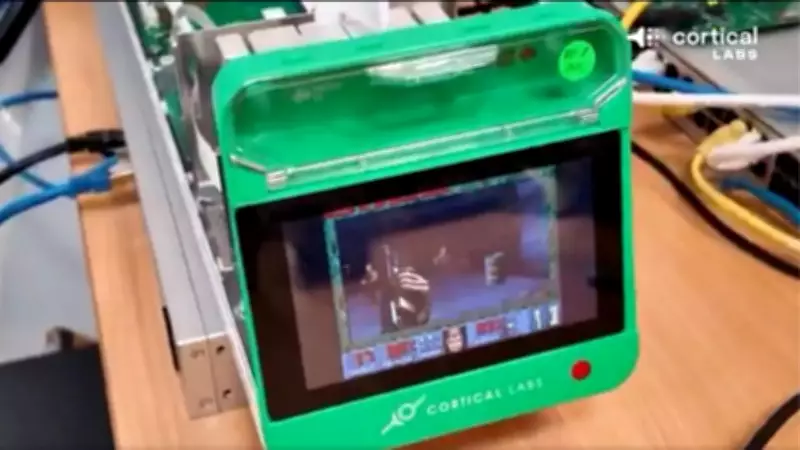
Human Brain Cells Learn to Play Doom in Groundbreaking Biological Computing Experiment
For decades, the fusion of biological intelligence with machines remained firmly in the realm of science fiction, depicted in films like The Matrix and Ex Machina. Now, a revolutionary laboratory experiment is forcing scientists to confront a startling new reality where living human neurons interact with computer systems to learn and adapt.
How Scientists Created a Biological Computer
Researchers at Cortical Labs, led by CEO Hon Weng Chong in collaboration with institutions including Monash University, have demonstrated that lab-grown human brain cells can be cultivated on silicon chips and connected to software environments. Their electrical activity directly influences digital systems, creating what they term biological computing.
The system combines two distinct worlds: living human neurons grown in laboratory conditions and silicon microchips that communicate with those neurons. By placing neurons on specialized electronic devices called microelectrode arrays, scientists can both stimulate and record neural activity. The electrodes deliver tiny electrical signals to the cells and capture the electrical spikes neurons produce in response.

These spikes, identical to the fundamental signals used by neurons in the human brain, are then translated into digital commands. Essentially, a biological neural network becomes an integral component of a computer system.
The DishBrain Experiments: From Pong to Doom
One of the most widely discussed systems developed by Cortical Labs is called DishBrain. This setup involves approximately 200,000 living neurons grown on a microelectrode array, with electrodes serving as a bridge between the biological cells and a computer running simulations.
In earlier experiments, the neural network learned to play the classic arcade game Pong. According to Hon Weng Chong, the neurons began adjusting their firing patterns to better control the game through feedback mechanisms. "The neurons organize themselves in a way that allows them to respond to the environment," Chong explained. "They learn through feedback."
The neurons receive electrical signals representing the game environment and respond with their own firing patterns, which the system interprets as actions:
- One firing pattern might correspond to moving left
- Another might represent firing a weapon
- Another might adjust movement or direction
Through repeated interaction, the network begins producing patterns that result in more successful outcomes, demonstrating basic learning capabilities.
Why Doom Became the Ultimate Test
The decision to experiment with Doom is particularly significant. Since its 1993 release, Doom has become a cultural benchmark in computing circles, with programmers frequently testing unusual hardware by asking: "Can it run Doom?" Over the years, the game has been run on everything from calculators to ATMs and kitchen appliances.
Running Doom or interacting with its game environment demonstrates that a system can process inputs and outputs quickly enough to behave like a computer. In this case, while the computer still runs the game engine itself, the neurons function as a biological control system influencing actions within the game.
The Origins of Laboratory Neurons
The neurons used in these experiments are not taken directly from human brains. Instead, scientists begin with ordinary human cells such as skin or blood cells. Using a Nobel Prize-winning technique developed by Shinya Yamanaka, researchers reprogram these cells into induced pluripotent stem cells capable of becoming almost any cell type in the body.
These stem cells are then chemically guided to develop into neurons. Over time, the neurons grow long extensions called axons and dendrites, forming connections through synapses. Even in a dish, they naturally organize into small neural networks capable of producing electrical patterns and demonstrating neuroplasticity—the ability to adapt to feedback.

Why Biological Computing Is Attracting Global Attention
The long-term interest in these experiments extends far beyond video games. Modern artificial intelligence relies heavily on enormous data centers filled with powerful graphics processors from companies like Nvidia, consuming megawatts of electricity during training. By contrast, the human brain operates on approximately 20 watts—roughly the energy of a dim light bulb.
This extreme efficiency has led researchers to explore whether biological neural systems could complement or even outperform traditional silicon computing for specific tasks:
- Real-time learning without massive datasets
- Pattern recognition with minimal data input
- Adapting to unpredictable environments
These capabilities remain challenging for conventional AI systems to replicate effectively.
Investor Interest and National Security Implications
The potential implications of biological computing have attracted significant investor attention. One notable backer of Cortical Labs is In-Q-Tel, a venture capital organization funded by the U.S. intelligence community that invests in emerging technologies relevant to national security.
Historically, In-Q-Tel has funded technologies that later became central to modern digital infrastructure, including geospatial data platforms and advanced analytics systems. Their involvement signals that intelligence agencies are monitoring this technology closely, though it doesn't necessarily indicate military applications.
The Promise and Limitations of Living Computers
Despite the excitement, scientists emphasize that this technology remains in its infancy. The neural cultures contain around 200,000 neurons, compared to the human brain's approximately 86 billion neurons arranged in extremely complex structures. These cultures lack organized architecture, sensory systems, memory structures, and awareness.
Most neuroscientists agree such neural cultures are far too simple to be conscious. Instead, they function as biological neural networks capable of responding to electrical stimuli—more akin to adaptive biological circuits than thinking entities.
A Glimpse Into a Hybrid Computing Future
The research hints at an unusual future where computing systems may not rely entirely on silicon chips. Scientists have begun exploring hybrid systems combining traditional processors with biological neural networks:
- Silicon chips could handle precise calculations and data processing
- Biological neurons could manage adaptive learning and pattern recognition
While this idea remains speculative, experiments with neuron cultures interacting with software environments provide an early proof of concept. For now, neurons controlling video games represent a scientific curiosity, but the image of living human brain cells influencing digital worlds challenges our understanding of biology-technology boundaries.
This may not be the sentient machines imagined in science fiction, but it serves as a powerful reminder that the division between biological intelligence and artificial systems is becoming increasingly blurred.