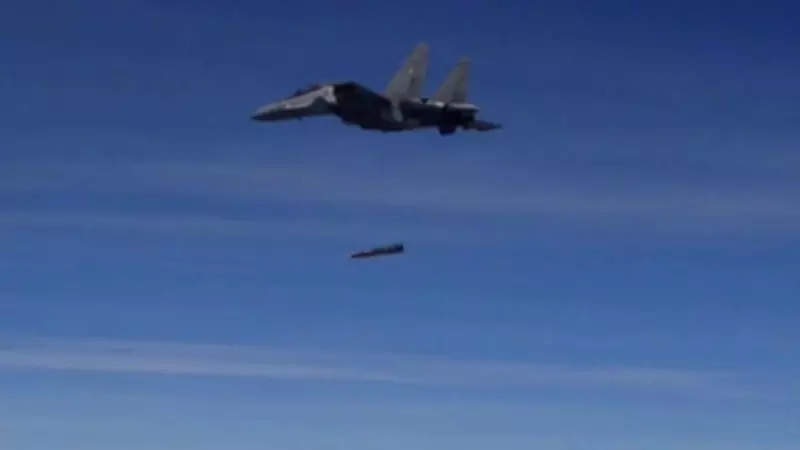
Operation Sindoor demonstrated how a supersonic weapon flying at nearly Mach 3 (3,700 kmph), or five times the speed of sound, is nearly impossible to stop. A missile flying at low level would be detected by ground-based radar at a distance of 15 km, providing an early warning of around 15 seconds to impact. This compresses the decision cycle of an air defence commander. A hypersonic weapon flying at over Mach 5 (6,100 kmph) will be virtually unstoppable with current technology, as a surface-hugging missile covers the same distance in less than 9 seconds, further reducing reaction time.
What Makes Hypersonic Weapons Different?
With most surface-to-air missiles flying at under Mach 5, very few systems can intercept a hypersonic weapon from behind. Hypersonic warfare represents the next great transformation in military technology, reshaping deterrence, escalation, and survivability of strategic assets. Their speed, manoeuvrability, and ability to evade defences make them virtually unstoppable, ensuring that nations mastering them dictate deterrence terms while those lagging face strategic vulnerability. Hypersonic weapons travel above Mach 5 and fall into two categories: hypersonic glide vehicles (boosted by rockets to high altitudes, then gliding unpredictably) and hypersonic cruise missiles (powered by scramjets, flying within the atmosphere at sustained hypersonic speeds). Unlike ballistic missiles following predictable arcs, hypersonic weapons can change course mid-flight and fly at lower altitudes, exploiting the radar horizon. Their combination of speed and manoeuvrability makes interception nearly impossible with current missile defence systems.
Technological Challenges
Developing hypersonic weapons is fraught with challenges. At Mach 5 and above, vehicles face extreme thermal loads requiring advanced cooling systems. Scramjet combustion stability is notoriously difficult to sustain, as airflow must remain supersonic while fuel burns efficiently. Guidance systems face plasma interference, as the ionised air sheath around the vehicle disrupts communications and sensors. Materials must withstand immense stress and heat without structural failure, demanding breakthroughs in composites and alloys. Flying at very high speeds at lower altitudes, where air is thicker, requires additional power. Testing infrastructure is scarce and costly, with hypersonic wind tunnels and flight ranges limited to a few nations. Integration with warheads and payloads requires compact designs surviving hypersonic stresses. Launch platforms must handle enormous acceleration and aerodynamic forces.

India's Hypersonic Journey
India has steadily advanced from supersonic to hypersonic systems. Operation Sindoor in 2025 demonstrated the lethality of BrahMos supersonic cruise missiles, proving speed alone can overwhelm defences. The Defence Research and Development Organisation (DRDO) achieved a landmark by testing an actively cooled, full-scale scramjet combustor for 20 minutes, setting a global benchmark. This demonstrated mastery over thermal management, a critical barrier in hypersonic propulsion, positioning India among a select group with indigenous hypersonic capability. India's projects include the Hypersonic Technology Demonstrator Vehicle (scramjet testbed achieving Mach 6), the BrahMos-II (planned hypersonic cruise missile at Mach 7 for naval strike), the Dhvani glide vehicle for long-range deterrence, the LR-AShM to neutralise enemy ships including aircraft carriers, and the ET-LDHCM (extended trajectory hypersonic cruise missile for precision land attack).
United States Hypersonic Programmes
The US has invested heavily in hypersonic research, recognising the strategic threat from Russian and Chinese deployments. Key programmes include the AGM-183 Air-launched Rapid Response Weapon (boost-glide system tested by US Air Force), the Hypersonic Air-breathing Weapon Concept (scramjet-powered cruise missile under DARPA), and the Conventional Prompt Strike programme (hypersonic glide vehicle for US Navy global precision strikes). The US approach emphasises redundancy across air-breathing and boost-glide systems, ensuring multiple deployment pathways. Challenges remain in thermal management, guidance, and cost.

China's Operational Advantage
China has fielded operational systems, notably the DF-17 missile equipped with the DF-ZF glide vehicle, demonstrated at the National Day Parade. Capable of Mach 5 to 10, the DF-17 penetrates US and allied missile defences in the Indo-Pacific. Its manoeuvrability and precision make it a formidable tool for deterrence and coercion. China conducted an orbital hypersonic test in 2021, demonstrating global reach. Beyond these, China invests in scramjet research, hypersonic wind tunnels, and reusable spaceplanes, indicating a comprehensive approach. Strategically, China views hypersonics as a means to offset US superiority.
Russia: Pioneer in Operational Deployment
Russia remains the pioneer in operational hypersonic weapons. The Kinzhal missile (air-launched, Mach 10) has been combat-tested in Ukraine. The Tsirkon cruise missile (ship-launched, Mach 8) is designed for anti-ship and land-attack roles. Russia's operational deployment reshapes deterrence, forcing adversaries to accept vulnerability and demonstrating that hypersonic warfare is a present reality.
Other Nations in the Race
France is developing the Véhicule Manoeuvrant Experimental (V-MaX), a hypersonic glide vehicle expected to test in the mid-2020s, supporting France's nuclear deterrence posture. Australia, with the US, is pursuing the Southern Cross Integrated Flight Research Experiment (scramjet programme targeting operational systems by late 2020s). Japan's Hyper Velocity Gliding Projectile is designed to defend remote islands, with deployment planned by 2030.
The Next Arms Race
Deployment of such weapons will likely result in a new arms race. It will also revolutionise air defence systems, with nations relying on space-based assets for beyond-the-horizon early warning. India is working on its own air and ballistic missile shield called Sudarshan Chakra, announced by PM Modi from the Red Fort, which will use space-based inputs. A key cat-and-mouse contest between effectors and counter-effectors has already begun.
A Modern-Day Brahmastra?
India's scramjet breakthrough and indigenous projects mark its entry into the elite hypersonic club. The US, China, Russia, France, Australia, Japan, and even North Korea are pursuing hypersonic weapons, ensuring the future battlefield will be dominated by unstoppable weapons. Hypersonic weapons are not a distant prospect but an unfolding reality, defined by speeds above Mach 5 and manoeuvrability currently impossible to intercept. Developing these weapons tests a nation's edge in aeronautics, propulsion, material science, and other areas. All effort aims to deploy an undefeatable weapon, a modern-day Brahmastra, ensuring peace through deterrence.