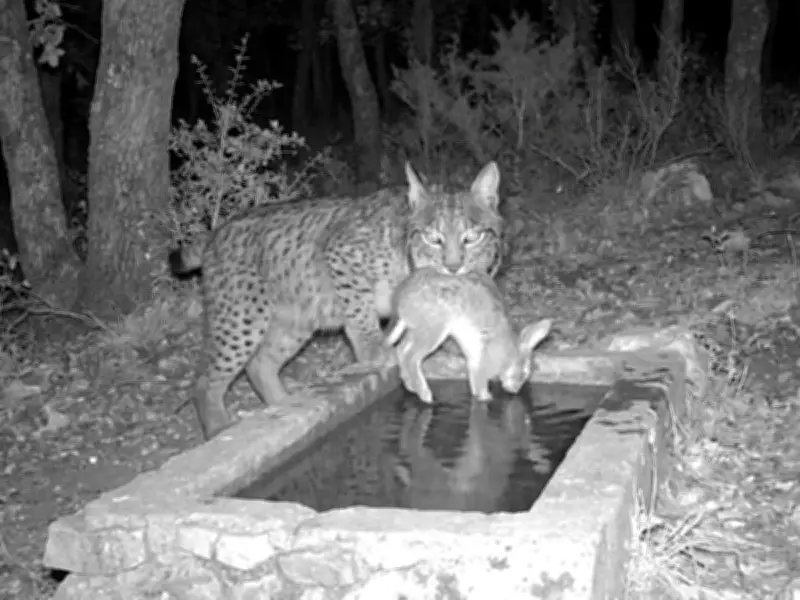
Scientists have witnessed a rare behavior among large wild cats that has prompted a reconsideration of predator instincts. The surprising discovery occurred during a routine wildlife study in central Spain, where camera traps captured Iberian lynxes carrying deceased rabbits to watering spots and submerging them before departing.
Although the practice appears unusual, researchers consider it unprecedented, marking the first time a carnivore has been observed dipping its prey in water. In the study documented in Ecology in March 2026, Wai-Ming Wong, director of small-cat conservation science at Panthera, described the finding as fascinating and certainly surprising. He noted that wild cats are typically regarded as instinctive predators, making it remarkable to witness a specific specimen altering its prey-handling techniques. This discovery has opened the door to a first-of-its-kind behavior observed in the animal kingdom.
What Scientists Discovered About Iberian Lynxes
Researchers from the Spanish National Research Council have been monitoring Iberian lynxes in the Montes de Toledo since 2014, aiming to investigate survival rates, reproductive habits, and mobility patterns. In 2020, a camera trap captured a female lynx named Naia carrying a rabbit to a water trough and submerging the prey. Initially considered an anomaly, subsequent observations from 2020 to 2025 recorded eight such instances across five different lynxes. In all cases, the lynxes spent anywhere from one to over four minutes submerging the prey. Notably, all lynxes exhibiting this behavior were female, and after submerging the rabbits, they removed them from the water.

An Activity Not Performed Before by Any Carnivore
Soaking food is known in many species. Raccoons wash their food to aid texture discrimination, monkeys clean food to remove dirt, and some birds soak their food. However, in most cases, such behavior is exhibited by omnivorous animals or those in captivity. There has been no prior record of carnivores manipulating their prey in this manner. According to Wong, the discovery is significant because it demonstrates problem-solving. A lynx was seen soaking its food, highlighting a cognitive ability previously unobserved in wild felines.
Reason Behind Lynxes' Actions
Scientists are working to determine why this unusual behavior occurs. One theory suggests it hydrates the body by drinking water retained from soaking. Experiments have shown that immersing a dead rabbit in water increases its weight by nearly 4 percent. Another theory relates to parenthood: Iberian lynx cubs depend on their mothers, and immersing the dead rabbit could make it easier for babies to consume solid food after nursing. Jose Jimenez, lead author from the Institute for Game and Wildlife Research, explained in a press release that the capacity for adaptation and social learning of new hunting strategies is unusual in wild felines. The study also observed that lynxes exhibiting this behavior were in overlapping areas or were relatives, suggesting that such behaviors are learned rather than instinctive. If other individuals observe and copy the behavior, it could spread within the population.
Conservation of the Iberian Lynx
Counted among the world's rarest wild cats, the endangered Iberian lynx had fewer than 100 individuals recorded in 2002. The cat feeds mainly on European rabbits, which comprise up to 80 percent of its diet. Rabbit numbers have declined due to diseases and environmental changes. Additionally, lynx habitats have been fragmented by urban expansion and agriculture, while climate change poses further threats. Scientists believe this unusual behavior could help lynxes cope with new conditions. Soaking prey may aid hydration or nutrition, especially for newborn kittens facing moisture scarcity later in the year.